
December 19 police action in Mangaluru, 'Gross violation of human rights': People's tribunal
Former SC Judge headed tribunal demands Judicial Commission of Inquiry in the case

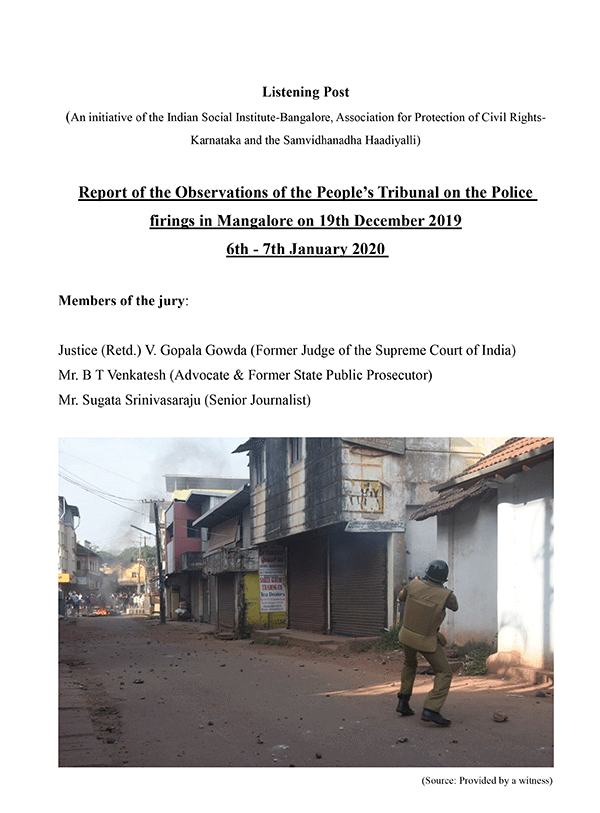
Mangaluru: A three-member people’s tribunal constituted by ‘Listening Post’ and headed by former Supreme Court Judge Justice (Retd.) V. Gopala Gowda has released its observation on the December 19 violence and police action in the city. The tribunal also comprised of B T Venkatesh, former Public Prosecutor, Karnataka High Court, and senior Journalist Sugata Srinivasaraju.
The tribunal was organised on January 6th and 7th and was tasked with conducting public hearings to hear from all the persons affected by the police firing on December 19 and to report on the observations made by it. The tribunal was organised by Indian Social Forum, Bangalore, Association for Protection of Civil Rights (APCR) and "Samvidhanadha Haadiyalli" under the banner of Listening Post.
In a three page long summary report, the tribunal after hearing from victims, journalists present on the scene and witnesses of the incident, the tribunal has made several key observations. It has observed that the imposition of prohibitory orders under section 144 by the Police Commissioner was unwarranted and that there was no such situation in the city that demanded the imposition.
“Upon statements made before the Tribunal, it is observed that imposition of prohibitory orders under section 144 of Code of Criminal Procedure were unwarranted. There was no such situation in Mangalore that required imposition of orders under section 144 of the CrPC. It is pertinent to note that none of the ingredients that warrant an imposition of prohibitory orders under section 144 of the CrPC were present” the tribunal in its report stated.
It also stated that the communication of the prohibitory orders under section 144 was not effectively conveyed to the residents. “While the Commissioner of Police of Mangalore, Dr. P.S. Harsha, imposed prohibitory orders under Section 144 of the CrPC on the evening of 18th December 2019, the order was not effectively communicated to the residents of the area. After the imposition of the prohibitory orders under section 144 CrPC, permission that was earlier granted was subsequently revoked/cancelled but the same was not effectively communicated” it added.
“As a result of a complete breakdown of communication, civilians who had no connection with the protest were subjected to indiscriminate lathicharge and Police firing. The testimonies of the victims presented before the Tribunal display a complete abdication of responsibility by Police personnel present at the site of violence” the report added.
Coming down on the police, the tribunal observed that the police failed to comply with the Karnataka Police Manual and failed to uphold rights of the citizens.
“One of the main responsibilities of Police officials, as stipulated in Chapter 1 (Code of Conduct of the Karnataka State Police Force) is to uphold the rights of citizens in accordance with the Constitution of India. As a result, the Police officials must “respect the limitations of their power and functions”.” It observed.
It also observed that the police authorities who were tasked with maintaining law and order on December 19 used slurs and deplorable language in order to provoke the protesters.
The tribunal also nailed the hammer on Police department’s failure to furnish the CCTV footage to support their allegations against civilians asserting that the protesters attacjed the Kini Rifle Shop and tried to barge into Bunder Police Station as mentioned in some the FIRs.
“Victims have suffered immense financial hardship as a result of the atrocities committed on 19th December, 2019. Given the allegations of communalism against the Police authorities in question and the palpably disproportionate use of force by Police personnel, it is clear that the State and the officials in question are jointly and severally liable for such transgressions” it stated.
Taking note of the force against Journalists it added “It is clear from statements by journalists present at the scene of the violence that force was deliberately administered against journalists even after they identified themselves to the Police officials. This represents a mala fide use of the coercive power of the state to intimidate the press”.
It also opined that the police action to barge into Highland Hospital was not discernable why the cops entered the hospital premises and proceeded to use tear gas. “From the footage available, it is not discernable why the Police authorities entered the hospital premises and proceeded to use tear gas. No reasons have been suggested by Police authorities to justify such an excessive use of force” it stated.
Adding that the whole incident that killed two people in the city was gross violation of human rights norms the tribunal called for thorough investigation of the extra-judicial killings while citing Supreme Court in one of the similar cases.
“Article 2 of The Code of Conduct for Law Enforcement Officials states that law enforcement officials must respect human rights norms and uphold human dignity at all times. Such words ring hollow in the context of the events of 19th December and the manner in which extreme force was used against civilians. Proportionality is an important aspect of the use of force in the context of policing unlawful assemblies. In regards to the maintenance of the rule of law, it is imperative that extra-judicial killings are thoroughly investigated. The Supreme Court in the case of People’s Union for Civil Liberties v. State of Maharashtra & Ors has laid down important guidelines to ensure independent investigation of such killings” it added.
Conclusion:
“From the statements it is observed that greater harm was caused to civilians and innocent persons who had nothing to do with the protests, if any. Their livelihood has been severely affected. More specifically, two lives have been lost. The children of Jaleel are rendered without care of a very loving and caring father. In Nausheen, the mother lost a son. A son who was simple and a worker eking out a livelihood by small work. The families of victims have been badly affected. They need to be protected and adequately compensated.
“It is observed from the statements made before the People’s Tribunal that the entire incident requires to be probed by constituting a Judicial Commission of Inquiry that would give greater opportunity and give confidence to the public and to the Police and would help in arriving at the truth of the incident” the tribunal concluded.
Let the Truth be known. If you read VB and like VB, please be a VB Supporter and Help us deliver the Truth to one and all.
Rickelton's ton in vain as SRH beat MI by 6 wickets

Mumbai (PTI): Ryan Rickelton's whirlwind unbeaten ton was overshadowed by Heinrich Klaasen's unbeaten 65 as Sunrisers Hyderabad defeated Mumbai Indians by six wickets in an IPL match here on Wednesday.
Chasing an imposing 244-run target, Travis Head (76 off 30) and Abhishek Sharma (45 off 24) shared 129 runs for the opening wicket to set the platform for SRH.
Klaasen (65 not out off 30 balls) then displayed his all-round hitting abilities to guide SRH home with the help of Nitish Kumar Reddy (21) and Salil Arora (30 not out off 10) in 18.4 overs.
Earlier, Rickelton's knock powered MI to 243 for five.
MI rode on a 93-run stand between Rickelton (123 not out off 55 balls) and Will Jacks (46 off 22) in 7.1 overs for the opening stand to power the side.
MI skipper Hardik Pandya scored a valuable 31 off 15 balls before being dismissed.
Praful Hinge (2/54), Eshan Malinga (1/29), Sakib Hasan (1/39) and Nitish Kumar Reddy (1/31) were the wicket-takers for SRH.
Brief Scores:
Mumbai Indian: 243 for 5 in 20 overs (Ryan Rickelton 123 not out; Praful Hinge 2/54).
Sunrisers Hyderabad: 249 for 4 in 18.4 overs (Travis Head 76, Heinrich Klaasen 65 not out; AM Ghazanfar 2/51).


