16-year-old gang-raped by six over 5 days in Andhra Pradesh

Amaravati (AP): A 16-year-old girl was allegedly raped for five days by six persons, including three minors, after being locked up in a room in Ongole town of Andhra Pradesh, police said Sunday.
All those accused of allegedly raping her have been apprehended from different parts of the state and police said they are further investigating the case.
The incident also stirred up a row over safety of women in the state with Home Minister M Sucharita promising stern action.
Prakasam District Superintendent of Police Siddharth Kaushal told reporters that one of the accused befriended the girl when she was waiting for her friend at the RTC bus station in Ongole on June 17.
She was then taken to his room where he and five of his friends allegedly raped her for five days.
The girl, who belonged to the neighbouring Guntur district, escaped from their clutches and reached the bus station on Saturday evening when an on-duty home-guard Venkateswarlu and Assistant Sub-Inspector of Police Babu Rao spotted and rescued her, the police official said.
She was then admitted to the government hospital for treatment and her condition was state to be stable.
Based on the girl's complaint, police launched a manhunt for the accused and nabbed them from different places since late Saturday night.
One of the accused was nabbed at Bitragunta in SPS Nellore district while he was trying to board a train, he added.
Condemning the incident, Andhra Pradesh Director General of Police Gautam Sawang said safety and security of women and children and prevention of crime against them would be given high priority.
Perpetrators of such crimes would be dealt with sternly and brought to book systematically, he said in a statement here. Sawang directed the Prakasam district SP to ensure the case was investigated thoroughly to secure conviction of the accused.
A case under different sections of POCSO Act and IPC was registered against the accused. "This is a heinous crime and we will take deterrent steps to ensure such incidents did not recur," said the Home Minister.
Ongole MLA and Energy Minister Balineni Srinivasa Reddy also condemned the incident.
Let the Truth be known. If you read VB and like VB, please be a VB Supporter and Help us deliver the Truth to one and all.
US rules out use of nuclear weapons against Iran
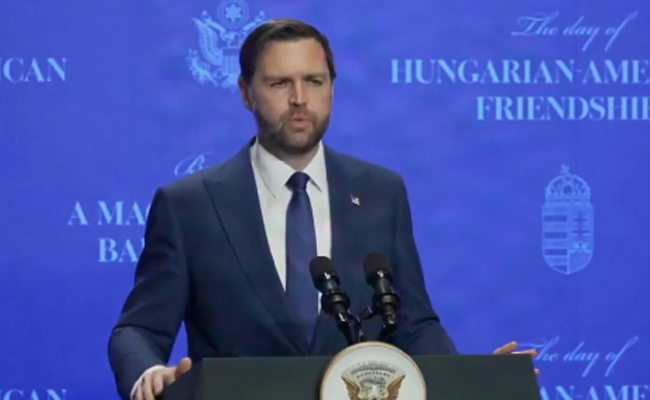
Washington DC: The White House has reportedly ruled out the use of nuclear weapons against Iran, even as uncertainty continues over ongoing peace negotiations and a deadline set by US President Donald Trump approaches.
Issues bout a possible escalation had increased after US Vice President JD Vance said that the United States has “tools in our toolkit that we so far haven’t decided to use” in dealing with Iran.
His remarks came amid rising tensions and ahead of a deadline linked to peace efforts.
The situation has attracted attention as Trump warned Iran that its “whole civilization will die tonight tonight” if an agreement is not reached by Tuesday at 8 pm.
This statement led to speculation about the possibility of extreme military measures, including a nuclear strike.
Following Vance’s comments, the White House issued a clarification distancing itself from such interpretations. In a post on X, it said, "Literally nothing @VP said here 'implies' this, you absolute buffoons." In a later statement, it added that “only the president knows” what action will be taken regarding Iran.
Literally nothing @VP said here "implies" this, you absolute buffoons https://t.co/7JU3wXMaWX
— Rapid Response 47 (@RapidResponse47) April 7, 2026