19 Bills pending in Rajya Sabha, oldest dates back to 1992
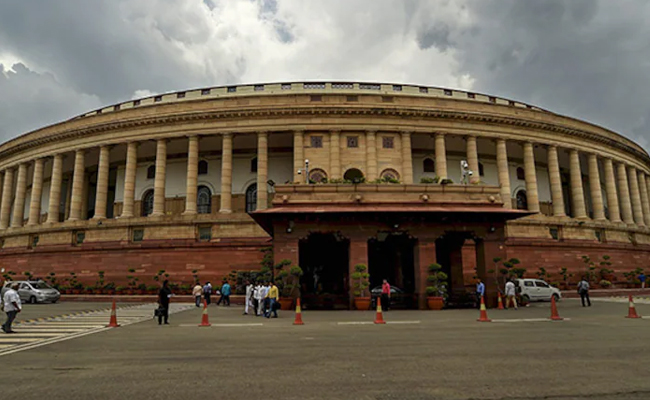
New Delhi (PTI): As many as 19 government Bills remain pending in the Rajya Sabha, with the oldest, pertaining to population control, dating back to 1992.
The Rajya Sabha is a permanent House which is never dissolved, with one-third of its members retiring every two years. While the Bills pending in the Lok Sabha lapse when the House is dissolved, a Bill pending in the Rajya Sabha never lapses.
According to a bulletin of the Upper House, there are 19 pending Bills at present, the oldest being The Constitution (Seventy-ninth Amendment) Bill, 1992.
The Bill proposed to amend the Directive Principles of State Policy to provide that the State shall promote population control and the small family norm, and to include promoting and adopting the small family norm in the Fundamental Duties. It also proposed that an MP or an MLA should be disqualified if they have more than two children.
Also among the pending bills is The Delhi Rent (Amendment) Bill, 1997, which was to amend the Delhi Rent Act, 1995 that aimed to modernise rent control laws, but faced significant pushback from tenant and landlord groups.
While the government is working on bringing The Seed Bill 2025, among the pending Bills is The Seeds Bill, 2004, which aimed to regulate the quality of seeds for sale, import and export and to facilitate the production and supply of quality seeds.
Another Bill that remains pending is The Inter-State Migrant Workmen (Regulation of Employment and Conditions of Service) Amendment Bill, 2011, which was introduced when Congress president Mallikarjun Kharge was the labour minister.
Other pending Bills which were introduced in the UPA 2 include The Building and Other Construction Workers Related Laws (Amendment) Bill, 2013; The Employment Exchanges (Compulsory Notification of Vacancies)Amendment Bill, 2013; and The Readjustment of Representation of Scheduled Castes and Scheduled Tribes in Parliamentary and Assembly Constituencies (Third) Bill, 2013.
The pending Bills introduced during the NDA regime include The Constitution (One Hundred and Twenty-fifth Amendment) Bill, 2019, which aimed to strengthen tribal autonomy in the northeast by enhancing financial and executive powers of Autonomous Councils in Assam, Meghalaya, Tripura, and Mizoram, introducing elected village and municipal councils, and The Registration of Marriage of Non-Resident Indian Bill, 2019.
The latest pending Bill, The Pesticide Management Bill, dates back to 2020.
Let the Truth be known. If you read VB and like VB, please be a VB Supporter and Help us deliver the Truth to one and all.
Mumbai-Pune Expressway connecting link now fully operational
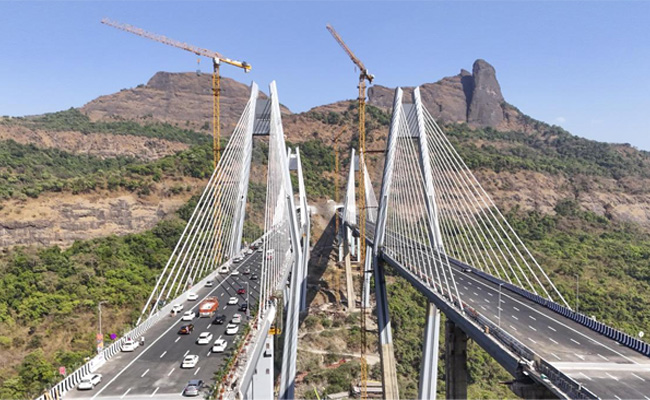
Mumbai (PTI): The Mumbai-bound carriageway of the Mumbai-Pune Expressway connecting link was opened to vehicular traffic on Saturday noon after a delay caused by the dismantling of inauguration infrastructure and cleaning work, a day after the Pune section became operational.
The 13.3 km-long "missing link", which bypasses a section of the Bhor Ghat stretch of the expressway and cuts travel time between Mumbai and Pune by 25 to 30 minutes, was inaugurated a day earlier by Chief Minister Devendra Fadnavis in the presence of Deputy CMs Eknath Shinde and Sunetra Pawar.
The Pune-bound carriageway of the corridor was opened to traffic immediately; however, the Mumbai-bound section remained closed to traffic for several hours after the inauguration.
An official of the Maharashtra State Road Development Corporation told PTI on Saturday that the opening of the Mumbai-bound carriageway was delayed mainly due to the dismantling of the inauguration infrastructure and cleaning work.
The removal of the stage and other decorations was completed in the morning. The work to load and transport the material slightly delayed the opening of the carriageway.
Vehicular movement on the carriageway began after all the remaining material was cleared and road cleaning was completed, the official added.
The expressway control room said that despite significant vehicular movement, the access-controlled highway has not witnessed any major traffic snarls since Friday evening, after the Pune-bound carriageway of the missing link was opened to traffic.
The Missing Link project connects Khopoli (in Raigad) on the Mumbai side to Kusgaon near Lonavala in Pune district and is expected to make the expressway fully access-controlled, easing congestion in the ghat section.
Developed by the MSRDC and dubbed an "engineering marvel", the project includes two tunnels, two viaducts and a cable-stayed bridge over Tiger Valley. It bypasses the steep, accident-prone ghat section, where frequent traffic snarls are reported during weekends and on public holidays.