3 elephants fall into well in Chhattisgarh wildlife sanctuary, rescued
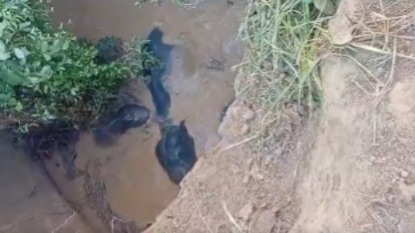
Balodabazar(PTI): Three elephants fell into a well at Barnawapara Wildlife Sanctuary in Chhattisgarh, prompting a major rescue operation that lasted nearly three hours before they were safely pulled out using a makeshift ramp on Tuesday, officials said.
The elephants -- an adult female, her calf, and a juvenile male -- had accidentally fallen into the well at the farmland of a resident in Hardi village in Balodabazar-Bhatapara district, Principal Chief Conservator of Forests (Wildlife) Arun Kumar Pandey told PTI.
The well lacked an outer boundary wall. Forest officials earlier said four elephants had fallen into the well.
Some locals spotted the elephants struggling inside the well early in the morning and immediately alerted the forest department. Senior forest officials, along with rescue teams, rushed to the site and an operation was launched to save the jumbos, Pandey said.
Earth-excavator machines were deployed, and a ramp was constructed, following safety protocols, by digging the sides of the well to allow the pachyderms to climb out safely, said Balodabazar Divisional Forest Officer (DFO) Dhammhil Ganveer, who guided the rescue operation.
The three elephants were rescued after a two-and-a-half-hour-long operation, without any injury, and later released into a nearby forest area, where they rejoined their herd, he said.
"The forest department's responsibility is not limited to protecting wildlife, rather, safeguarding every life is our priority. This rescue operation in Hardi village is an excellent example of the department's swift response, collective dedication, and the efficiency of the field team," Ganveer said.
The Balodabazar forest division continues to strengthen its rapid rescue response system, enhance field team training, and build stronger coordination with local communities to effectively handle such emergencies in the future, he added.
Chief Conservator of Forests (Wildlife) Satovisha Samajdar visited the site and supervised the rescue operation.
The department has been working to cover open wells across all forest divisions with iron grills using CAMPA (Compensatory Afforestation Fund Management and Planning Authority) funds, to prevent such accidents in the future, Pandey said.
Raipur-based wildlife activist Nitin Singhvi, however, blamed the forest department for the incident and called it "gross negligence".
Singhvi said that he has been urging authorities since 2018 to cover or secure open and abandoned wells located in and around forest areas to prevent such accidents.
Taking cognizance of his concern, the Ministry of Environment, Forest and Climate Change (MoEFCC) had written to the Chhattisgarh government in 2021, directing action to close unsafe wells. Later, in 2022, following his representation, the central government issued an advisory to all states and Union Territories, instructing them to ensure that open wells were properly covered or fenced, he claimed.
Despite these repeated warnings, the state forest department has taken no substantial action to obtain budgetary support for securing these wells, he said.
As per his estimate, there are more than 25,000 open and dry wells within and around forest areas across the state.
"In 2024, using CAMPA funds, only 450 wells were secured, and that too only in Kanker district," he claimed, adding that the lack of consistent efforts has left wildlife at serious risk.
4 elephants including 2 calves fell in open well with water filled about 6 ft at Barnawapara area, some 100 km from #Chhattisgarh capital. The rescue operation has begun. @moefcc (Centre) in Feb 2022 asked all states (chief wildlife warden) to cover open wells to protect… pic.twitter.com/4990DDHEH2
— Ejaz Kaiser (@KaiserEjaz) November 4, 2025
Let the Truth be known. If you read VB and like VB, please be a VB Supporter and Help us deliver the Truth to one and all.
Madhu Kishwar booked over misleading content on social media
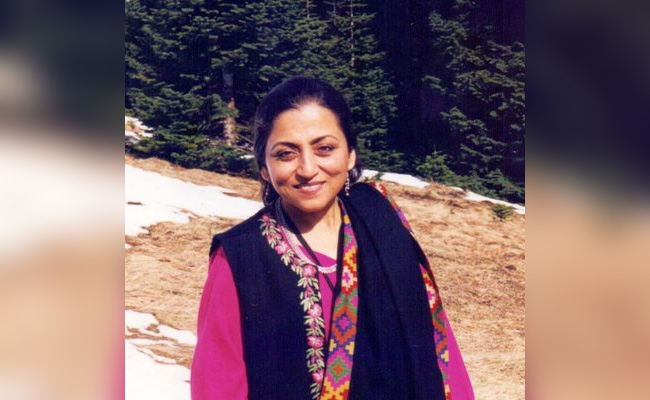
Chandigarh (PTI): Madhu Kishwar has been booked following a complaint by a Chandigarh resident over the alleged circulation of forged and misleading content on social media.
An FIR has been lodged against Kishwar and some other social media users under relevant sections, including 196 (criminalises acts that promote enmity, hatred, or ill-will between groups based on religion, race, language), 336 (1) (forgery) and 356 (criminal defamation) of Bharatiya Nyaya Sanhita and the IT Act at Police Station Sector-26 here.
According to an official statement issued by the Chandigarh police on Monday, a city-based complainant on April 19 alleged that some forged and misleading social media posts and video clips with obscene text and content were being circulated by various social media users, misidentifying the person in the video.
Further investigation into the matter is underway.
As per the complainant, it is a deliberate act of creating a false electronic record using obscene words and phrases, having knowledge and sufficient reason to believe that the posts are misleading and false, with the intent to cause damage or injury.
The video, which circulated with the intent to cause harm to the reputation of a constitutional authority and to disturb public peace and tranquility, should be investigated, and appropriate action should be taken, according to the complainant.
As per the complainant, the person seen in the video is a travel vlogger whose wife regularly posts updates about their activities on social media. The original video was shared from her social media account.
"As per the statement of the woman, she disclosed that the person in the video shared from her account is her husband. Statements of her husband and another lady in the video have also been recorded during preliminary investigation," said police in the statement.
Meanwhile, Kishwar, in a social media post, said a team of Chandigarh police had visited her late Monday night to serve her notice regarding the FIR registered against her.
"Since the law forbids the police to visit or arrest women after dark and before sunrise, I spoke on phone to the leader of the delegation. She told me that their team has come to serve notice regarding an FIR registered against me in Chandigarh. I insisted that they go by the law and come in the morning," she wrote on X.