3 months after return to IAS, Shah Faesal appointed as deputy secretary in Union tourism ministry
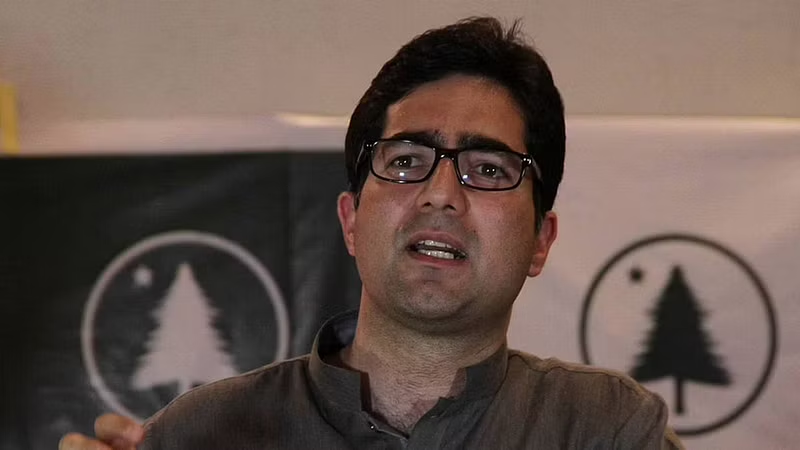
New Delhi, Aug 13: IAS officer Shah Faesal, who had a brief stint in politics, has been posted as a deputy secretary in the union tourism ministry over three months after being reinstated, officials said on Saturday.
The order on the posting of 2010-batch IAS officer from erstwhile Jammu and Kashmir cadre was cleared earlier this week.
He was reinstated in the last week of April after the government accepted his application for withdrawing his resignation.
Faesal could not be reached for a comment through calls or messages.
Faesal, who was the first Indian Administrative Service exam topper from Jammu and Kashmir, had earlier this year dropped hints about his return to the government service when he sent out a series of tweets speaking about his idealism letting him down in 2019 when he had resigned.
He had said, "8 months of my life (Jan 2019-Aug 2019) created so much baggage that I was almost finished. While chasing a chimera, I lost almost everything that I had built over the years. Job, Friends, Reputation, Public goodwill. But I never lost hope. My idealism had let me down," he had said.
"But I had faith in myself. That I would undo the mistakes I had made. That life would give me another chance. A part of me is exhausted with the memory of those 8 months and wants to erase that legacy. Much of it is already gone. Time will mop off the rest in believe," he had tweeted.
"Just thought of sharing that life is beautiful. It is always worth giving ourselves another chance. Setbacks make us stronger. And there is an amazing world beyond the shadows of the past. I turn 39 next month. And I'm really excited to start all over again," he tweeted in April this year.
Faesal, who had submitted his resignation in January 2019 and floated the Jammu and Kashmir People's Movement (JKPM) party, was detained under the stringent Public Safety Act immediately after the abrogation of the special status of the erstwhile state of Jammu and Kashmir.
However, after his release, Faesal gave up on politics and gave indications he was willing to rejoin government service. His resignation had not been accepted.
The doctor-turned-bureaucrat formed his party to "revive democratic politics" in Jammu and Kashmir but his political career ended abruptly.
The home ministry, which is the cadre controlling authority for the Arunachal Pradesh-Goa-Mizoram and Union Territory (AGMUT) cadre, had asked for an opinion of the Jammu and Kashmir administration about his plea for withdrawing his resignation.
Hailing from the remote village of Lolab in north Kashmir, Faesal, whose father was killed by terrorists in 2002, had topped the UPSC examination in 2009.
Faesal was vocal about the "unprecedented curbs" on the people of Jammu and Kashmir after the abrogation of the operative provisions of Article 370.
He was detained at Delhi airport on the intervening night of August 14-15, 2019, and sent back to Srinagar and placed under detention.
After spending six months in preventive detention, first at the Sher-e-Kashmir International Conference Centre (SKICC) and then at Srinagar's MLA hostel, he was booked under the draconian Public Safety Act in February 2020 which was revoked four months later.
In an interview with PTI in 2020, Faesal had said his decision to join politics had done more harm than benefit as his "innocuous act" of dissent was seen as an "act of treason".
About his decision to form a political party, Faesal had said he wanted to revive democratic politics in Jammu and Kashmir.
"But soon after quitting (IAS), I realised that my innocuous act of dissent was being seen as an act of treason. It had done more harm than benefit," he had said, adding his act had discouraged a lot of civil services aspirants and his colleagues felt betrayed by him. "It upset me a lot."
Let the Truth be known. If you read VB and like VB, please be a VB Supporter and Help us deliver the Truth to one and all.
Biker injured, leopard dies in road accident near forest area in Shivamogga
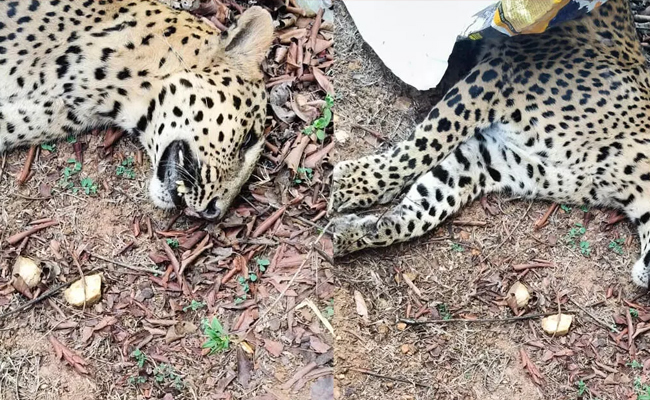
Shivamogga: A leopard was killed after being hit by a motorcycle near Mandagadde in Thirthahalli taluk of Shivamogga district.
According to reports, the biker was travelling from Shivamogga towards Thirthahalli when the leopard suddenly came onto the road from a nearby forest area near Mandagadde. The rider is said to have lost control of the bike and crashed into the animal.
The leopard suffered severe injuries in the impact and died on the spot. The biker also fell onto the road along with the motorcycle and sustained serious injuries. He was shifted to a hospital in Shivamogga for further treatment.
After receiving information about the incident, forest department officials, including Gajanur RFO Vinay Kumar, visited the spot and conducted an inspection.