483 dead, 14 missing in Kerala floods: Pinarayi Vijayan
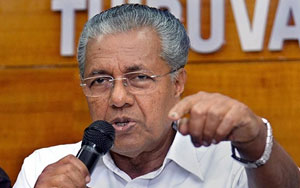
Thiruvananthapuram, Aug 30 : The Kerala flood disaster has claimed 483 lives and 15 people are still missing, Chief Minister Pinarayi Vijayan said on Thursday.
Opening the debate at a special one-day session of the Assembly to discuss the disaster, Vijayan said that at the height of the floods, the worst to hit the state in a century, there were 14.50 lakh people in relief camps.
"The latest figure is there are 59,296 people in 305 relief camps. A total of 57,000 hectares of agriculture crops have been destroyed. An approximate estimate of the loss is more than the annual outlay of our state," he said.
The Chief Minister said the Meteorological department gave out adequate warnings regarding the rains but the unprecedented showers led to a deluge.
The predicted rains from August 9 to 15 were 98.5 mm but the state got 352.2 mm, he said.
Hitting hard at the government, senior Congress legislator V.D. Sateeshan, whose constituency Paravur in Ernakulam district was submerged in flood and dam waters, called it "a man-made tragedy".
"This is not a natural calamity, instead a man-made tragedy due to the faulty handling of the dam water management. Dams in the state were overflowing and the primary reason for this tragedy is the way the dam waters were indiscriminately let out," he said.
"Several dams was opened at midnight. The need of the hour is to fix responsibility and find out who all are responsible for this."
Thomas Chandy, a former Minister who represents Kuttanadu in Alappuzha, one of the worst hit districts, asked Vijayan to release the Rs 10,000 that the government had promised as interim relief to every family without delay.
K.M. Mani, a veteran opposition legislator, applauded the rescue efforts but said the tragedy could have been avoided had there been a proper dam management policy.
"Now that the tragedy is over, rehabilitation work has to take a systematic approach," he said. Mani added that money pouring into building a new Kerala should be collected in a separate account.
"We all know what happened when Ockhi struck and still there has been no proper accounting of the money which is kept in the Chief Minister's Distress Relief Fund. So we should have a separate account."
The session saw a tough stand taken by the CPI-M when it failed to allow two of its legislators, Raju Abraham and Saji Cherian, from speaking in the Assembly while permitting nine other legislators to do so.
According to informed sources, the Chief Minister was cut up with the two MLAs as they had gone public criticizing the rescue operations and also the way the dams were opened.
Let the Truth be known. If you read VB and like VB, please be a VB Supporter and Help us deliver the Truth to one and all.
EAM Jaishankar meets Jamaican PM, gifts over 10 BHISHM Cubes
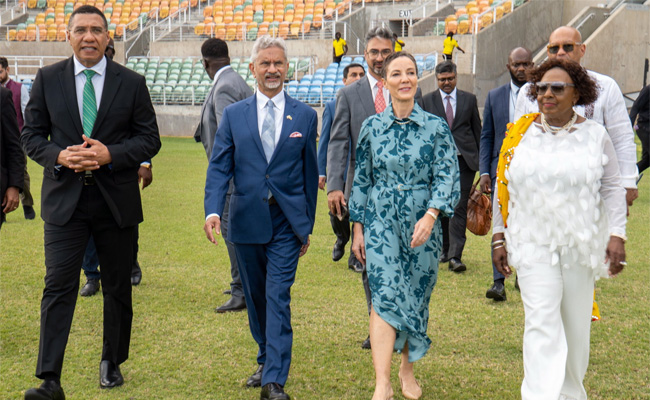
Kingston (PTI): External Affairs Minister S Jaishankar on Monday met Jamaican Prime Minister Andrew Holness and discussed ways to further deepen "political, economic and people-to-people cooperation."
Jaishankar also conveyed greetings from Prime Minister Narendra Modi to Holness.
"Pleased to call on Prime Minister @AndrewHolnessJM in Kingston. Conveyed the greetings of PM @narendramodi," Jaishankar posted on X.
"Discussed deepening our political, economic and people-to-people cooperation. Value his commitment towards further strengthening India-Jamaica relations," the post further read.
Also, the external affairs minister handed over 10 BHISHM (Bharat Health Initiative for Sahyog Hita & Maitri) Cubes as a gift to Jamaica.
"Formally handed over 10 BHISHM Cubes as a gift from India to Jamaica, in the presence of PM @AndrewHolnessJM, Health Minister @christufton and FM @kaminajsmith," Jaishankar posted on X.
"The BHISHM Cube mobile hospital system, designed for rapid deployment, will help Jamaica during disasters and emergencies. The gift of these cubes is a statement of friendship, a commitment to disaster preparedness, and an outcome of innovation," the post said.
Jaishankar arrived in Kingston on Saturday evening, marking the first leg of his nine-day tour of Jamaica, Suriname, and Trinidad and Tobago, aimed at further strengthening India's strategic and cultural ties with the Caribbean nations.
Earlier in the day, he interacted with the Indian diaspora and discussed India's ongoing transformation in infrastructure, human development and technology-driven governance and entrepreneurship with them.
He also highlighted the cricket bond between both countries as India gifted a scoreboard to Jamaica.
A scoreboard was dedicated at Sabina Park in Kingston. It is the home of the Jamaica cricket team and is the only Test cricket ground in the Caribbean island nation.
The minister expressed hope that the new scoreboard would witness many memorable innings, including those symbolising the enduring friendship between the two countries.
Cricket has long been a strong cultural bridge between India and Jamaica, which is part of the West Indies cricket team.
Jamaican players, including Chris Gayle, Courtney Walsh and Michael Holding, have played a major role in shaping the legacy of West Indies cricket in the international arena, contributing to its dominance in earlier decades and its continued global appeal.