8 dead, 14 injured as passenger train 'jumps' red signal, collides with goods train in Chhattisgarh
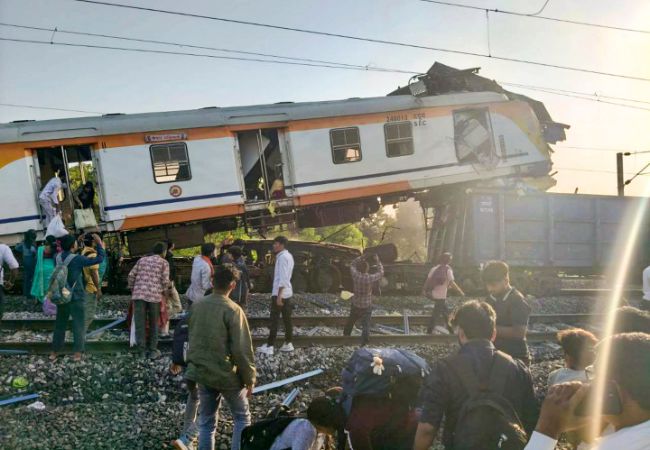
Bilaspur (PTI): At least eight persons, including the loco pilot, were killed and 14 others injured after a passenger train allegedly jumped a red signal and collided with a goods train from behind near Bilaspur station in Chhattisgarh on Tuesday, officials said.
The incident took place around 4 pm when the MEMU (mainline electric multiple unit) passenger train was heading to Bilaspur from Gevra (in neighbouring Korba district), they said.
The impact of the collision was so severe that a coach of the passenger train ended up on top of a wagon of the cargo train, the railway officials said, adding that two to three persons are still feared trapped in the wreckage.
When the passenger train was between Gatora and Bilaspur railway stations on the Howrah-Mumbai rail route section, it rammed into a goods train from behind, according to them.
The spot is a few kilometres away from Bilaspur city, which houses the headquarters of South Eastern Central Railway (SECR) zone.
"So far, eight deaths have been confirmed in the accident. Two to three others are still feared trapped inside the wreckage and efforts are on to evacuate them," Bilaspur Collector Sanjay Agrawal told PTI.
Gas cutters are being used to cut the coach, he said.
The injured passengers have been shifted to Apollo Hospital and Chhattisgarh Institute of Medical Sciences (CIMS) hospital in Bilaspur. The condition of one of them is said to be critical, he added.
"The passenger train hit the goods train from behind at a speed of 60 to 70 kmph after overshooting a red signal," a senior railway official said.
"It is now a matter of investigation as to why the loco pilot jumped the red signal and failed to apply the emergency brake in time, even though the goods train was within visible distance," the official said.
Loco pilot of the passenger train, Vidya Sagar, was killed in the accident and assistant loco pilot Rashmi Raj, a female, sustained serious injuries.
He added that the passenger train rammed into the brake van with such a force that it was mangled badly.
The train manager (guard) of the goods train jumped out of the brake van - the last coach of the goods train - at the last moment and sustained minor injuries, the official added.
Both the injured railway personnel have been hospitalised, they added.
The railway authorities have mobilised all resources at the spot, and required measures are being taken for the treatment of the injured persons, the officials said.
As per the visuals, the collision resulted in a coach of the passenger train getting mounted onto a wagon of the goods train.
The railway authorities announced a compensation of Rs 10 lakh each to kin of the deceased and Rs 5 lakh to the seriously injured persons, while those who sustained minor injuries will receive Rs 1 lakh assistance, an official statement said.
A detailed inquiry into the incident will be conducted at the level of the Commissioner of Railway Safety (CRS) to ascertain the cause and recommend necessary corrective measures, it said.
Relief and rescue operations have been launched on a war footing by the railway administration. Senior officials have rushed to the site to monitor the situation, and the injured have been shifted to nearby hospitals for treatment, it said.
The railway authorities are providing all possible assistance and coordination to the affected passengers.
Helpline numbers have been issued for the convenience of passengers and their families, it added.
Chhattisgarh Chief Minister Vishnu Deo Sai expressed grief over the accident and announced a compensation of Rs 5 lakh to kin of each of the deceased and Rs 50,000 each to the injured.
Sai has expressed profound grief over the tragic train accident near Bilaspur, calling it an extremely painful and distressing incident, an official statement said.
The CM said that teams from the district administration and the Railways are working on the ground with full dedication in the rescue and relief efforts. All necessary medical facilities and resources are being made available for the treatment of the injured.
He said that the State Government has been keeping a close watch on the situation with full sensitivity and vigilance and is taking every necessary step to assist those affected.
Speaking to the media, an injured woman passenger said the train was running when it suddenly rammed into the goods train.
"Before I could understand what happened, people started screaming and shouting for help," she recalled.
The woman, who was travelling to Bilaspur from Akaltara town in neighbouring Janjgir-Champa district, said she was in the coach that climbed onto the goods train due to the impact.
"After the collision, my leg got trapped under the seat. I was rescued by the responders and first taken to the railway hospital before being referred to another hospital," she said.
Lying on the hospital bed, she added that her leg suffered a fracture in the accident.
According to some local residents, the loud sound of the collision propelled the nearby villagers to rush to the spot and launch an immediate rescue operation.
The accident disrupted train operations on the route. Many trains running on the Howrah-Mumbai section were rescheduled.
Union Minister of State for Housing and Urban Affairs Tokhan Sahu and BJP MLA Dharamlal Kaushik visited CIMS hospital to meet the injured.
Let the Truth be known. If you read VB and like VB, please be a VB Supporter and Help us deliver the Truth to one and all.
A 99-run loss is unacceptable: Hayden blames batting horror
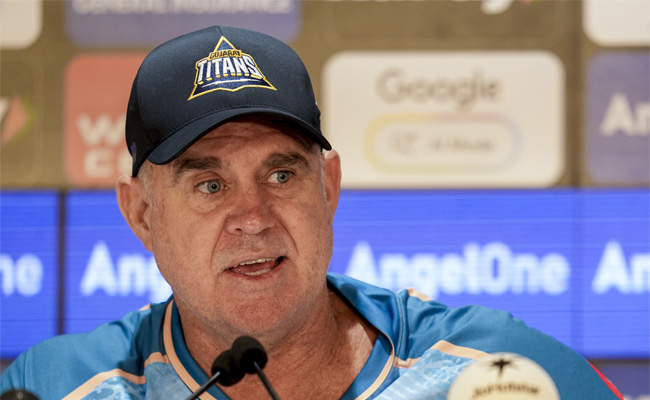
Ahmedabad (PTI): Gujarat Titans' batting coach Matthew Hayden was scathing about their 99-run defeat to Mumbai Indians, blaming a "horror" batting display and poor death bowling for the heavy loss in the IPL.
From being 44/3 in 5.5 overs, MI hammered 73 runs in the last four overs to post a challenging 199/5 here on Monday. In reply, GT were bundled out for 100.
"I expect our margins to be a lot smaller than 100 (99). That is an unacceptable scorecard for our batting unit," the legendary Australian opener told media in the post-match interaction.
"It was just a horrible day for us today. Truth be told, there was nothing good about this day, really, apart from Rabada's performance with the ball. so we've got some work to do, definitely."
GT boast a strong batting line-up in Sai Sudharsan (759 runs), Shubman Gill (717), and Jos Buttler (538). They have also added New Zealand’s explosive Glenn Phillips in the middle order alongside Shahrukh Khan and Rahul Tewatia.
"When you look down at our batting line-up, we've got wonderful players that have to be in a better mindset and better position to take their opportunities. That is our expectations and has been since the conception of this Gujarat Titans franchise...
"So you can't be sitting here and being happy about, a 100-run (99) margin game in a 20-over game. I mean, back in my day, 100 runs was almost a winning total in 50-over cricket!"
The 54-year-old said GT lost the game in the powerplay.
"Well, middle order was undoubtedly exposed today. When they're coming in with six overs, you know that you're in deep trouble. The thing about the power plays is that you can't win it from there, especially in a run chase, but you can definitely lose it, and we lost it in the power play," he said.
Shahrukh (35 off 25 balls) and Tewatia (49 off 42) have not fared well this season and Hayden feels the duo along with Phillips (67 off 54 balls) have been struggling because the top order has been below its best.
"The relevance behind balls faced when you look at, for example, someone like Glenn Phillips -- his record in T20 cricket is an impressive strike rate and you'll take that all day long in the majority of games," Hayden said.
"However, you need an upfront batting effort where you consistently taking the lion's share of the batting. We shouldn't be allowing, Tiwu (Tewatia) or Shahrukh or these guys lots of balls. That's not their role. That's not what they train for."
Hayden said GT has an aggressive and adaptable unit but their execution fell apart on the day.
"We are a very good thinking batting unit. We're not a conservative batting unit. You don't go out and get 200s as often as we do being conservative. But they're an adaptive batting unit. ...they've got their roles and they play them and today they simply didn't.
"So the worry isn't just today about the middle order. It'd be unfair to say that, they were going to go on and score 13 runs an over because by that stage, I felt like as a batting coach, I was on the mast and the boat was sinking."
It was poorly executed bowling effort
=======================
Hayden also pointed to poor execution in the death overs.
"I feel like one-dimensional is very unfair on a world-class bowling attack, but I will take on board it was a poorly executed bowling effort this evening.
"When you look back at those last four overs, that was just a 'horror story' -- 73 off the last four is unacceptable as world-class players. That bowling line-up has to reflect on that performance... It was purely an executional thing."
He added that GT were below par with the ball on a surface that didn’t fully justify the high total.
"We're very average with the ball, firstly, on a wicket that I really felt was probably a 175-type wicket.
"When you look historically at this black soil pitch on No. 5, it's a 200-wicket for the loss of five batters. That's been its winning first-inning score, and today it wasn't that wicket (199/5)... It was visible that it had cracks in it. It was visible that it was up and down.
"So credit also has to go to Tilak Varma, who put in a wonderful performance. It wasn't a cookie-cutter type performance. It was a dominant performance down the ground. He read the play nicely. He was able to pick up and play with power and precision."
Hayden said the chase was still within reach but poor shot selection proved costly.
"And when you reflect on our own batting, we had one side of the ground that was a little more inaccessible than the other, and we lost, what, three wickets into the bigger side of that boundary.
"And it wasn't an impossible total. 200 still is a total that I would back our three world-class players at the top of the order to etch into that a bit more and then allow our more sort of game players. An opportunity to set out their stalls and bat deep into the innings."