9-year-old girl suffers seizures after application of 'mehndi' on hand, doctors call it unusual case
New Delhi (PTI): Doctors at a leading private hospital here on Tuesday said they have reported an "unusual" case of a nine-year-old girl who suffered epileptic seizures triggered by the smell of "mehndi" applied on her hand.
The case study has been published in the January 2023 edition of the Clinical Neurophysiology, the Sir Ganga Ram Hospital said in a statement.
The department of neurology at the hospital recently reported "an unusual case" of a nine-year-old girl who was suffering epileptic seizures after application of "mehndi", it said.
When she had suffered her first convulsion after application of "mehndi", she had "abrupt loss of consciousness, leading to fall and convulsions for 20 seconds", doctors at the hospital said.
Recently, she was brought to the hospital for further check-up, they said.
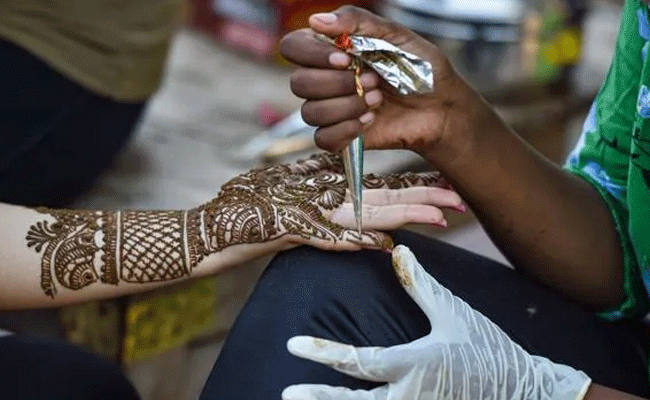
"Mehndi" is the art of making designs on someone's hands with "henna", a reddish-brown herbal dye.
According to Dr (Col) P K Sethi, senior consultant, department of neurology at the hospital, "This was an unusual case of reflex epilepsy, where epileptic seizures are consistently induced by identifiable and objective-specific triggers as against other epileptic seizures which are usually unprovoked."
"In our reported case, seizures were consistently induced by the application of 'mehndi'," Sethi said.
In the hospital settings, "mehndi" was applied to the right hand of the patient.
"Henna" has a very distinctive earthy smell and as soon as the "mehndi" applied on her hand was brought near to the chest of the patient, she started having seizures, doctors said.
"Video-electroencephalography revealed an organised background with a posterior rhythm of 9 hz. The patient became restless which were followed by seizures," the hospital said in the statement.
"In our patient, seizures were not triggered by mere application of 'mehndi' on hands and feet, rather it was the fragrance which acted as the stimulus leading to stimulation of functional anatomic networks," Sethi said.
The patient was prescribed sodium valproate and parents were advised to avoid exposure to "mehndi". The patient is stable now with no reported case of seizure, doctors said.
Let the Truth be known. If you read VB and like VB, please be a VB Supporter and Help us deliver the Truth to one and all.
Flagrant injustice to underprivileged: Mehbooba on govt action against Shopian school

Srinagar (PTI): PDP president Mehbooba Mufti on Monday said declaring Dar Ul Uloom Jamia Siraj Ul Uloom in Jammu and Kashmir's Shopian an unlawful entity under the UAPA was a "flagrant injustice" to the underprivileged sections of society.
She also alleged that banning such "altruistic institutions" without any solid evidence of anti-national activity "shows a deep seated prejudice and ill intention".
The institution allegedly run by individuals affiliated with a banned organisation has been declared an "unlawful entity" under the Unlawful Activities (Prevention) Act (UAPA).
In a post on X, Mehbooba said, "Every single day the j&k government acts as a mute bystander & a timid enabler of vicious assaults on J&Ks identity & dignity. Declaring Dar Ul Uloom Jamia Siraj Ul Uloom as an unlawful entity under UAPA is a flagrant injustice to the poor underprivileged sections of society".
The former chief minister said the institution served as a "beacon of quality education" for students unable to afford expensive schooling.
"It has produced reputed doctors and professionals who served this nation with dedication. Banning these altruistic institutions without any solid evidence of anti national activity shows a deep seated prejudice & ill intention," she added.
Divisional Commissioner Kashmir Anshul Garg issued a two-page order based on the dossier presented by Senior Superintendent of Police Shopian pointing towards the alleged illegal activities at Darul Uloom Jamia Sirajul Uloom at Imam Sahib in Shopian district in south Kashmir.
According to the order issued by Garg on April 24, there were "credible inputs and evidence on record, to indicate sustained and covert linkages of the institution with Jamaat-e-Islami, which the Government of India banned in 2019.