95-year-old man dies by suicide in West Bengal, family blames fear over voter list revision stress
Kolkata (PTI): A 95-year-old man from West Bengal's Paschim Medinipur district allegedly died by suicide in Birbhum after being reportedly distressed over the ongoing Special Intensive Revision (SIR) of electoral rolls, his family claimed on Thursday.
This is the second such death reported in West Bengal in the past 72 hours, following a similar incident at Panihati near Kolkata. A farmer in Cooch Behar, who tried to end his life, is currently admitted to the hospital.
According to police, the deceased, identified as Kshitish Majumdar, was found hanging at his daughter's residence in Illambazar area of Birbhum district on Wednesday night.
"The man was found hanging from the ceiling of one of the rooms of his daughter's residence here in Illambazar. The body has been sent for post-mortem examination. His family alleged that the person was under severe stress, fearing exclusion following the voter list verification process," a police officer claimed.
Family members said Majumdar had been anxious after learning that his name was missing from the 2002 electoral rolls.
"He would often say that since his name was not there in the 2002 voter list, he would have to go back to Bangladesh", a family member said, adding that he had been mentally disturbed over the matter.
Police have registered an unnatural death case and begun an investigation.
Police sources said Majumdar’s family moved to West Bengal from Bangladesh in 1995 and settled in Paschim Medinipur district.
Initial probe revealed that Majumdar was listed on the voter rolls and had exercised his franchise multiple times over the years, the source said.
"Majumdar was repeatedly told by his neighbours that anyone whose name did not appear on the 2002 voter list would have to return to Bangladesh. The warnings reportedly left him deeply anxious," he said.
No official statement has yet been issued by the Election Commission (EC) regarding the incident.
Meanwhile, Chief Minister Mamata Banerjee condemned the deaths and the suicide bid allegedly linked to distress over the proposed SIR in the state.
Banerjee said the incidents reflected the "tragic consequences of the BJP's politics of fear, division and hate".
"We are witnessing the tragic consequences of the BJP’s politics of fear, division and hate. Within 72 hours of the Election Commission’s announcement of the SIR exercise in Bengal - An exercise bulldozed through at the BJP’s behest. One avoidable tragedy after another has occurred," Banerjee posted on X.
Referring to the recent cases, she said, "And today, 95-year-old Khitish Majumder from Kotwali, Paschim Medinipur living with his daughter in Ilambazar, Birbhum ended his life, gripped by the fear that he and his family might be dispossessed of their land."
She described the situation as "not just tragedy, it is betrayal of humanity itself" and asked, "Who will answer for these avoidable, politically inflicted tragedies? Will the Home Minister accept responsibility? Will the BJP and its allies find the courage to speak out?"
Banerjee urged citizens not to be provoked or take extreme steps.
"I appeal to every citizen: Do not be provoked, do not lose faith, I and do not take any extreme step. Our Maa-Mati-Manush Sarkar stands with you. We will not allow the NRC to be implemented in Bengal. We will not permit a single legitimate citizen to be branded an 'outsider.'"
She added, "Until the last drop of our blood, we will fight to protect the rights of the people and to defeat the BJP and their allies' nefarious agenda to tear apart the social fabric of our nation."
Let the Truth be known. If you read VB and like VB, please be a VB Supporter and Help us deliver the Truth to one and all.
Annpurna Devi expresses anguish over girl's rape in TN, urges NCW to act
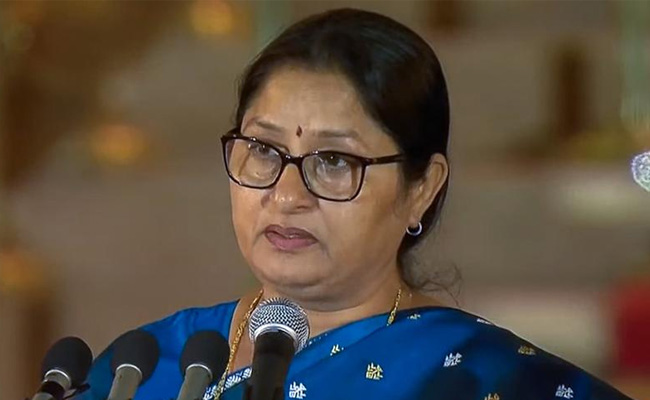
New Delhi (PTI): Union Minister for Women and Child Development Annpurna Devi on Tuesday expressed her anguish over the alleged gang rape of a girl in Tamil Nadu and urged the National Commission for Women to take immediate cognisance of the matter.
In a post on X, Devi said, "Deeply anguished by this horrific incident. I urge the NCW to take immediate cognisance and act swiftly in coordination with the concerned authorities to ensure the strictest action against all culprits."
Devi said, "Justice must be swift and unsparing — the accused must be brought to book without delay," adding, "the safety, dignity, and justice of every daughter of India remain our highest priority."
"We stand firmly with the survivor and her family in this difficult hour," she said.
Reacting to a post by former Tamil Nadu BJP president K Annamalai, who flagged concerns over the law and order situation in the state, Devi said such incidents "expose grave concerns" under the Dravida Munnetra Kazhagam government.
Annamalai, in his post, alleged that a 15-year-old girl from Kanchipuram, who had come to participate in a temple festival near Seyyaru in Tiruvannamalai district, was gangraped.
He said the incident was "deeply shocking and enraging" to him and alleged that such crimes point to a "complete failure" of law and order in Tamil Nadu.
Annamalai demanded immediate arrest of all those involved and the "harshest punishments" for the accused.
He also called for full protection and mental health counselling for the survivor and her family.