Aadhaar data not an atom bomb, remove fear: UIDAI to SC
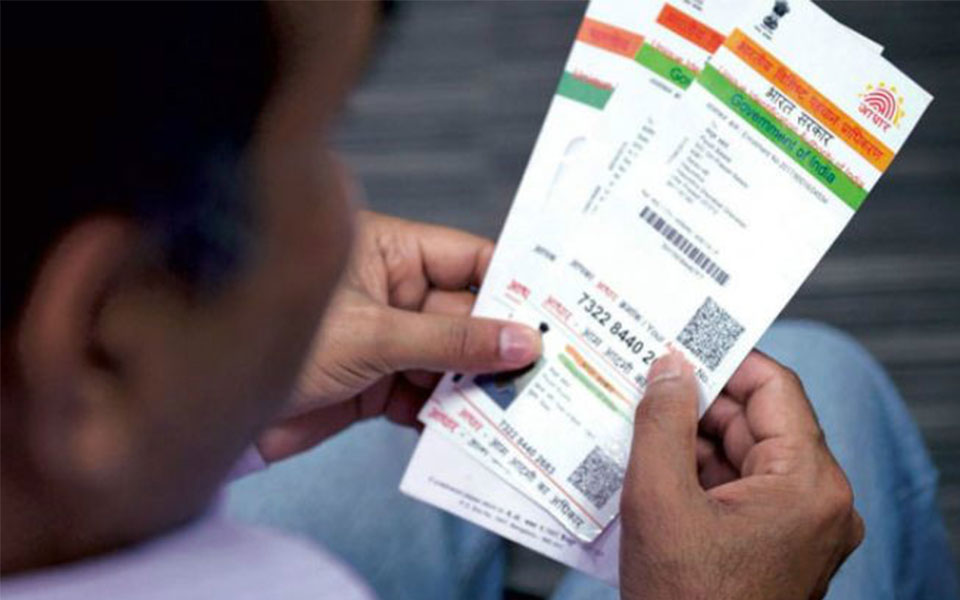
New Delhi, April 17: The Unique Identification Authority of India (UIDAI) on Tuesday told the Supreme Court that the collection of biometric and demographic information under Aadhaar was not an atomic bomb as it sought to dismiss the hyper phobia the unique identity card's critics have created around it.
"Collection of information under Aadhaar is not an atomic bomb. Please remove the fear and phobia created by the petitioners (opposing it). There is no question of leaking or sharing of information," the UIDAI told a five-judge constitution bench headed by Chief Justice Dipak Misra.
Buttressing the point, senior counsel Rakesh Dwivedi appearing for the UIDAI told the bench, also comprising Justice A.K. Sikri, Justice A.M. Khanwilkar, Justice D.Y. Chandrachud and Justice Ashok Bhushan, that the UIDAI has matching technology and not analysing technology which he described as learning algorithms.
Justice Chandrachud said: "The apprehension of the sharing of data is not symptomatic but real. The data available can be used to influence elections. We have seen this in past experience. Whether democracy can survive where data is used to influence the electoral outcome..."
Having adverted to the apprehensions, Justice Chandrachud asked Dwivedi: "You must think of what are the nature of safeguards that can be introduced."
"We can't have a blinkered view of reality" because of your limitations, Justice Chandrachud said, since "we are going to lay down a law that will affect future generations."
"How the requesting entities will use the data is a matter of concern," said Justice Chandrachud pointing out to data being used for election, an apparent reference to the leak of data of a social media site during the US Presidential election.
The court said this as Dwivedi said that they have some limitation of technological knowledge coupled with a little bit of exaggeration and lamented the "Hyperbole being created by the petitioner".
He said the information being collected under Aadhaar is not genetic information or genetic data but for simple identification and authentication.
Describing Aadhaar as a simple device for identification and authentication, Dwivedi said: "We can't analyse the data. It can't be surreptitiously obtained by any one. A lot of thought has gone into making the design and architecture of Aadhaar."
Telling the court that there are forces working against Aadhaar and that search engine Google and smart card companies do not want it, Dwivedi tried to make light of the plea for an interim order citing authentication failure in six crore cases.
"We welcome the test of fire. Unless we do it we can't win the trust of the people," Dwivedi said pointing to challenges being thrown at the implementation of Aadhaar.
"What is the purpose of opening Aadhaar platform to private entities," Justice Chandrachud asked as Dwivedi told the bench that the entire funding of the project is from the consolidate fund of India.
Dwivedi said in all major fields like aviation, defence, infrastructure there was public-private partnership, assuring the court that all the private entities were under their control and are "bound by law".
The court was hearing a batch of petitions, including by former Karnataka High Court Judge K.S. Puttuswamy, Magsaysay awardee Shanta Sinha, feminist researcher Kalyani Sen Menon, social activists Aruna Roy, Nikhil De, Nachiket Udupa and others challenging the constitutional validity of the Aadhaar scheme on the touchstone of the fundamental right to privacy.
Dwivedi will continue his arguments on Wednesday.
Let the Truth be known. If you read VB and like VB, please be a VB Supporter and Help us deliver the Truth to one and all.
Bengaluru narcotics crackdown: 15 held, drugs worth Rs 10.59 cr seized

Bengaluru (PTI): Fifteen people, including three foreign nationals, have been arrested for allegedly peddling banned narcotic substances across Bengaluru, police said on Tuesday.
The arrests were made in joint operations carried out in different police station limits following specific inputs about drug trafficking activities.
“The CCB Narcotics Control Wing and police stations under various limits of Bengaluru City have arrested a total of 15 persons, including three foreign nationals and 12 persons from other states, for selling banned narcotic substances such as hydroponic ganja, MDMA, cocaine, LSD pills, LSD strips, hashish oil and ganja,” the press release issued by the Office of the Commissioner of Police, Bengaluru City, stated.
Cases were registered under the NDPS Act based on credible information received on different dates that banned narcotic substances were being sold within the limits of the CCB Narcotics Control Wing and the police stations of Amruthahalli, Hebbagodi, JB Nagar, Sheshadripuram, Mahalakshmi Layout and Govindapura.
“Acting on the information, raids were conducted at the identified locations and a total of 15 people, including three foreign nationals and 12 persons from other states, were apprehended on different dates,” the release said.
According to police, during interrogation, the accused admitted that they were involved in drug peddling for quick money.
“During interrogation, the accused confessed that with the intention of making quick money, they procured banned narcotic substances such as hydroponic ganja, ganja, MDMA, cocaine, LSD pills, LSD strips and hashish oil from unidentified foreign and out-of-state persons and were selling them to the public, college students and IT/BT employees,” it said.
Police said a large quantity of drugs and other materials were seized from the accused.
“The seized items include 9 kg 460 grams of hydroponic ganja, 5 kg 677 grams of MDMA, 34 kg of ganja, 131 grams of cocaine, 462 ml of hashish oil, 29 LSD pills, 27 grams of LSD strips, one car, one two-wheeler and four mobile phones. The total value of the seized property is Rs 10.59 crore (market value Rs 21.50 crore),” the release stated.
In addition, Rs 24,500 in cash was also seized from the accused.
Efforts are underway to trace the foreign and other suppliers who provided the banned narcotic substances to the arrested persons, they said.
Investigation in the case is in progress.