Advance tips to drivers: Consumer Protection Authority issues notice to Uber on app feature

Bengaluru: The Central Consumer Protection Authority (CCPA) issued a notice on Wednesday to taxi booking app Uber regarding a feature where it prompts users booking rides to pay tips in advance to drivers.
In a post on his ‘X’ account, Union Consumer Affairs Minister Pralhad Joshi has expressed concern regarding the issue, saying it was unethical as well as exploitative of the agency to force or nudge users to tip the drivers in advance to ensure a faster service. He also clarified that the actions amounted to unfair trade practice, adding that a tip was given as a token of appreciation after the service rather than as a matter of right, according to a report by The Indian Express.
Joshi said that, taking cognizance of this, he had asked the CCPA to handle the matter, following which, the CCPA had issued a notice to Uber on Wednesday, demanding an explanation on the feature of advance tipping the drivers. The minister also stressed on the need to uphold fairness, transparency and accountability in all customer interactions.
While traditional tipping occurs after service and based on the quality of the service rendered to the customers, forward tipping is designated to incentivize the drivers to accept a ride by offering additional payment.
CCPA is known to have taken action against Uber following complaints by several users, who pointed out that the aggregators had been seeking ‘tips before trips’. The system was also found to be unchallenged by transport departments across states.
Urban mobility expert Satya Arikutharam has opined that, using the app feature, the customers were being forced often to pay tips only to book rides, adding that the system showed the drivers becoming unprofessional by accepting trips only if the consumers offered them tips.
Incidentally, Namma Yatri, the Bengaluru-based auto-hailing app that had been launched in November 2022, was among the first to introduce the advance tipping system in the ride-hailing ecosystem in India. The platform operates on a zero-commission model, where drivers keep 100 per cent of their base fares, and implemented tipping as an additional feature on its app. A year later, by late 2023, Rapido incorporated tipping into its service.
Uber was the latest ride-hailing firm to adopt this feature, having introduced advance tipping only last month. The app, however, introduced the post-service tipping globally back in 2017.
Sources have said that offering drivers tips upfront has become an industry norm with different names. Some platforms that did not pay 5 per cent GST claimed that they have a SaaS (Software as a Service) model and got drivers to earn more through tips. All members in the system, however, moved to this new model eventually, to avoid an unfair advantage, the sources added.
Let the Truth be known. If you read VB and like VB, please be a VB Supporter and Help us deliver the Truth to one and all.
Ordinance issued to increase number of Supreme Court judges from 34 to 38
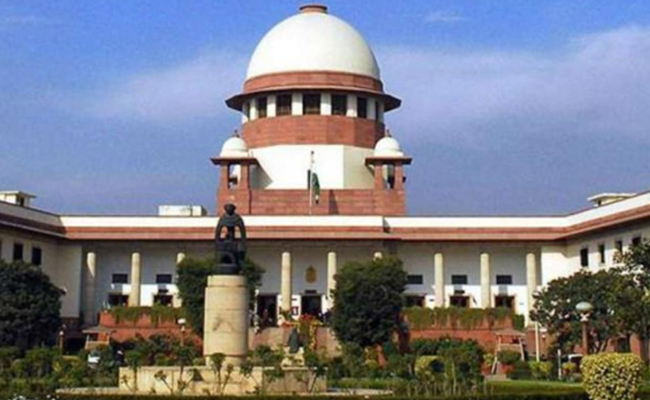
New Delhi (PTI): The government has promulgated an ordinance to increase the strength of the Supreme Court from the present 34 judges to 38, including the Chief Justice of India.
The law ministry notified the ordinance on Saturday, which amended the Supreme Court (Number of Judges) Act, 1956, to increase the sanctioned strength of the top court.
So far, the sanctioned strength of the top court was 34, including the Chief Justice of India (CJI). Now, the number of judges has been increased by four, taking the sanctioned strength to 38.
The top court will now have 37 judges, other than the CJI.
With the apex court having two vacancies at present, and the ordinance coming into force immediately, the Supreme Court Collegium will now have to recommend six names for appointment as judges in the top court.
A bill will be brought in the Monsoon Session of Parliament to convert the ordinance – an executive order – into a law passed by Parliament.
The Union Cabinet had cleared a draft bill on May 5 to increase the number of apex court judges.
The strength of the Supreme Court was last increased from 30 to 33 (excluding the CJI) in 2019.
The Supreme Court (Number of Judges) Act, as originally enacted in 1956, put the maximum number of judges (excluding the CJI) at 10.
This number was increased to 13 by the Supreme Court (Number of Judges), Amendment Act, 1960, and to 17 by another amendment to the law.
The Supreme Court (Number of Judges) Amendment Act, 1986, augmented the strength of judges from 17 to 25, excluding the CJI.
A fresh amendment in 2009 further increased the strength from 25 to 30.
Article 124(3) of the Constitution lists the qualifications required to become a Supreme Court judge.
An Indian citizen who has either served as a high court judge for at least five years, or as an advocate for 10 years, or is a distinguished jurist, can be appointed to the top court.
The strength of the Supreme Court is increased based on the recommendations of the CJI, who writes to the Union law minister. After consulting the finance ministry, the Department of Justice under the law ministry moves the Cabinet with a draft bill.