After SC order, EC asks parties to share details of donations received through electoral bonds
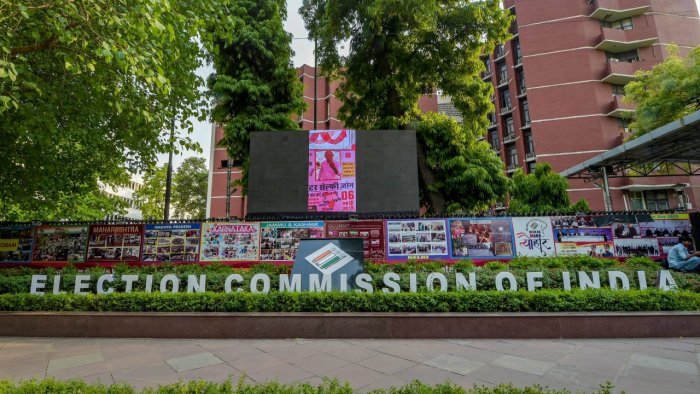
New Delhi, Nov 13: The Election Commission has asked "all such parties" which have ever got any donation through electoral bonds to furnish by November 15 the details of such contributions received by them since the inception of the scheme.
The move by the EC comes after the Supreme Court on November 2 directed the poll panel to produce before it in sealed cover the "up to date" data of funds received by political parties through electoral bonds till September 30, 2023.
In a letter to heads of all political parties on November 3, the EC has also asked them to share detailed particulars of the donors against each bond, the amount of each such bond and the full particulars of the credit received against each bond in a sealed cover.
The EC's letter said particulars should be sent in double sealed cover -- one duly sealed envelope containing the particulars and second duly sealed envelope containing the first envelope -- to its secretary of the election expenditure division.
The EC said the sealed covers should reach it latest by November 15 evening. It also said the envelops should be clearly marked as "confidential-electoral bonds".
While passing its order on November 2, the apex court had said, "This exercise shall be carried out on or before November 19, 2023. Data in a sealed packet shall be handed over to the Registrar (Judicial) of this court."
A five-judge constitution bench headed by Chief Justice D Y Chandrachud referred to the April 12, 2019 interim direction passed by the apex court directing political parties to furnish the details of funds received by them through electoral bonds to the poll panel in a sealed cover.
The apex court had, in April 2019, declined to stay the electoral bonds scheme and made it clear that it will accord an in-depth hearing on the pleas as the Centre and the Election Commission had raised "weighty issues" that had "tremendous bearing on the sanctity of the electoral process in the country".
The electoral bonds scheme, which was notified by the government on January 2, 2018, was pitched as an alternative to cash donations made to political parties as part of efforts to bring in transparency in political funding.
According to the provisions of the scheme, electoral bonds may be purchased by any citizen of India or entity incorporated or established in the country. An individual can buy electoral bonds, either singly or jointly with other individuals.
Only political parties registered under Section 29A of the Representation of the People Act, 1951 and which secured not less than one percent of the votes polled in the last election to the Lok Sabha or a state legislative assembly are eligible to receive electoral bonds.
According to the government notification, electoral bonds shall be encashed by an eligible political party only through an account with an authorised bank.
Let the Truth be known. If you read VB and like VB, please be a VB Supporter and Help us deliver the Truth to one and all.
Several Gurugram schools receive hoax bomb threats

Gurugram (PTI): Several Gurugram schools received another hoax bomb threat emails on Wednesday morning, prompting police to launch searches on the premises.
Police said the email was sent by the 'Khalistan National Army', with threats issued to Haryana Chief Minister Nayab Singh Saini to declare April 29 as the "40th Khalistan Declaration Day". It also threatened to bomb the Red Fort in Delhi.
Police said it was a hoax as no suspicious items were found after an intensive search.
Several schools, including Shri Ram, Amity, and the HDFC school, received threatening emails at 8.33 am, when classes had already begun, police said.
The school administrations became aware of the threats around 9 am and immediately informed the police, a senior police officer said.
The schools immediately implemented emergency protocols, with many declaring a holiday and asking parents to take their children home safely, the officer said.
A large number of anxious parents gathered outside the schools, as police and bomb squad teams reached the spots and started checks.
"Around 10 schools have approached the police from morning until now over bomb threats. Police teams are alert, and searches are underway on all the premises", the officer said.
As soon as the information about this email was received, police in Gurugram and Delhi swung into action and started investigation.
Schools immediately implemented emergency protocols upon receiving the mail. Many schools declared a holiday and sent messages to parents, asking them to take their children home. Large crowds of parents gathered outside the schools.
The schools were sanitised by sending a bomb disposal squad as well as a dog squad.
A senior police officer said that police teams thoroughly searched the school premises, classrooms, buildings, and surrounding areas. No suspicious objects or explosive materials were found during the investigation.
"Police teams are seriously investigating the entire matter. Cyber experts are being consulted to determine the authenticity of the email, its source, and the identity of the sender", added the officer.
This is the third time since January that schools have received fake bomb threats.
In March, at least a dozen schools in the city received bomb threat emails, which later turned out to be hoaxes.
Similarly, on January 28, as many as 13 schools received hoax bomb threats via email, forcing authorities to evacuate campuses and suspend classes.
Last month, police arrested a Bangladeshi national whose email ID was allegedly used to make a bomb threat for some payment.