Air India plane crash: AAIB report says fuel to both engines cut off within gap of a second
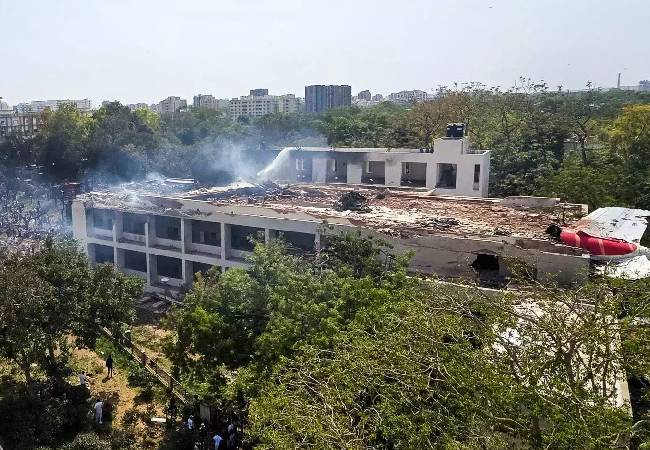
New Delhi (PTI): A preliminary report has found that the fuel supply to both engines of Air India flight AI171 was cut off within a second of each other, causing confusion in the cockpit and the airplane plummeting back to ground almost immediately after taking off.
The 15-page report says that in the cockpit voice recording, one unidentified pilot asked the other why he had cut off the fuel, which the other denied.
On June 12, the London-bound Boeing 787 Dreamliner began to lose thrust almost immediately after taking off from the Ahmedabad airport and ploughed into a medical college hostel, killing all but one of the 242 onboard and another 19 on ground in the deadliest aviation accident in a decade.
According to a chronology laid out in the report by Aircraft Accident Investigation Bureau, both fuel control switches - which are used to turn the engines off - were moved to the cutoff position almost immediately after takeoff.
The report however did not say how this happened or who did it.
Soon after both fuel cutoff switches moved from RUN to CUTOFF, one second apart, a RAT pump was deployed to supply hydraulic power as both engines fell below minimum idle rate.
About 10 seconds later, Engine 1 fuel cutoff switch moved to its so-called RUN position, followed by Engine 2 four seconds later. The pilots managed to relight both engines, but only Engine 1 recovers while Engine 2 failed to build up enough power again to reverse deceleration.
One of the pilots issued a "Mayday, Mayday, Mayday" distress call but before air traffic controllers could get a response about what had gone wrong, the plane crashed just outside the Ahmedabad airport boundary having grazed some trees before plunging into a hostel packed with students.
At the time the aircraft took off, the co-pilot was flying the plane, while the captain was monitoring.
The time between the takeoff and the crash was only about 30 seconds.
The preliminary report by AAIB released on Saturday, recommended no action for now for the operators of Boeing 787-8 planes.
"The aircraft achieved the maximum recorded airspeed of 180 Knots IAS at about 08:08:42 UTC (13.38 IST) and immediately thereafter, the Engine 1 and Engine 2 fuel cutoff switches transitioned from RUN to CUTOFF position one after another with a time gap of 01 sec," the report said.
As per the report, the engine N1 and N2 began to decrease from their take-off values as the fuel supply to the engines was cut off.
"In the cockpit voice recording, one of the pilots is heard asking the other why did he cutoff. The other pilot responded that he did not do so," it said.
Almost immediately after the plane lifted off the ground, CCTV footage shows a backup energy source called ram air turbine (RAT) had deployed, indicating a loss of power from the engines.
The report provided only a limited picture of the interaction between the two pilots in the flight deck and also did not say how the switches could have flipped to the cutoff position during the flight.
Normally, flipping to cutoff, which almost immediately cuts fuel supply, is often used to turn engines off once a plane has arrived at its airport gate and in certain emergency situations, such as an engine fire. The report did not indicate there was any emergency requiring an engine cutoff.
The report said both fuel switches were found in the run position at the crash site and that there had been indications of both engines relighting before the low-altitude crash.
In a statement, Air India said that it "stands in solidarity with the families and those affected" and "[continues] to mourn the loss" of those killed in the accident.
Air India said it was "working closely with stakeholders, including regulators" and "continue to fully cooperate with the AAIB and other authorities as their investigation progresses."
On its part, Boeing said: "Our thoughts remain with the loved ones of the passengers and crew on board Air India Flight 171, as well as everyone affected on the ground in Ahmedabad. We continue to support the investigation and our customers."
The US National Transportation Safety Board noted that there were no recommended actions in the report aimed at operators of Boeing 787 jets or the GE engines.
The ill-fated flight was commanded by Sumeet Sabharwal, 56, a veteran with 30 years of experience at Air India. He had logged 15,638 flying hours, including 8,596 on the Boeing 787. He was also an Air India instructor. His co-pilot was Clive Kunder, 32, who had 3,403 hours of total experience, with 1,128 on the Dreamliner.
Kunder was the pilot flying, while Sabharwal was the pilot monitoring.
The crew had passed pre-flight breathalyser tests and were seen at the gate on CCTV before they took off, the report adds.
The June 12 accident was India's worst aviation disaster in almost three decades and the industry's deadliest in 11 years, as well as the first fatal involving a Boeing Dreamliner.
The investigation was conducted with assistance from the UK's Air Accident Investigation Branch and the US National Transportation Safety Board.
Aviation experts have said it is difficult for pilots to inadvertently move the fuel switches as there is a little mechanical gate built into the switch. Switches need to be lifted up over this little gate to shut off supply. They also asked why the report made no reference to cockpit camera footage.
The AAIB report cited a FAA airworthiness bulletin from 2018 on the "potential disengagement of fuel control switch locking feature" on Boeing planes including the 737 and 787. The Air India jet was not inspected for the locking mechanism fault as it was never mandatory and that there has been no defect reported pertaining to the fuel control switch since 2023, it said.
It said the aircraft took off at 08:08:39 UTC (13:38:39 IST) and at about 08:09:05 UTC (13:39:05 IST) one of the pilots transmitted 'MAYDAY MAYDAY MAYDAY'.
"The ATCO (Air Traffic Controller) enquired about the call sign. ATCO did not get any response but observed the aircraft crashing outside the airport boundary and activated the emergency response," the report said.
In the report, AAIB also said fuel samples taken from bowsers and tanks used to refuel the aircraft were tested at the DGCA (Directorate General of Civil Aviation) Lab and were found satisfactory.
The preliminary report was widely anticipated to throw more light on what could have led to the crash.
The AAIB said the wreckage site activities, including drone photography/ videography have been completed and the wreckage has been moved to a secure area near the airport.
"Both engines were retrieved from the wreckage site and quarantined at a hangar in the airport. Components of interest for further examinations have been identified and quarantined," it said.
According to the report, fuel samples taken from the bowsers and tanks used to refuel the aircraft were tested at the DGCA's Lab and were found satisfactory.
"Very limited amount of fuel samples could be retrieved from the APU filter and Refuel/Jettison valve of the left wing. The testing of these samples will be done at a suitable facility capable of carrying out the test with the limited available quantity," it said.
The AAIB is gathering additional details based on initial leads and data downloaded from the forward Enhanced Airborne Flight Recorder (EAFR) is being analysed.
"At this stage of investigation, there are no recommended actions to B787-8 and/or GE GEnx-1B engine operators and manufacturers," the report said.
The plane that crashed was powered by GEnx-1B engines.
Statements of the witnesses and the surviving passenger have been obtained by the investigators.
The complete analysis of post-mortem reports of the crew and the passengers is being undertaken to corroborate aeromedical findings with the engineering appreciation, the AAIB said.
The probe is continuing and the investigation team will review and examine additional evidence, records and information that is being sought from the stakeholders.
There were 230 passengers on board -- 15 in the business class and 215, including two infants, in economy class.
The Pilot In Command (PIC) had more than 15,638 hours of flying experience while the first officer had over 3,403 hours of flying experience.
Let the Truth be known. If you read VB and like VB, please be a VB Supporter and Help us deliver the Truth to one and all.
Trump administration says its war in Iran has been 'terminated' before 60-day deadline

Washington (AP): The Trump administration is arguing that the war in Iran has already ended because of the ceasefire that began in early April, an interpretation that would allow the White House to avoid the need to seek congressional approval.
The statement furthers an argument laid out by Defense Secretary Pete Hegseth during testimony in the Senate earlier Thursday, when he said the ceasefire effectively paused the war. Under that rationale, the administration has not yet met the requirement mandated by a 1973 law to seek formal approval from Congress for military action that extends beyond 60 days.
A senior administration official, who spoke on condition of anonymity to discuss the administration's position, said for purposes of that law, “the hostilities that began on Saturday, Feb 28 have terminated.” The official said the US military and Iran have not exchanged fire since the two-week ceasefire that began April 7.
While the ceasefire has since been extended, Iran maintains its chokehold on the Strait of Hormuz, and the US Navy is maintaining a blockade to prevent Iran's oil tankers from getting out to sea.
Under the War Powers Resolution, the law that sought to constrain a president's military powers, President Donald Trump had until Friday to seek congressional authorisation or cease fighting. The law also allows an administration to extend that deadline by 30 days.
Democrats have pushed the administration for formal approval of the Iran war, and the 60-day mark would likely have been a turning point for a swath of Republican lawmakers who backed temporary action against Tehran but insisted on congressional input for something longer.
“That deadline is not a suggestion; it is a requirement,” said Sen Susan Collins, R-Maine, who voted Thursday in favour of a measure that would end military action in Iran since Congress hadn't given its approval. She added that “further military action against Iran must have a clear mission, achievable goals, and a defined strategy for bringing the conflict to a close."
Richard Goldberg, who served as director for countering Iranian weapons of mass destruction for the National Security Council during Trump's first term, said he has recommended to administration officials to simply transition to a new operation, which he suggested could be called “Epic Passage,” a sequel to Operation Epic Fury.
That new mission, he said, “would inherently be a mission of self-defence focused on reopening the strait while reserving the right to offensive action in support of restoring freedom of navigation.”
“That to me solves it all,” added Goldberg, who is now a senior adviser at the Foundation for Defense of Democracies, a hawkish Washington think tank.
During testimony before the Senate Armed Services Committee on Thursday, Hegseth said it was the administration's “understanding” that the 60-day clock was on pause while the two countries were in a ceasefire.
Katherine Yon Ebright, counsel at the Brennan Center's Liberty and National Security Program and an expert on war powers, said that interpretation would be a “sizeable extension of previous legal gamesmanship” related to the 1973 law.
“To be very, very clear and unambiguous, nothing in the text or design of the War Powers Resolution suggests that the 60-day clock can be paused or terminated,” she said.
Other presidents have argued that the military action they've taken was not intense enough or was too intermittent to qualify under the War Powers Resolution. But Trump's war in Iran would certainly not be such a case, Ebright said, adding that lawmakers need to push back against the administration on that kind of argument.