Air pollution levels creep up in Delhi
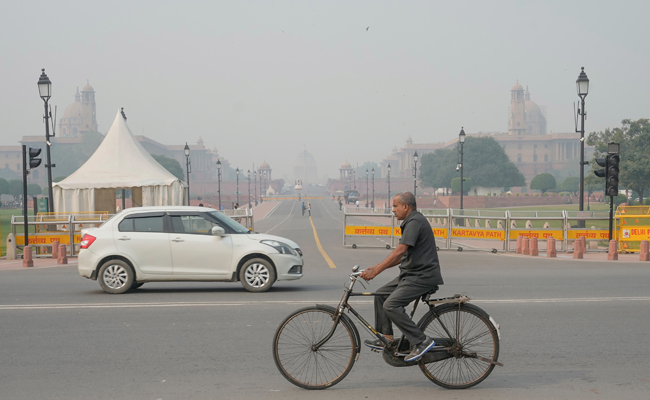
New Delhi (PTI): Air quality in Delhi and its suburbs deteriorated again overnight after a marginal improvement a day ago with forecasts suggesting that a major relief is unlikely in the coming days.
The city's Air Quality Index (AQI) stood at 338 at 8 am on Monday, deteriorating from 301 at 4 pm and 290 at 7 am on Sunday.
The 24-hour average AQI, recorded at 4 pm every day, was 319 on Saturday, 405 on Friday and 419 on Thursday.
Neighbouring Ghaziabad (306), Gurugram (239), Greater Noida (288), Noida (308) and Faridabad (320) also recorded a dip in air quality.
An AQI between zero and 50 is considered 'good', 51 and 100 'satisfactory', 101 and 200 'moderate', 201 and 300 'poor', 301 and 400 'very poor', 401 and 450 'severe' and above 450 'severe plus'.
The Centre on Saturday removed stringent curbs, including a ban on construction work related to linear projects and the entry of polluting trucks into Delhi in view of a dip in air pollution levels due to favourable wind speed and direction.
These measures constitute the final stage -- Stage IV -- of the Centre's air pollution control plan called the Graded Response Action Plan (GRAP).
The Commission for Air Quality Management (CAQM) in National Capital Region and Adjoining Area, a statutory body responsible for formulating strategies to combat pollution in the region, asked Delhi and NCR states to revoke all emergency measures, under which only CNG, electric and BS VI-compliant vehicles from other states are allowed to enter Delhi, with exemptions granted to those involved in essential services.
All medium and heavy goods vehicles not engaged in essential services were also banned in the capital under Stage IV of GRAP.
According to the latest CAQM order, all other curbs under stages I, II and III of GRAP, including a ban on non-essential construction work, mining, stone crushers and diesel generators will continue.
Delhi Environment Minister Gopal Rai on Sunday said that people should remain vigilant and adhere to pollution control measures.
He also recalled that the progress made just before Diwali due to rain and favourable meteorological conditions was compromised by people bursting firecrackers.
The minister confirmed that other restrictions under stages I, II and III of GRAP will continue in the capital.
The ban on BS III petrol and BS IV diesel vehicles will also continue, he said.
"We will reassess these restrictions if the situation continues to improve," the minister said.
According to the Air Quality Early Warning System developed by the Pune-based Indian Institute of Tropical Meteorology, no major improvement in air quality is likely in the next few days.
Recent data from a joint project by the Delhi government and the Indian Institute of Technology (IIT), Kanpur, showed that vehicular emissions accounted for about 36 per cent of the capital's air pollution on Saturday and 38 per cent on Sunday.
Secondary inorganic aerosols -- particles such as sulfate and nitrate that are formed in the atmosphere due to the interaction of gases and particulate pollutants from sources like power plants, refineries and vehicles -- are the second major contributor to Delhi's foul air, accounting for 30 to 36 per cent of the air pollution in the city over the last few days.
Let the Truth be known. If you read VB and like VB, please be a VB Supporter and Help us deliver the Truth to one and all.
Man kills 12-year-old nephew over property dispute in Karnataka’s Sindhanur
Sindhanur: A 12-year-old boy was killed and his mother seriously injured after a man allegedly attacked his elder brother’s family with a knife over a property dispute in Alabanur village of Sindhanur taluk on Wednesday morning.
The deceased has been identified as Nagaraj Siddappa Alvi (12). Amrutha Siddappa (42) sustained serious injuries in the attack. Police said the accused is Basavaraj Rudrappa Alvi, the younger brother of the victim boy’s father.
According to preliminary information, Basavaraj had arrived in Alabanur village on Tuesday and was staying at his mother’s house.
On Wednesday morning, he allegedly went to the house of his brother Siddappa carrying a knife. At the time, Siddappa’s wife Amrutha and children Nagaraj and Dhanush were present in the house.
Police said the accused allegedly attacked them with the knife. Nagaraj died in the incident, while Amrutha and Dhanush suffered serious injuries.
The injured were shifted to the government hospital in the city for treatment.
Deputy Superintendent of Police G. Chandrashekhar visited the spot and gathered information.
Sources said Chinnamma Rudrappa of Alabanur village has two sons Siddappa, who lives in Alabanur, and Basavaraj, who resides in Alliganur village of Siruguppa taluk.
Police suspect the long-standing property dispute between the two brothers led to the fatal attack.