Air pollution: SC asks CAQM to consider directing NCR schools to postpone sports competitions
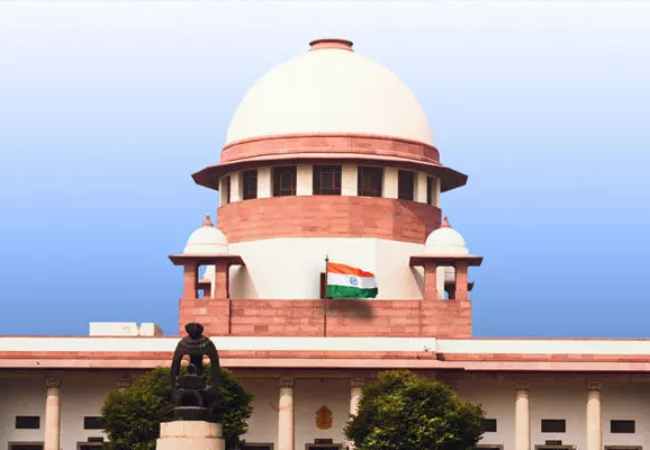
New Delhi (PTI): The Supreme Court on Wednesday asked the Commission for Air Quality Management (CAQM) to consider directing schools in Delhi-NCR to postpone open air sports competitions planned in November and December to “safer months” keeping in mind air pollution levels.
A bench comprising Chief Justice B R Gavai and Justice K Vinod Chandran said the issue of severe air pollution crisis in Delhi-National Capital Region needed a pro-active approach and the top court should hear the case to monitor the development on a monthly basis.
The direction to the CAQM was passed after senior advocate Aprajita Singh, who is assisting the bench as an amicus curiae, said when elders are sitting in closed spaces with air purifiers on, the kids are training for sports and games competitions in an open “gas chamber”.
“Children are most vulnerable. Holding sports now is like putting them in gas chambers,” she said.
“We request CAQM to take this into consideration and issue necessary directions to shift such sport competition to safer months," the CJI said.
At the outset, Additional Solicitor General Aishwarya Bhati, appearing for the Centre, said that a high level meeting was chaired by the secretary of the MoEFCC (Ministry of Environment, Forest and Climate Change) along with senior officers of Delhi-NCR states on Tuesday and long term and short term measures to tackle air pollution were discussed.
“There is already a long-term policy since 2018 and a graded response plan since 2015, and it is all court-driven. All looks very good, but on the ground State Pollution Control Boards have no manpower,” the amicus curiae said.
The bench said reactive measures should not be taken only when pollution peaks and the main plea be listed once every month so that implementation of anti-pollution strategies could be monitored consistently.
It permitted CAQM and the CPCB to impose stricter restrictions under GRAP regime keeping in mind the emerging situations.
On the issue of construction workers sitting jobless due to GRAP restrictions, the CJI said, “We have already held that labourers depend on activities which are banned and thus suffer…”.
The bench also addressed the impact of pollution-related restrictions on daily wage workers, especially in construction and allied sectors.
It directed NCR states, Delhi, Uttar Pradesh, Haryana and Rajasthan, to obtain instructions and inform the court at the next hearing regarding payment of subsistence allowances to the workers.
On Tuesday, the bench batted for a long-term solution for air pollution in Delhi-NCR. It refused to impose year-round restrictions on all activities prohibited under the Graded Response Action Plan (GRAP) - a set of emergency measures to control pollution.
The top court asked the Punjab and Haryana governments to strictly follow the directions of the Commission for Air Quality Management (CAQM) on the issue of stubble burning in the two states.
"If the CAQM's suggestions to Punjab and Haryana are implemented, then stubble burning can be adequately tackled. Thus, we direct both states to have a combined meeting and ensure that the CAQM's suggestions are scrupulously implemented," the bench said.
GRAP is a framework designed to tackle air pollution in Delhi-NCR through a tiered system of measures based on the severity of air quality according to the Air Quality Index (AQI).
According to the Central Pollution Control Board (CPCB), an AQI between 0-50 is considered 'good', 51-100 'satisfactory', 101-200 'moderate', 201-300 'poor', 301-400 'very poor', and 401-500 'severe'.
GRAP I restrictions come into force when the AQI is between 201 to 300, GRAP II restrictions come into force when it is between 301 to 400 and GRAP III restrictions come into effect when it is between 401 to 450.
GRAP IV restrictions are imposed when the AQI crosses 451.
The bench said temporary or piecemeal measures cannot offer a sustainable solution.
It noted that despite a reported fall in stubble burning incidents in Punjab, air quality levels have not shown corresponding improvement.
On November 12, taking note of further deterioration of the air quality in Delhi-NCR due to stubble burning, the court asked the Punjab and Haryana governments to apprise it about the action taken to control the situation.
On November 3, the top court directed the CAQM, the Centre's air quality panel, to file an affidavit detailing the steps taken by it so far to prevent the pollution levels in Delhi-NCR from worsening further.
Let the Truth be known. If you read VB and like VB, please be a VB Supporter and Help us deliver the Truth to one and all.
Women's quota bill would have ensured defeat of democracy, Constitution: Aaditya Thackeray

Mumbai (PTI): Shiv Sena (UBT) leader Aaditya Thackeray on Saturday said that the passage of the women's quota bill would have ensured a "total defeat of democracy", alleging that the legislation, linked with a delimitation exercise, was a political tool designed to reduce the voice of states.
Thackeray, in a post on X, claimed that the Bill would have amended the Constitution for the political means of the ruling regime to increase seats, reduce the voice of many states and enable the gerrymandering of constituencies to ensure unfair victories.
"The very amendment that would have ensured the total defeat of democracy and the Constitution in India stands rejected by the unity of the Opposition MPs," he wrote.
The legislation should have been called "Delimitation to ensure unfair victory Bill", the former minister said, adding that there was a genuine need to enable 33 per cent reservation for women in the current number of seats.
"Now, it is up to the government to ensure that it is implemented in the 543 seats of the Lok Sabha for the 2029 elections and all elections across India, if that is the real intent of the government," he wrote.
A Constitution Amendment Bill to implement reservation for women in legislatures in 2029 and increase the number of Lok Sabha seats was defeated on Friday in the Lower House.
While 298 members voted in support of the Bill, 230 MPs voted against it. Out of 528 members who voted, the Bill required 352 votes for a two-thirds majority.
According to the Constitution Amendment Bill, Lok Sabha seats were to be increased to a maximum of 850 from the current 543 to "operationalise" the women's reservation law before the 2029 parliamentary polls, following a delimitation exercise based on the 2011 Census.