Air quality worsens in Delhi
New Delhi (PTI): Delhi's air quality worsened on Sunday as weak winds trapped pollutants, raising the overall AQI to 366 in the "very poor" category with three monitoring stations recording readings above 400 in the "severe" category, Centre Pollution Control Board data showed.
The PM2.5 concentration stood at 189.6 micrograms per cubic metre and PM10 at 316. PM2.5 refers to fine inhalable particles with diameters that are 2.5 micrometres or smaller, while PM10 includes slightly larger particles up to 10 micrometres in diameter, as per CPCB.
At such levels, these pollutants can cause breathing discomfort, especially among people with lung or heart diseases, children and the elderly.
The overall AQI rose sharply from 303 recorded a day earlier, CPCB data showed.
Neighbouring cities in the National Capital Region (NCR) also reported "very poor" air quality -- Ghaziabad (351), Gurugram (357), Noida (348) and Greater Noida (340). Faridabad, however, recorded a "poor" AQI of 215.
According to the Air Quality Early Warning System (AQEWS) for Delhi, the wind speed dropped below 8 kmph from the northwest direction during the evening and night hours, reducing the dispersion of pollutants.
It added that a ventilation index lower than 6,000 m ²/s and wind speeds less than 10 kmph are unfavourable for pollutant dispersal.
The air quality is likely to remain in the "very poor" category till November 4, the AQEWS said.
Three monitoring stations in the city recorded "severe" air quality with readings above 400, with Wazirpur reporting the highest level at 413.
Another 28 stations registered "very poor" air quality with readings above 300, as per CPCB's Sameer app.
An AQI between 0 and 50 is considered "good", 51-100 "satisfactory", 101-200 "moderate", 201-300 "poor", 301-400 "very poor" and 401-500 "severe", according to CPCB standards.
The maximum temperature was recorded at 30.7 degrees Celsius, 0.5 degrees below the seasonal average, while the minimum settled at 16.8 degrees Celsius, 1.5 degrees above normal, according to the India Meteorological Department (IMD).
The humidity stood at 75 per cent at 5.30 PM.
The weather office has forecast shallow fog on Monday, with the maximum and minimum temperatures likely to hover around 30 and 15 degrees Celsius, respectively.
A ban on the entry of commercial goods vehicles not registered here and not compliant with BS-III or lower emission standards came into force in the national capital on November 1.
Let the Truth be known. If you read VB and like VB, please be a VB Supporter and Help us deliver the Truth to one and all.
ED searches: Karnataka CM Siddaramaiah accuses Centre of targeting Cong leaders
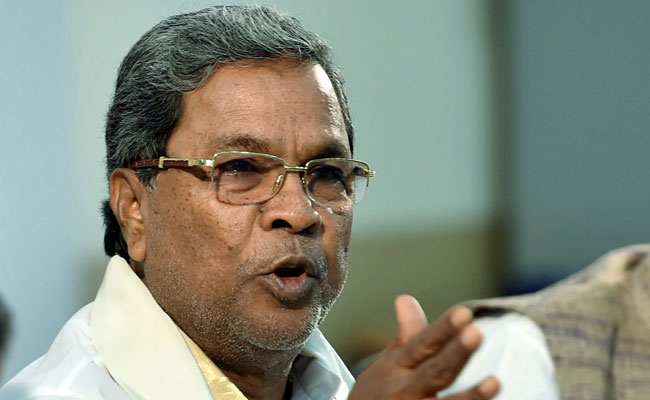
Chamarajanagara (Karnataka) (PTI): Karnataka Chief Minister Siddaramaiah on Tuesday accused the central government and its agencies of consistently targeting Congress members by using searches on their properties, and questioned why similar action is not taken against BJP leaders.
He was reacting to searches conducted by the Enforcement Directorate on Monday on several individuals, among them the sons of Karnataka Congress MLA N A Haris and the grandson of former Union Cabinet minister K Rahman Khan, in connection with a cryptocurrency-linked money laundering case.
"The central government always targets Congress leaders. Will they raid the houses of BJP leaders?" Siddaramaiah said in response to a question. More than a dozen premises in the city were searched as part of the operation carried out by the ED under the provisions of the Prevention of Money Laundering Act (PMLA).
The premises searched comprised those of Mohammed Haris Nalapad and Omar Farook Nalapad, the sons of the MLA; Aqeeb Khan, the grandson of veteran Congress leader K Rahman Khan; and an alleged crypto hacker, Srikrishna Ramesh, alias Sriki, officials said.
The money laundering case stems from Karnataka Police FIRs and charge sheets filed in a 2017 case involving the hacking of national and international websites, theft of bitcoins, and the sale of these stolen virtual digital assets (VDAs) through crypto platforms by the alleged hacker Sriki and his associates.
Mohammed Haris Nalapad, Omar Farook Nalapad, and Aqeeb Khan are alleged to be beneficiaries of the proceeds of crime generated through this crypto-linked activity, officials added.