All-woman SWAT team ready to fight terrorists in Delhi
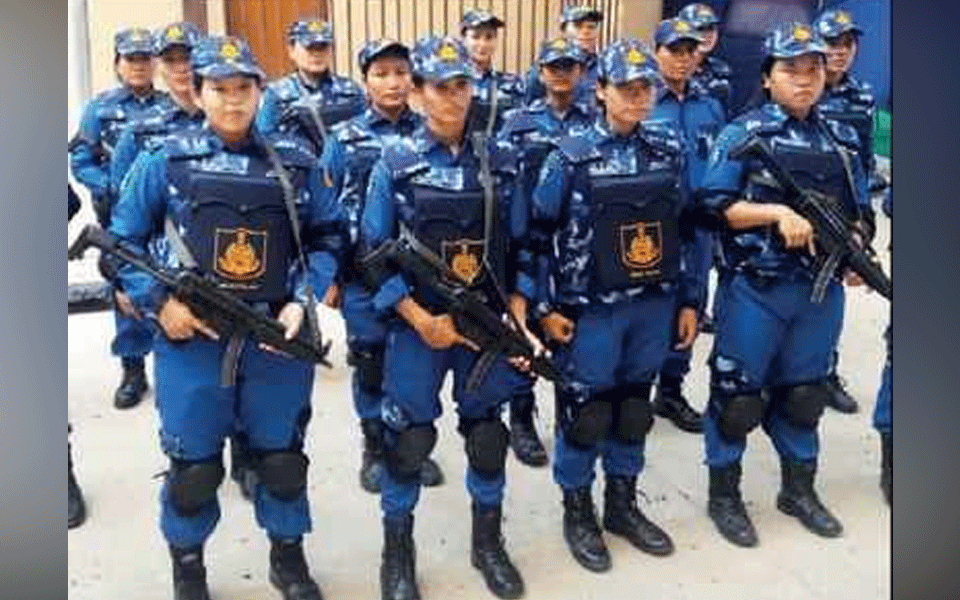
New Delhi, Aug 10 : The Delhi Police on Friday inducted an all-woman Special Weapons and Tactics (SWAT) team, consisting of 36 commandos -- the first-ever by any police force in India -- for anti-terrorist operations.
Presiding over the induction ceremony, Union Home Minister Rajnath Singh expressed happiness that the Delhi Police has raised an all-woman SWAT team and mentioned that "they will be deployed during the upcoming Independence Day celebrations".
The elite women commandos, hailing from the north-eastern states, will be deployed at strategic locations for securing the Independence Day celebrations.
"The 36 women SWAT commandos have undergone rigorous 15-month training which includes basic, commando and advanced honing of skills under the tutelage of NSG (National Security Guard) trainers. The Delhi Police has raised the commandos for anti-terrorism duty under the Special Cell unit of the force," Rajnath Singh said.
On the occasion, the Minister asked the Delhi Police to play a lead role as being the police of the national capital and advised the force to become a role model for other states and union territories' police.
"The practices adopted by Delhi Police should be among the best practices of police," he said.
Rajnath Singh also stressed upon the perceptional change of the Delhi Police, directing senior officers to go on patrolling with juniors on some occasions and motivate them to adopt a public-friendly approach while taking part in their policing activities.
On Friday, he also inaugurated the building of the offices of Deputy Commissioner of Police (South-West district), Delhi Cantt Police Station and Delhi Police residential complex and said that "construction of new complexes strengthen the basic infrastructure of the department which will lead to new energy in the personnel towards their duty, finally benefiting the citizens".
He said that the society has a lot of expectations from the Delhi Police and to meet these expectations, it needs modern working place and good working environment.
For the purpose, the Minister said the government has increased the fund allocation to Delhi Police from Rs 6,378.18 crore in 2017-18 to Rs 7,426.98 crore in 2018-19, an increase of 15 per cent.
He said the government has also sanctioned procurement of Facial Recognition System for the Crime Unit and 2,700 hand-held devices with SIM card for equipping constables with e-beatbook.
The senior Bharatiya Janata Party (BJP) leader also said that a proposal to recruit 12,000 additional personnel in the Delhi Police is under consideration, but added that the approval has been given to recruit 3,139 police personnel.
Besides, the government created 4,227 posts in the year 2016 and another 3,139 posts this year while separating the crime investigation from the law and order functions with an aim to improve the conviction rate, he said.
Lieutenant Governor Anil Baijal, Delhi Police Commissioner Amulya Patnaik and other senior officers were present on the occasion.
Let the Truth be known. If you read VB and like VB, please be a VB Supporter and Help us deliver the Truth to one and all.
Two injuries, one DNF, a DQ as India end messy World Relays campaign
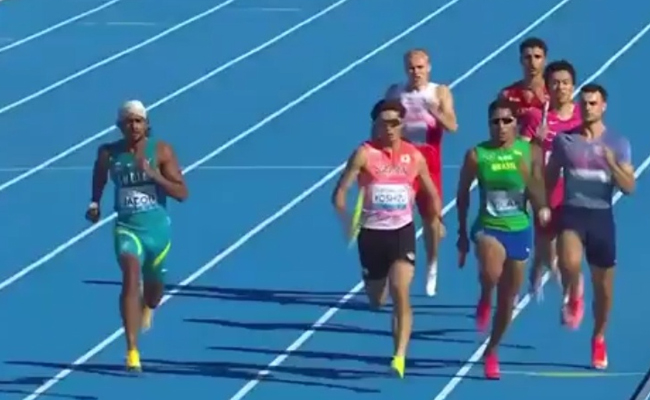
Gaborone (Botswana) (PTI): Amoj Jacob and Ragul Kumar got injured during the men's 4x400m and 4x100 races respectively as India ended their World Athletics Relays campaign in disappointment on the second day of competitions here on Sunday.
The Indian camp had high hopes of making the 2027 World Championships in the men's 4x400m relay but the team did not finish (DNF) the race as Jacob suffered cramps and pulled out of the race after taking the baton from the first leg runner Dharamveer Choudhary. Rajesh Ramesh and Vishal TK were to run in the third and fourth legs.
Those teams which could not qualify for the 2027 Beijing World Championships by reaching the final round of each of the six relay events on Saturday were given another chance in the second qualification round on Sunday.
The top two teams in each of the two heats (in all six relay events) booked the Beijing ticket on Sunday.
India will now have to try and qualify for the World Championships through the Top Lists of the World Athletics, which is a long and tedious process.
In the men's 4x100m race, third leg runner Ragul Kumar fell down the track after failing to hand over the baton inside the exchange zone to fourth leg runner Gurindervir Singh, which clearly showed the lack of coordination among the runners.
Harsh Santosh Raut and Animesh Kujur ran the first two legs.
The Indian quartet was disqualified and Kumar was seen being taken away from the Field of Play with the help of the volunteers.
It was a comedy of errors in the case of the women's 4x100m race, which saw the baton being dropped during an exchange between first leg runner Tamanna and second runner Nithya Gandhe, though the Indians finished the race in 53.09 seconds.
Gandhe started running quite a distance, but after realising that the baton was not in her hand, she turned and ran back to pick it up.
The only silver-lining for the Indian contingent was the national record time in the mixed 4x100m relay race, though the quartet of Ragul Kumar, Nithya Gandhe, Animesh Kujur and Sneha SS finished sixth in heat number two with a time of 41.35 seconds, bettering the previous national mark of 42.30 seconds set in March in Chandigarh.
The mixed 4x400m relay quartet of Theerthesh P Shetty, Kumari Saloni, Nihal William and Rashdeep Kaur ended at fifth in heat number one with a time of 3 minutes and 19.40 seconds.
On Saturday, all the five Indian relay teams had failed to make it to the respective final rounds and thus missed out on the 2027 World Championships berths.