Allahabad HC orders Uttar Pradesh govt to pay Rs 50,000 to man jailed in false anti-conversion case

Lucknow: The Allahabad High Court has imposed a fine of Rs 75,000 on the Uttar Pradesh government in a false anti-conversion case, directing the state to pay Rs 50,000 to the petitioner, Umed alias Ubaid Khan, who was jailed for one and a half months even after the alleged victim had stated before a magistrate that she had left home voluntarily.
A division bench of Justices Abdul Moin and Babita Rani passed the order on October 30 while hearing a petition filed by Khan and others, who were arrested under the Uttar Pradesh Prohibition of Unlawful Conversion of Religion Act, The Indian Express reported on Wednesday.
The petitioners had sought to quash a First Information Report (FIR) lodged at Matera police station in Bahraich district, accusing them of abducting a woman and attempting to convert her religion.
The bench ordered Khan’s release, noting that even after the woman had stated before a magistrate that she had gone to Delhi voluntarily to meet her daughter, the police continued the probe and kept the accused in custody.
“This petition is a glaring example of the state authorities failing and scrambling over each other in order to score brownie points,” the newspaper quoted the court as saying.
Describing the police action as “vexatious”, the bench ordered the state to pay Rs 50,000 to Khan and deposit the remaining Rs 25,000 with the court’s Legal Aid Services.
The case pertains to a complaint filed on September 13 by Pankaj Kumar, a resident of Bahraich, alleging that his wife had gone missing with jewellery and cash, and that five men, including Khan, had lured her away. Police booked the accused under Bharatiya Nyay Sanhita sections pertaining to kidnapping and under the state’s anti-conversion law.
The woman returned home and gave a statement, following which police added charges of criminal breach of trust, stolen property and a provision of the 2021 Prohibition of Unlawful Conversion of Religion Act. Khan was arrested on September 18.
However, on September 19, the woman gave a fresh statement before the magistrate, saying that she had left home voluntarily due to “regular domestic abuse” by her husband. In this statement, she did not allege any attempt at religious conversion and handed over all her jewellery to the police. Her lawyer later told the High Court that her earlier statement had been made under threats and coercion from her husband and in-laws, the report added.
“The court, having gone through the entire records… proceeds to exercise powers vested in it under Article 226 of the Constitution of India to quash the FIR and all consequential proceedings,” the court stated.
Let the Truth be known. If you read VB and like VB, please be a VB Supporter and Help us deliver the Truth to one and all.
VP, PM greet civil servants on Civil Services Day
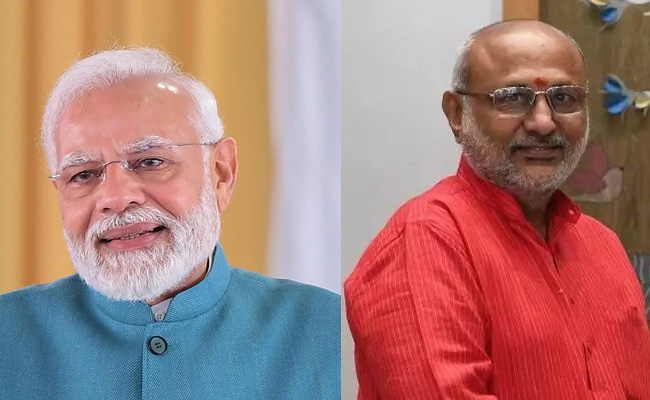
New Delhi (PTI): Vice President C P Radhakrishnan and Prime Minister Narendra Modi on Tuesday greeted civil servants on the occasion of Civil Services Day and said it is time to further strengthen the resolve to work towards good governance and nation building.
The Vice President said as the enduring pillar of India's administrative framework, the efforts of the civil servants in strengthening governance and delivering public services are of immense significance.
The prime minister said from the grassroots to policy-making, the efforts of civil servants touch countless lives and contribute to India's progress
"On the occasion of Civil Services Day, I extend my warm greetings to all civil servants and convey my sincere appreciation for your dedication and exemplary service to the nation," Radhakrishnan said in a post on X.
ALSO READ: 5.2-magnitude quake jolts Manipur
He said the theme for this year, "Viksit Bharat: Citizen-Centric Governance and Development at the Last Mile", aligns with the vision of Viksit Bharat 2047 and underscores the Government's commitment to transparent, accountable, and citizen-centric governance, with a strong emphasis on last-mile delivery and inclusive development.
"Let us all celebrate the day and continue to work collectively towards building an inclusive and developed India," he said.
The Vice President will deliver the keynote address at the Civil Services Day celebrations at Vigyan Bhawan here on Tuesday.
In his message, Modi greeted all civil servants on Civil Services Day and said this is an occasion to further strengthen the resolve to work towards good governance and nation building.
"May our civil servants continue to serve with excellence, compassion and innovation, upholding the highest standards of duty," he said.
The prime minister said service to the nation is the foundation of a 'Developed India'.
"On the glorious occasion of Civil Services Day, let us reaffirm our resolve to build a strong, prosperous, and sensitive India by bringing the person standing at the last line into the mainstream of development," he said.
The central government celebrates April 21 every year as 'Civil Services day' as an occasion for civil servants to rededicate themselves to the cause of citizen and renew their commitments to public service and excellence in work.
This date is chosen to commemorate the day when the first Home Minister of Independent India, Sardar Vallabhbhai Patel, addressed the probationers of Administrative Services Officers in 1947 in Delhi, and referred to civil servants as the 'steel frame of India'.