Any hint of dissent is frowned upon by Modi government: Shashi Tharoor
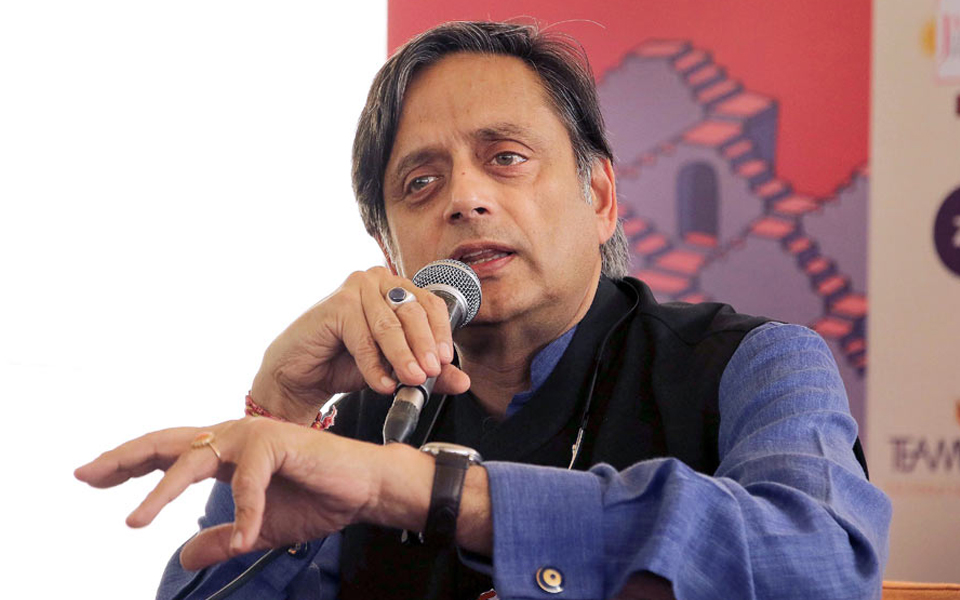
Mumbai, Sep 5 : Congress MP Shashi Tharoor, who is now actively involved in an ambitious multilingual web series based on his book 'Why I Am A Hindu", says any criticism of the current government is frowned upon nowadays.
Tharoor's next book on the four years of Prime Minister Narendra Modi's government is all set for release. Being known to be a vocal voice of dissent against the Narendra Modi government, does the author-politician foresee controversy for his new book?
He said: "Not from the readers, the people who read my books... No, they won't see anything worthy of dissent. However, I can't predict how the Government in power would react to the book.
"Nowadays, any hint of dissent is frowned upon by the government. Unfortunately, any criticism of the government's policies, no matter how healthy and just, is taken as an attack on individuals who run the Government. This was not the case when we, of the Congress (I), were in power," Tharoor said.
"Criticism of the government, was in fact, encouraged then. Now when we are in the opposition, the rules have changed," he added.
As though the erudite and articulate parliamentarian-academic didn't have enough on his plate, he has now involved in an adaptation of "Why I Am A Hindu", for which he will also turn narrator.
He says he agreed to the web series because he believed in the producer, Sheetal Talwar.
"When Sheetal Talwar came to me, I liked his conviction. He made no tall promises. But he assured me the essence of my book would be captured in the series. I have not read the screenplay yet.
"But I'm confident it will do justice to my thoughts on Hinduism. Nowadays this question of who is a real Hindu is being asked constantly. I want my thoughts on this subject to reach out a wider public than the one afforded by a book."
Tharoor, who deals simultaneously and actively with his parliamentarian duties, has also authored a large volume of fictional and non-fictional work.
"If we include the book that is coming out in the next few months, it is 17 books. I've various other duties and obligations, including an ongoing legal battle to prove my innocence in the case where I'm being made out to be the person that I am not."
Adding to his schedule is now the web series, which he says is important to him.
"There are many misconceptions about Hinduism in the current times. I am going to be the narrator for the English version of the series. A very distinguished voice will join in for the Hindi version," he said.
Cinema is one of the pleasures that Tharoor has forfeited in the pursuit of a larger good.
"In the past few years, my work as a parliamentarian and my writings have occupied a large part of my time. Then there are various other imperative pursuits.
"For these, I've given up many pleasures, including cinema and cricket. But there is no regret over these losses. I cannot be a rubber stamp politician. Politics is a tool for me to try and improve the status quo to the best of my abilities. Likewise my writing, Tharoor said.
"It is important for me to ensure the thoughts in my book on Hinduism are put out there on a platform where the optimum would be able to receive them," he added.
Tharoor's tweets are perceived as works of art, carved and polished with the most chiseled words.
Taking the compliment graciously, he said: "It's kind of you to say that. But the truth is, I don't toil over the tweets. "The medium demands brevity and one has to finish what one has to say in the shortest possible way."
In the meanwhile, there are miles and miles to go before Tharoor takes a long nap.
With the January 2014 case pertaining to the death of his wife Sunanda Pushkar ongoing against him, he admits the bandwidth of his creativity is somewhat shrunk.
"There is much more that I want to do. But current circumstances restrain me from expressing myself fully. Because of the legal issues, I am not even allowed to speak about the case," he said.
"My one reassurance in this whole situation is that the people I meet do not seem to believe in what I am being accused of. Wherever I go, I am met with the same warmth and goodwill that I experienced before," Tharoor said.
Let the Truth be known. If you read VB and like VB, please be a VB Supporter and Help us deliver the Truth to one and all.
Power bank catches fire inside stationary IndiGo plane at Chandigarh airport; all evacuated

New Delhi (PTI): The power bank of a passenger onboard a stationary IndiGo aircraft caught fire at the Chandigarh airport on Tuesday, and all passengers and the crew were evacuated, according to a source.
In a statement, the airline said that when IndiGo flight 6E 108 from Hyderabad to Chandigarh was stationary after landing, an incident involving a customer's personal electronic equipment catching fire was reported.
"In the interest of safety, an immediate evacuation was carried out, and all the relevant authorities were immediately informed. All customers have been safely moved to the terminal and are being attended to by the team to ensure their well-being," the statement said.
The source said that soon after the aircraft landed, there was smoke coming from one of the overhead bins and all onboard were evacuated.
The smoke was due to the power bank catching fire, the source said, adding that no one sustained major injuries.
Details about the number of passengers could not be ascertained.