'Artificial rain' fraud, BJP govt wants to steal Lord Indra's credit: Saurabh Bharadwaj
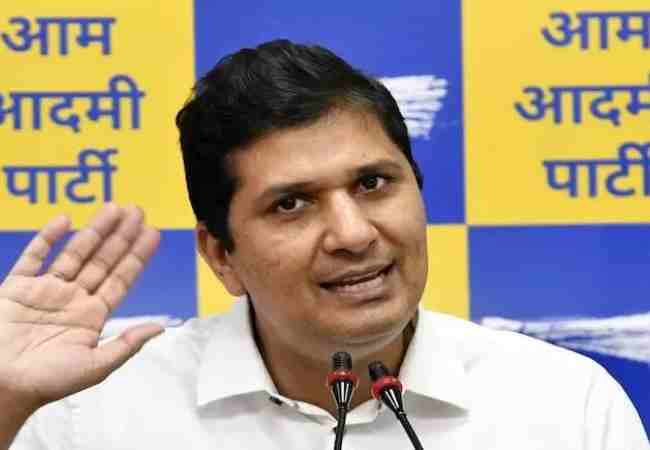
New Delhi (PTI): The Aam Aadmi Party termed the Delhi BJP government's cloud seeding experiment on Tuesday a "big fraud" and said it might attempt to steal the credit of (Hindu rain god) Lord Indra if actual rain happens.
There was no immediate reaction from the BJP.
After 53 years, Delhi conducted cloud seeding trials to induce artificial rain as pollution levels surged and the weather department ruled out any trace of rain in the horizon.
The trials were conducted in parts of the city, including Burari, north Karol Bagh, Mayur Vihar and Badli, with more such exercises planned over the next few days, according to Environment Minister Manjinder Singh Sirsa.
Chief Minister Rekha Gupta said that her government is trying out cloud seeding to see if it could solve Delhi's pollution problem.
In a statement, AAP's Delhi president Saurabh Bharadwaj said the BJP government has "committed fraud even in the name of rain".
Citing data from India Meteorological Department that confirmed no rainfall anywhere in Delhi on Tuesday, Bharadwaj said, "The BJP government is claiming to have carried out artificial rainfall, but not a single drop fell anywhere in the city."
Kondli MLA Kuldeep Kumar and Burari MLA Sanjeev Jha also confirmed that there was no rain in their constituencies.
"It seems even Lord Indra is upset with the BJP," Bharadwaj remarked, pointing out that there was no trace of rain in Central Delhi either.
He said there were news reports that said rain is forecast for the city on Tuesday.
Taking a dig at the ruling dispensation, he said that if Lord Indra indeed makes it rain, the BJP ministers will hold a press conference and claim that it was their doing.
"Lord Indra won't come down to clarify who caused the rain, so the BJP will take full advantage of it. This government can even claim credit for Lord Indra's work because after all they have to pay the contractor for the trial," he said.
Later in the day, Bharadwaj visited Central Delhi to inspect if there was rain. "Not a single drop has fallen here," he said.
"The BJP will wait for an actual shower. And the moment Lord Indra brings rain, they will steal even his credit and say 'we made it rain'. Lord Indra will bring the rain while the BJP government will foot the bill," he added.
While the AAP was in power, it had also considered holding cloud seeding trials as a measure to tackle pollution but failed to secure permissions.
Delhi Environment Minister Manjinder Singh Sirsa said, "Historical data shows that rain happens at 50 per cent humidity. If the IIT Kanpur experiment is successful, it will be historic, as rainfall would have occurred with 10-15 per cent humidity. If the (cloud seeding chemical) mixture induces rainfall, it will be the biggest solution," Sirsa added.
Let the Truth be known. If you read VB and like VB, please be a VB Supporter and Help us deliver the Truth to one and all.
Man booked for duping 7 persons of Rs 91 lakh on promise of awarding govt works

Mumbai (PTI): The Mumbai police have registered a case against a man for allegedly duping seven persons of Rs 91 lakhs on the promise of awarding them works of different government departments, an official said on Tuesday.
The accused was identified as Satish Kadam, a resident of Nanded in Marathwada region, an official said.
A complaint was filed by Hanumant Vadje, who alleged that the accused cheated him and six others of around Rs 91 lakh by promising to give them various works of Urban Development and Social Justice Department, he said.
The fraud occurred between 2024 and 2026, with Kadam collecting money in cash and into his accounts, police said, adding he had returned some amount to them partially.
Multiple cheques issued by the accused bounced, prompting the victim to lodge a complaint at the Marine Drive police station. Based on the complaint, a case of cheating and criminal breach of trust was registered against him.
The case is under further investigation, the official said.