Arun Jaitley criticises JDS, Congress for organising protest against IT searches
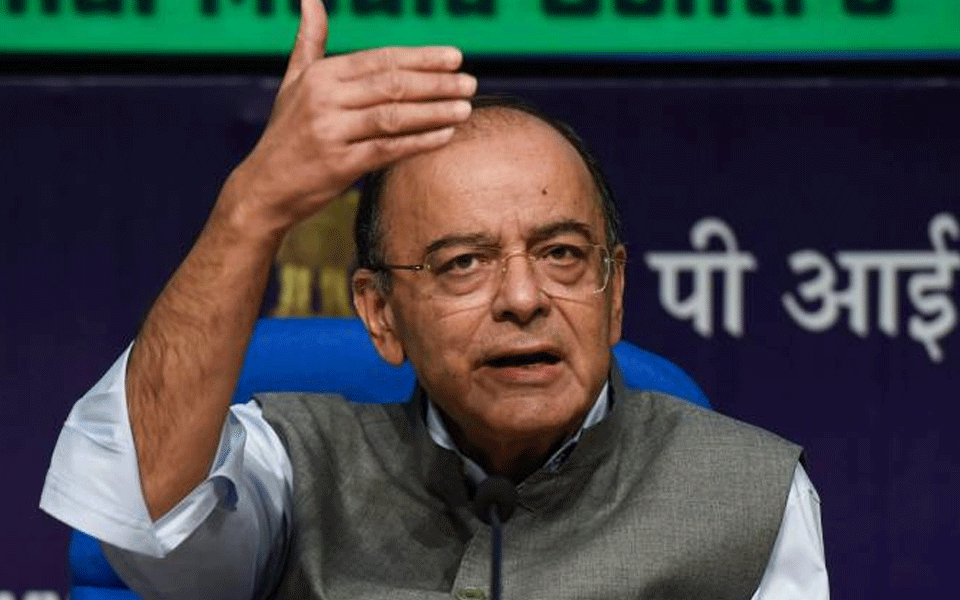
New Delhi: Finance Minister Arun Jaitley Saturday criticised JDS and Congress leaders for organising a protest outside the Income Tax Office at Bengaluru for conducting searches on PWD contractors and engineers.
Stating that the disproportionality of the reaction of the Congress and the JDS raises a needle of suspicion, Jaitley said
"If no politician has been searched, no minister has been searched, then why the protest?"
"The Bengaluru case is a text book method of the UPA on 2 fronts: use government money, round trip it through contractors and beneficiaries to enrich themselves and then lip sympathy for federalism destroying it whenever the opportunity arises. This is a very transparent self goal," Jaitley said in his blog titled 'The UPA makes corruption a cause'.
Led by Karnataka Chief Minister H D Kumaraswamy, the Congress-JDS ruling combine organised a protest in front of the Income Tax department at Bengaluru on Thursday against a statewide crackdown on his partymen and others.
Jaitley said that it was unprecedented that the chief minister of a state joined the street protest against income tax searches with a political motivation.
"The disproportionality of the reaction of the Congress and the JDS raises a needle of suspicion. Was the minister's nephew a PWD contractor to whom largesses have been given a case of nepotism? The CM and the ministers who joined the protest need to answer these questions," Jaitley said.
Even as the JDS and Congress leaders in the state alleged that ministers had been searched, the best evidence they could provide for was that the nephew' of a minister was searched, Jaitley said, adding that even the tax authorities have issued a statement saying that no MP, MLA or minister was searched.
Questioning whether states' attitude is a threat to federalism, Jaitley said federalism is not merely the rights of the states. Indian federalism entails India as a union of states .
"The rights of the union are equally important. Security of India, sovereignty, dealing with terrorism, managing the borders, custom check points, income tax enforcement are all amongst the several constitutional powers of the union.
"If the states stand in way of any of them it is guilty of breaching federal norms. Can a state barge its police into the customs area and direct the customs as to what is to be done? This would be a threat to federalism," he said.
Jaitley said many states have stopped giving police security to income tax authorities when they conduct their operations.
"Alternatively, when state police is asked for, the information is leaked out to the political government and it reaches the targets of the operations. Tax authorities increasingly have to rely on central forces. In the Kashmir valley recently, searches were conducted under the governor's rule after 17 years. These taxes are meant for the welfare of the poor in India," he added.
Let the Truth be known. If you read VB and like VB, please be a VB Supporter and Help us deliver the Truth to one and all.
EAM Jaishankar meets Jamaican PM, gifts over 10 BHISHM Cubes
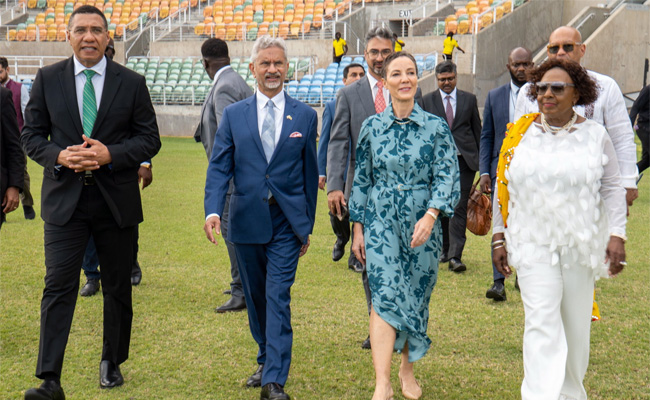
Kingston (PTI): External Affairs Minister S Jaishankar on Monday met Jamaican Prime Minister Andrew Holness and discussed ways to further deepen "political, economic and people-to-people cooperation."
Jaishankar also conveyed greetings from Prime Minister Narendra Modi to Holness.
"Pleased to call on Prime Minister @AndrewHolnessJM in Kingston. Conveyed the greetings of PM @narendramodi," Jaishankar posted on X.
"Discussed deepening our political, economic and people-to-people cooperation. Value his commitment towards further strengthening India-Jamaica relations," the post further read.
Also, the external affairs minister handed over 10 BHISHM (Bharat Health Initiative for Sahyog Hita & Maitri) Cubes as a gift to Jamaica.
"Formally handed over 10 BHISHM Cubes as a gift from India to Jamaica, in the presence of PM @AndrewHolnessJM, Health Minister @christufton and FM @kaminajsmith," Jaishankar posted on X.
"The BHISHM Cube mobile hospital system, designed for rapid deployment, will help Jamaica during disasters and emergencies. The gift of these cubes is a statement of friendship, a commitment to disaster preparedness, and an outcome of innovation," the post said.
Jaishankar arrived in Kingston on Saturday evening, marking the first leg of his nine-day tour of Jamaica, Suriname, and Trinidad and Tobago, aimed at further strengthening India's strategic and cultural ties with the Caribbean nations.
Earlier in the day, he interacted with the Indian diaspora and discussed India's ongoing transformation in infrastructure, human development and technology-driven governance and entrepreneurship with them.
He also highlighted the cricket bond between both countries as India gifted a scoreboard to Jamaica.
A scoreboard was dedicated at Sabina Park in Kingston. It is the home of the Jamaica cricket team and is the only Test cricket ground in the Caribbean island nation.
The minister expressed hope that the new scoreboard would witness many memorable innings, including those symbolising the enduring friendship between the two countries.
Cricket has long been a strong cultural bridge between India and Jamaica, which is part of the West Indies cricket team.
Jamaican players, including Chris Gayle, Courtney Walsh and Michael Holding, have played a major role in shaping the legacy of West Indies cricket in the international arena, contributing to its dominance in earlier decades and its continued global appeal.