Audit flags manipulation in Bihar Assembly polls, alleges mass disenfranchisement, data suppression
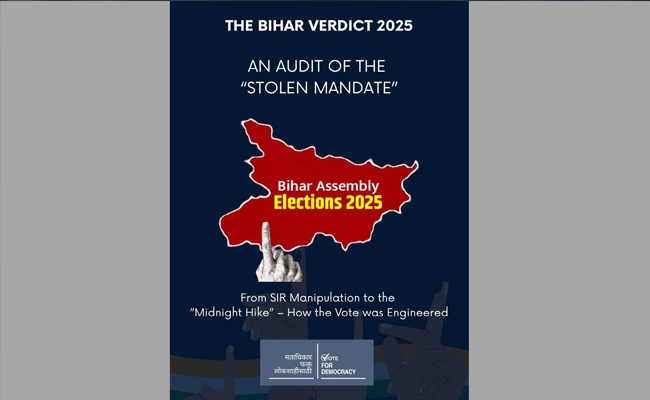
New Delhi: A detailed audit of the 2025 Bihar Legislative Assembly elections has raised grave concerns about the integrity of India’s electoral process, alleging large-scale voter disenfranchisement, opaque administrative actions and post-poll data manipulation. The report, titled The Bihar Verdict 2025, has been prepared by Vote for Democracy (VFD), Maharashtra, and is based entirely on official data released by the Election Commission of India, statutory provisions, constitutional norms and documented numerical inconsistencies.
According to the report, what unfolded in Bihar was not a series of isolated irregularities or clerical lapses, but a pattern of systemic electoral engineering that effectively hollowed out the democratic process before, during and after polling. The audit argues that the right of citizens to choose their representatives was undermined long before election day through voter roll manipulation, statistical anomalies and the withdrawal of transparency mechanisms.
The report has been authored and compiled by VFD under the guidance of former bureaucrat M. G. Devasahayam, founder of the Forum for Electoral Integrity, along with Pyara Lal Garg, Harish Karnick and Madhav Deshpande.
At the centre of the audit is the Special Intensive Revision (SIR) of electoral rolls notified by the ECI on June 24, 2025, just months before the Assembly elections. While electoral rolls undergo periodic revision, the report notes that Bihar’s rolls had already been under continuous revision since 2003, with a Special Summary Revision completed in January 2025. Despite this, a fresh and sweeping revision was undertaken without any recorded justification, disclosed empirical basis or transparent methodology.
The report contends that the timing and scale of the SIR violated statutory safeguards under the Representation of the People Act, 1950 and the Registration of Electors Rules, 1960, while also undermining constitutional guarantees under Articles 14, 19, 21, 325 and 326. It further states that the revision reversed the democratic presumption of inclusion, effectively shifting the burden onto voters to prove their eligibility through a process resembling citizenship verification, without legislative backing.
The impact, the audit says, was immediate and severe. Official ECI data shows that Bihar had 7.89 crore registered voters on June 24, 2025. By the draft roll published on August 1, the electorate had dropped to 7.24 crore, reflecting the deletion of 65.69 lakh voters. The final roll released on September 30 stood at about 7.42 crore electors. However, the report points out that only 3.66 lakh voters were ultimately found to be ineligible, making the scale of deletions nearly twenty times higher than the number justified.
One of the most striking phases occurred between July 21 and July 25, 2025, when more than 21.27 lakh voters were deleted in just three days. During this short period, 5.44 lakh voters were marked as dead, 14.24 lakh as permanently shifted, and those labelled “untraceable” increased by 809 per cent overnight. Despite the SIR being publicly justified as an exercise to remove foreigners from the rolls, the report notes that not a single foreign national was identified.
According to the audit, such figures defy administrative logic and statistical probability, suggesting bulk or algorithm-driven deletions rather than genuine field verification. It argues that the exercise amounted to mass disenfranchisement hidden within official processes.
Following public criticism, the ECI stated that it had received around 17 lakh objections or applications and carried out rectifications. However, the report documents that nearly 22 lakh entries were modified, far exceeding the number of applications claimed. Even after accounting for these corrections, the roll should have mathematically stood at around 7.38 crore voters. Instead, the final figure was declared as 7.42 crore, leaving an unexplained surplus of 3.24 lakh electors. The report notes that no reconciliation statement, independent audit or transparent explanation has been provided for this discrepancy.
The audit further highlights that voter rolls continued to change even after elections were notified, contrary to established legal convention. On October 6, 2025, the electorate stood at 7.43 crore, but by polling day it had increased to 7.46 crore. In just ten days, 3.34 lakh voters were added, including a sudden spike in young voters, which the report says is statistically impossible given eligibility timelines.
Beyond voter rolls, the report points to structural issues in election management. The number of polling booths increased sharply from 77,462 during the 2024 Lok Sabha elections to 90,740 in Bihar 2025, without a corresponding expansion in remote or riverine areas. This, the report argues, raises questions about constituency and booth-level engineering.
The Election Commission’s approach to data disclosure also came under scrutiny. Constituency-wise turnout figures and final votes polled before counting, data that had been routinely published in earlier elections were withheld. Instead, only fragmented district-level data was released, making independent verification difficult, if not impossible.
At the grassroots level, the report flags the deployment of around 1.8 lakh “Jeevika Didis” as poll volunteers. These women are beneficiaries of state welfare schemes involving cash transfers, and the report argues that their use blurred the line between welfare delivery and election administration, compromising institutional neutrality. The imbalance in Booth Level Agents further exacerbated the issue, with the ruling alliance deploying more than 91,000 agents while the opposition averaged just 1.55 agents per booth, leaving large sections of polling stations effectively unmonitored.
Polling and counting days were marked by multiple alleged violations, including CCTV failures, VVPAT slips reportedly found discarded on roads, unauthorised vehicles near strong rooms and the transportation of about 6,000 voters from Haryana via special trains, allegedly with free tickets.
The most consequential development, the audit says, came after polling had concluded. On November 12, 2025, official data recorded a uniform 0.18 per cent increase in voter turnout, identical for both men and women across phases. This so-called “midnight hike” added 1,34,145 votes and is said to have altered outcomes in around 20 constituencies. In 21 seats, victory margins ranged from zero to just 15 votes, yet no automatic VVPAT recount was ordered.
The report concludes that the Bihar election represents a new mode of electoral manipulation, carried out not through overt coercion or violence, but through administrative opacity, legal manoeuvring and control over data. It warns that what happened in Bihar is not an isolated aberration but a template that threatens the constitutional promise of universal adult suffrage.
According to the authors, when voters disappear from rolls without explanation, when official numbers fail basic arithmetic tests and when transparency is treated as expendable, the casualty is not just an election result but democracy itself.
Let the Truth be known. If you read VB and like VB, please be a VB Supporter and Help us deliver the Truth to one and all.
Manipur: Mortal remains of children killed in bomb attack handed over to family
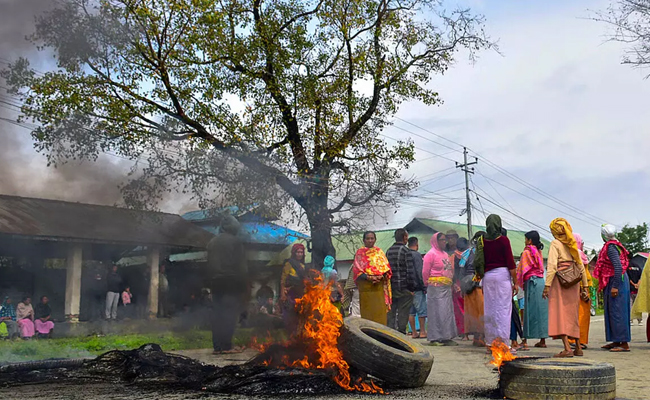
Imphal (PTI): The mortal remains of two children, who were killed in a bomb attack in Manipur's Bishnupur district in April, were handed over to family members on Saturday, officials said.
The bodies of the five-year-old boy and his six-month-old sister were kept in the morgue for 25 days, as the family members had refused to accept the mortal remains, demanding that the perpetrators be brought to book at the earliest.
On April 25, Chief Minister Y Khemchand Singh had appealed to the family members of the children to accept the bodies. Singh had also said that all efforts were underway to find the culprits.
The two children were killed in a bomb attack at Tronglaobi in Bishnupur district on April 7. Their bodies were kept in the morgue at the Regional Institute of Medical Sciences in Imphal.
The incident had triggered widespread violent protests in the five valley districts of Manipur, and the case was subsequently handed over to the NIA.
Hundreds of people lined up along the way to Tronglaobi to offer floral tributes, as the mortal remains were taken for the last rites in an open vehicle earlier in the day.