BJP government has taken over all premier institutions: Mamata Banerjee
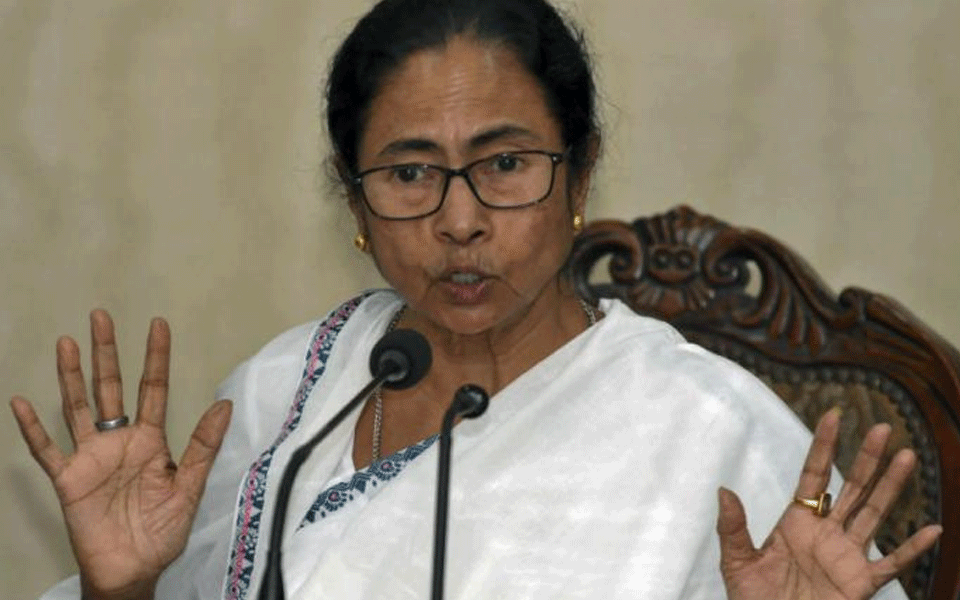
Kolkata: In an apparent reference to Prime Minister Narendra Modi's announcement of DRDO's recent space achievement, Trinamool Congress (TMC) supremo Mamata Banerjee Sunday said the BJP government has taken over all premier institutions in the country.
On March 27, the Defence Research and Development Organisation (DRDO) successfully conducted Mission Shakti, an anti-satellite missile test, from Dr APJ Abdul Kalam Island launch complex, paving the way for the country to join an elite space club comprising the US, Russia, China with such specialised capability.
Opposition parties have slammed the prime minister, saying the BJP government was trying to take credit for the DRDO's achievement.
Claiming that the people's liberty was at stake under the BJP's rule, Banerjee said "an atmosphere of fear" was prevailing in the country.
"The BJP government has taken control of all premier institutions in the country. People here live in fear. They do not have the right to speak freely under an autocratic government," the West Bengal chief minister said.
Earlier, too, the chief minister had taken a jibe at Modi, terming his announcement of the DRDO mission as "yet another limitless drama to reap political benefits" ahead of the Lok Sabha polls.
"India's Mission Programme is world-class for many many years. We are always proud of our scientists, @DRDO_India, other research & space organisations," she had tweeted, adding that "Modi, as usual, likes to take the credit for everything."
Talking to reporters at the Netaji Subhash Chandra Bose airport here before leaving for Visakhapatnam in Andhra Pradesh to participate in a Telugu Desam Party (TDP) rally, Banerjee said a "dictatorial government" is pulling the strings at the Centre using force and intimidation, "trampling democratic norms".
"Disinvestment has been done in public sector companies. Some workers are not getting salaries. The lives of farmers and labourers are under threat under the current dispensation.
"I feel that everyone will come forward, keeping aside their petty interests to collectively vote against the Modi government," said Banerjee, who has been trying to cobble up an united opposition alliance against the BJP.
The CM said she would extend her support to TDP chief Chandrababu Naidu, who pulled out his party of the NDA in March 2018, alleging injustice was being done to Andhra Pradesh by the Narendra Modi government.
"I am going to Visakhapatnam at the invitation of Chandrababu Naidu to extend my solidarity and participate in a public meeting," she said.
Giving details of her itinerary, Banerjee said she will visit Cooch Behar in north Bengal on April 4 and Assam the following day to address rallies.
In Bengal, Banerjee claimed, she would be holding as many rallies as possible over the course of the next two weeks.
"I will address nearly 100 meetings in Bengal," the Trinamool chief said.
Election to 42 Lok Sabha seats in Bengal will be held in seven phases from April 11 to May 19.
Let the Truth be known. If you read VB and like VB, please be a VB Supporter and Help us deliver the Truth to one and all.
EAM Jaishankar meets Jamaican PM, gifts over 10 BHISHM Cubes
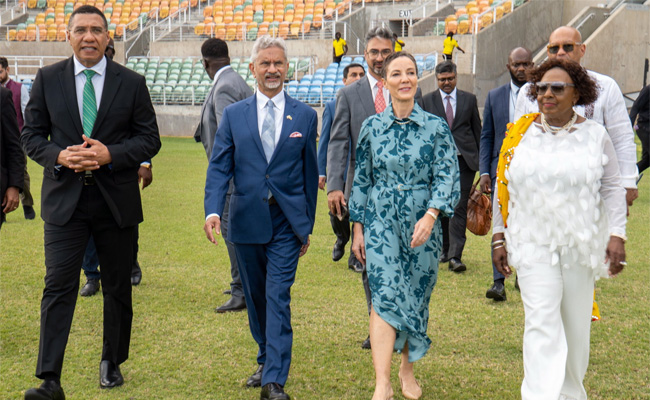
Kingston (PTI): External Affairs Minister S Jaishankar on Monday met Jamaican Prime Minister Andrew Holness and discussed ways to further deepen "political, economic and people-to-people cooperation."
Jaishankar also conveyed greetings from Prime Minister Narendra Modi to Holness.
"Pleased to call on Prime Minister @AndrewHolnessJM in Kingston. Conveyed the greetings of PM @narendramodi," Jaishankar posted on X.
"Discussed deepening our political, economic and people-to-people cooperation. Value his commitment towards further strengthening India-Jamaica relations," the post further read.
Also, the external affairs minister handed over 10 BHISHM (Bharat Health Initiative for Sahyog Hita & Maitri) Cubes as a gift to Jamaica.
"Formally handed over 10 BHISHM Cubes as a gift from India to Jamaica, in the presence of PM @AndrewHolnessJM, Health Minister @christufton and FM @kaminajsmith," Jaishankar posted on X.
"The BHISHM Cube mobile hospital system, designed for rapid deployment, will help Jamaica during disasters and emergencies. The gift of these cubes is a statement of friendship, a commitment to disaster preparedness, and an outcome of innovation," the post said.
Jaishankar arrived in Kingston on Saturday evening, marking the first leg of his nine-day tour of Jamaica, Suriname, and Trinidad and Tobago, aimed at further strengthening India's strategic and cultural ties with the Caribbean nations.
Earlier in the day, he interacted with the Indian diaspora and discussed India's ongoing transformation in infrastructure, human development and technology-driven governance and entrepreneurship with them.
He also highlighted the cricket bond between both countries as India gifted a scoreboard to Jamaica.
A scoreboard was dedicated at Sabina Park in Kingston. It is the home of the Jamaica cricket team and is the only Test cricket ground in the Caribbean island nation.
The minister expressed hope that the new scoreboard would witness many memorable innings, including those symbolising the enduring friendship between the two countries.
Cricket has long been a strong cultural bridge between India and Jamaica, which is part of the West Indies cricket team.
Jamaican players, including Chris Gayle, Courtney Walsh and Michael Holding, have played a major role in shaping the legacy of West Indies cricket in the international arena, contributing to its dominance in earlier decades and its continued global appeal.