BJP-RSS has shut doors of opportunities for poor; now they want to steal votes: Rahul in Bihar
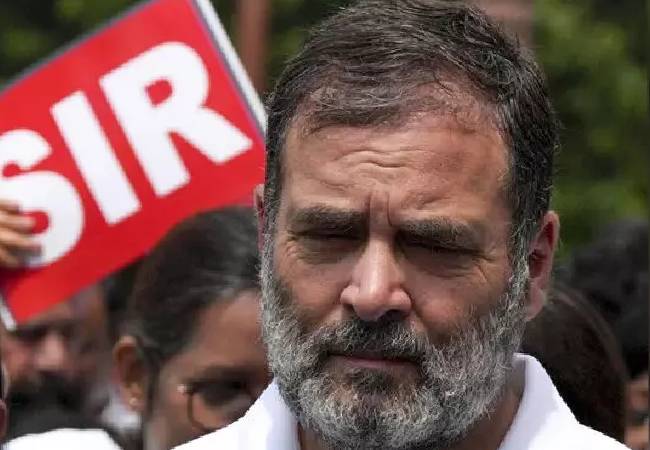
Katihal (PTI): Congress leader Rahul Gandhi on Saturday deplored "attempts to steal votes" in Bihar, ahead of upcoming assembly polls, in favour of the BJP which has allegedly "shut doors of opportunities" for the poor since coming to power at the Centre.
The Leader of the Opposition in the Lok Sabha, who has been touring the state as part of "Voter Adhikar Yatra", addressed a rally in Katihar district late in the evening.
Waving a copy of the Constitution, he said, "This book authored by Babasaheb Ambedkar may have been less than a century old, but the ideas it stands for have been around for millennia. But the BJP and the RSS are opposed to those ideas".
The BJP and the RSS believe that Dalits must not be emancipated, the extremely backward classes must not be allowed to move up the social ladder and women should not be given more freedom; and so they are hell bent upon destroying this Constitution, alleged Gandhi.
The former Congress president said, "The BJP-RSS stand for a model in which all power is concentrated in the hands of one organisation and all wealth is controlled by a few big business houses like Ambani and Adani. This has resulted in shutting of doors of opportunities for the deprived sections".
Earlier, the Dalits, the EBCs and minorities could fancy a career in the public sector undertakings and in the armed forces as a way to come out of the clutches of backwardness, but now that option is closed, he claimed.
Gandhi said that in an apparent reference to the Narendra Modi government's stress on privatisation and the introduction of Agniveer scheme a few years ago.
He also said, "Even the option of starting a business seems out of the question. Big defaulters can still get loans worth billions from banks, which would shoo away a humble entrepreneur from Bihar. These defaulters also end up getting more relief in the form of a waiver of their debt.
The Rae Bareli MP alleged that Prime Minister Narendra Modi, Union Home Minister Amit Shan and the RSS, to further their agenda, have been trying to snatch away a precious right bestowed upon the people through the Constitution.
“Every person has one vote and all votes are equal. They are trying to steal votes," he claimed.
"Votes were stolen in Karnataka, Maharashtra and Haryana. We have flagged before the Election Commission instances of hundreds of people having been shown living in the same house and lakhs of voters having been added in the electoral rolls of Maharashtra, after the Lok Sabha polls,” Gandhi said.
It appeared that all the new votes went to the BJP, in a state where we had beaten them in the Lok Sabha polls just a few months ago, he alleged.
“We shared our concerns with the EC and, upon being told that there was an unusually high turnout in the evening hours, sought CCTV footage for verification. But the laws were tweaked by the Modi government in no time to deny us the right to inspect those tapes," the Congress leader said.
"Now, attempts are being made to steal votes, in a similar fashion, in Bihar, through the special intensive revision of electoral rolls. This is the reason why we decided to carry out the Voter Adhikar Yatra. The response over the last five days has been electrifying", said Gandhi.
However, he added, the media would try to tell a different story.
“The media is controlled by people who are more interested in wasting their screen time on obscenely lavish weddings of people with deep pockets and their ostentatious lifestyles. I would request you all to do a little experiment. Just chant after me: ‘vote chor, gaddi chor’ (stealer of votes, give up power)".
After roars from the crowds reverberated through the area, Gandhi said, "Lakhs of people seem to have come here so late in the evening. But the media will not like to show these. So I want you all to stick to your guns and be aware of the forces that are arraigned against you".
Notably, this was the first instance since August 17, when the Yatra was launched at Sasaram, for Gandhi to address a rally from a make-shift stage.
The Congress leader, who has covered eight districts before reaching Katihar, a Congress stronghold, had so far been making addresses from atop his open vehicle, speaking into a hand-held mic.
Those who spoke before him included the INDIA bloc's de facto chief ministerial candidate Tejashwi Yadav, who called the BJP-led NDA a full form for "nahi denge adhikar (will deny your rights), and CPI(ML) general secretary Dipankar Bhattacharya.
Others present on the occasion included Karnataka Deputy Chief Minister D K Sivakumar, local Congress MP Tariq Anwar, and Shakil Ahmed Khan, the Congress legislative party leader whose Kadwa constituency happened to be the place where the rally was held before Gandhi left for the adjoining Purnea district.
Let the Truth be known. If you read VB and like VB, please be a VB Supporter and Help us deliver the Truth to one and all.
West Bengal exit polls: People’s Pulse projects TMC lead, others predict BJP surge
Kolkata: Exit polls for the West Bengal Assembly Election 2026 have shown different projections, with some surveys indicating a lead for the All India Trinamool Congress (TMC), while others suggest an advantage for the Bharatiya Janata Party (BJP).
According to People’s Pulse, the TMC+ alliance is projected to win between 177 and 187 seats in the 294-member Assembly.
The BJP is estimated to secure between 95 and 110 seats, while the Left Front+ is predicted to win up to one seat. The Congress (INC) is likely to get between one and three seats, and others are projected to win between one and two seats.
Matrize projections indicate a different trend, with the BJP projected to win between 146 and 161 seats, crossing the majority mark of 148, with a vote share of 42.5 per cent. The TMC is estimated to win between 125 and 140 seats with a vote share of 40.8 per cent.
P-MARQ has also projected a BJP lead, estimating the party to win between 150 and 175 seats, while the TMC+ alliance is expected to secure between 118 and 138 seats. The same survey projects Congress to win between 2 and 6 seats.
Poll Diary estimates suggest the BJP may win between 142 and 171 seats, while the TMC could secure between 99 and 127 seats. Other parties are projected to win between 5 and 9 seats.
Chanakya Strategies has projected the BJP to win between 150 and 160 seats, while the TMC is estimated to get between 130 and 140 seats. Others are expected to secure between 6 and 10 seats, while Congress and Left are projected at zero.
ABP projections estimate the BJP to win between 146 and 161 seats, while the TMC is expected to secure between 125 and 140 seats. Others are projected to win between 6 and 10 seats.
Polls in the state were held in two phases on April 23 and 29, and the counting of votes is scheduled to take place on May 4.