BJP's Comical Charts on Fuel Price Hikes Show How Difficult it is to Defend High Oil Taxes

New Delhi: John Cowperthwaite, the British civil servant who helped create Hong Kong’s free-market economy, believed that governments should never collect statistics, on the off chance that they be twisted and used by authorities to call for excessive state interference.
Would Cowperthwaite have been proud of the Bharatiya Janata Party, which on Monday used questionable graphs and charts to imply that Prime Minister Narendra Modi’s government doesn’t need to act on skyrocketing fuel prices because things were supposedly worse under the previous governments?
On Monday evening, the BJP’s Twitter handle put out a series of four charts, all of which were titled “Truth of Hike in Petroleum Prices”.

The first of these charts – all of them are broadly similar – is quite confusing. The graph, which at first glance appears to be a bar chart of petrol prices, obeys no clear sense of scale. Even though the price of petrol on September 10, 2018 (Rs 80.73) is higher than what it was in May 2014 (Rs 71.41), the chart makes it looks like 71 is higher than 80.
In the second graph (on the right), 72.83 (September 2018) looks smaller than 30.86
If you go by the title of the charts and reckon that it’s only supposed to depict the percentage increase in petrol prices, it still makes little sense. What are the first bars, the price of petrol/diesel in May 2004, supposed to represent? There’s nothing to indicate how much the first bar is worth in terms of year-on-year percentage increase.
Furthermore, in the first graph, the 13% increase is depicted as a strangely steep drop while the 75.8% increase between 2009 and 2014 looks only slightly bigger than the 20.5% increase between 2004 and 2009.
These confusing graphs not only fail to get their point across, but instead provoked a wave of jokes and memes on Twitter.
Since this is not yet a bell curve, I would propose a no-bell prize. https://t.co/pOBKxrdIkd
— Deepak Shenoy (@deepakshenoy) September 10, 2018
This graph will only make sense to those who understand entire Political Science or Entire Mathematics. https://t.co/Ky8wo8KkKO
— Caralisa Monteiro (@runcaralisarun) September 10, 2018
Even Modi is like kya yaar... https://t.co/0h2Gw2aakJ
— #RebuildKerala (@sidin) September 10, 2018
Missing international prices
The point that the BJP wants to make, however, is clear – even if its chart was the completely wrong way to do it. As the Congress and various opposition parties protest rising prices, the BJP wanted to say that the increase in prices of petrol and diesel over the past four years hasn’t been as bad as the increase between 2009 and 2014.
While seemingly fair, there are two fundamental flaws with this argument. First, it goes against the grain of the Modi government’s stated defence of rising fuel prices. In the past week, the Centre has claimed that factors beyond its control have contributed to the rise; namely global oil prices. This then begs the question: if global oil prices are the problem, how can it point a finger towards previous governments and blame them for a bigger price rise?
Secondly, what the BJP wants to ignore is the role that taxes levied by the Centre play in determining the final retail price of petrol and diesel in India. In response to the BJP’s charts, the Congress pointed out the obvious: namely that international crude oil prices are still roughly 70% of what they were back before the Modi government assumed power in 2014.
What explains the difference? Central and state taxes on petrol and diesel.
There! Fixed it for you @BJP4India#MehangiPadiModiSarkar pic.twitter.com/kbKBjUi0M7
— Congress (@INCIndia) September 10, 2018
This is an issue that The Wire has extensively reported on and analysed. In short, in India, depending on which state you live in, taxes currently make up anywhere between 45%-52% of the retail price of petrol and diesel. After the Modi government assumed power, international oil prices plunged, but the taxes remained the same (and were later hiked). Consequently, the Centre’s tax revenues from petroleum products rose from Rs 99,000 crore in 2014-15 to over Rs 2 lakh crore in 2017-2018.
Between 2014-15 and 2015-16, the Centre hiked excise duty on auto fuels nine times. Excise duty on petrol and diesel was Rs 9.48 and Rs 3.56 a litre respectively before the Modi government took office. However, through repeated hikes, it jacked up duty to Rs 21.48 and Rs 17.33 a litre, an increase of 226% and 486% respectively over the May 2014 level. This even though global oil prices fell from above $100 a barrel in 2014 to around $40 by early 2015.
What has sparked the current political debate around rising fuel prices is that since late 2017 , the price of Brent crude has steadily risen back up to $78 a barrel, which has in turn put a spotlight on the Modi government’s practice of high oil taxes.
The oil-tax windfall that the Modi government reaped has gone a long way in bridging India’s fiscal deficit. Unfortunately, this no longer seems tenable with a plunging rupee and rising global prices.
The oil conundrum that the Centre currently faces – on whether it should cut excise duties and risk breaching its fiscal deficit target – has given rise to the BJP’s questionable narratives surrounding high oil taxes.
Crumbling defences
Infrastructure argument: In May 2018, when fuel prices started rising, several senior central government ministers stated that keeping higher oil taxes allowed the Modi government to invest in infrastructure. For instance, law minister Ravi Shankar Prasad stated that the Centre’s high excise duties on fuel were not cruel but had instead helped fund India’s development by allowing the government to build highways, dams, electrical grids and optical fibre networks.
“So tax on fuel is linked with developmental issues. We understand that there is a compelling need for a long-term solution, structured solution (to deal with the present situation),” Prasad said.
However, as The Wire and other estimates have noted, an analysis of the Centre’s oil-tax gains show that it wasn’t funneled into capital expenditure spending (i.e., on infrastructure) but was instead mostly spent on shoring up revenue expenditure. By doing so, the quality of India’s fiscal deficit actually deteriorated in 2016-17.
State tax argument: Another defence put forth by the Modi government and the BJP is that state governments across the country need to take steps and reduce their own taxes on petroleum products. States in India charge taxes using ad valorem rates which means they reap windfall gains due to a price rise. While this argument is true, it is also hypocritical. The Centre has also reaped a windfall gain through excise duties so it can’t blame states for doing the same.
The Modi government also forgets that 22 of the 29 state governments in India are run by the BJP or its allies. It would be ideal if the party asked its state governments to walk the talk.
The only state governments that have taken steps to reduce the price of fuel so far are Kerala, which has reduced petrol and diesel prices by Re 1 per litre, and Rajasthan, which cut VAT to bring prices down by Rs 2.5 a litre.
Maharahstra, which has the highest effective valued-added tax (VAT) on petrol hasn’t taken any concrete steps although chief minister Devendra Fadnavis has promised to consider taking steps in the future.
Consumption argument: Closely on the heels of its odd charts and graphs is another bizarre argument being put forth that India’s citizens need to consume less petrol. Rajasthan’s state minister Rajkumar Rinwa on Monday, perhaps in response to the Congress’s Bharat Bandh, stated that Indians needed to take a hit for national interest.
“People do not understand the fact that when prices of crude oil increase, they should reduce their expenditure. In other countries, there is a national character, and people cut down their consumption,” Rinwa said.
While this narrative is not popular, it is an indication of how difficult it is becoming for the Modi government to justify high oil taxes and adhering to a strict fiscal deficit target in the face of rising petrol and diesel prices.
courtesy : thewire.in
Let the Truth be known. If you read VB and like VB, please be a VB Supporter and Help us deliver the Truth to one and all.
CM Siddaramaiah alleges ‘criminal conspiracy’ in Sringeri recount, vows legal action
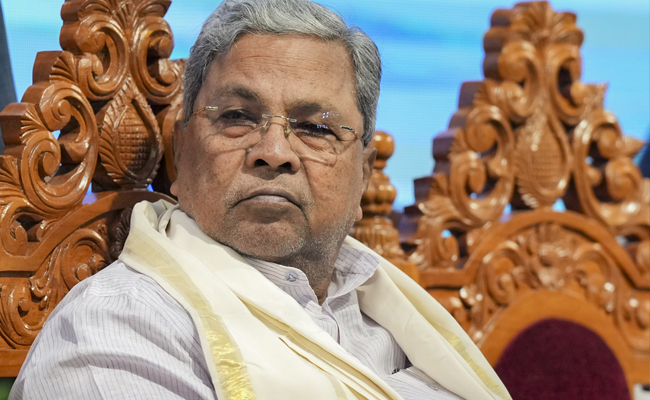
Bengaluru (PTI): Alleging a “criminal conspiracy” by BJP candidate D N Jeevaraj in the Sringeri Assembly poll recounting, Karnataka CM Siddaramaiah on Tuesday said the outcome was manipulated after valid postal ballot votes in favour of Congress leader T D Raje Gowda were tampered with during the recounting process.
Following a Karnataka High Court order on an election petition filed by Jeevaraj, challenging Raje Gowda’s election, the reverification and recounting were conducted on Saturday.
After the reverification and recount of postal ballots for the Sringeri Assembly constituency, votes polled in favour of Raje Gowda were reduced by 255, the returning officer said.
A report on the matter has been submitted to the Election Commission of India for further action, the officer added.
Congress leader Raje Gowda had won the 2023 Assembly polls from Sringeri by 201 votes, defeating his nearest rival Jeevaraj.
Addressing a press conference in Bengaluru, Siddaramaiah said the High Court had directed the recounting of postal ballots and that irregularities were noticed during the exercise conducted on May 2.
“This is a clear case of criminal conspiracy,” Siddaramaiah said, alleging that valid votes cast in favour of Raje Gowda were altered after being accepted by counting agents of all parties, including Congress, BJP, and JD(S).
He claimed that during the recounting of postal ballots, 255 votes were initially accepted as valid by all agents but were later tampered with by subordinate officials.
“There is a second mark on the votes polled in favour of Raje Gowda. They had accepted these as valid votes. Subsequently, another mark was made by officials. This is a clear case of criminal conspiracy,” he said.
When asked who was behind the alleged conspiracy, the CM replied, “It was hatched by Jeevaraj and others. It is planned.”
Siddaramaiah further alleged that the returning officer acted improperly by declaring the result despite the presence of an Election Commission observer during the recounting.
“Immediately after the counting, the returning officer announced the result. He should not have done so; this is against the law,” he said.
He pointed out that Raje Gowda had originally won by 201 votes, but after the recounting, the BJP candidate was declared the winner by 52 votes.
“The BJP has committed a criminal act of conspiracy. This is not vote chori but vote dacoity,” he alleged.
The CM said a police complaint had already been filed by Raje Gowda’s election agent, Sudhir Kumar, and emphasised the need for electoral integrity.
“We want transparency and free and fair elections. That is what our Constitution mandates,” he added.
Stating that the government would pursue legal remedies, Siddaramaiah said, “We are preparing an appeal challenging the returning officer’s announcement in a court of law.”
Responding to a separate query on elections in other states, the CM said there appeared to be an anti-incumbency factor in West Bengal, while results in Tamil Nadu were “surprising,” adding that Vijay’s party was emerging as the largest there.
Following the victory of party candidates in Bagalkote and Davanagere South, Siddaramaiah expressed confidence about future electoral prospects in Karnataka.
“Even in 2028, we will win the Assembly elections. We will come back,” the CM said.
Siddaramaiah added that he would order a forensic examination into the alleged tampering of postal ballots.