Budget to be tabled in WB Assembly on Wednesday, focus likely on social welfare, women empowerment

Kolkata (PTI): The Trinamool Congress government is all set to present on Wednesday its last full-fledged budget before the 2026 assembly elections, with a strong emphasis likely on social welfare and women empowerment.
Minister of State for Finance (independent charge) Chandrima Bhattacharya will table the state budget for the 2025-26 fiscal in the assembly in the evening.
With the elections just a year away, the Mamata Banerjee-led government is expected to roll out a host of populist measures aimed at consolidating the party's support base.
Party sources indicated that key welfare schemes such as 'Lakshmir Bhandar', a direct cash transfer programme for women, and 'Banglar Bari', a housing initiative, will receive increased allocation.
"The finance department is considering an enhancement in allowances under Lakshmir Bhandar," a senior TMC leader told PTI.
Last year, the scheme saw an additional allocation of Rs 12,000 crore, raising the monthly allowance to Rs 1,000 for general category women and Rs 1,200 for SC and ST women.
With women voters playing a crucial role in the state's electoral dynamics, the government is likely to further expand the scheme.
Apart from direct financial assistance, the budget is also expected to prioritise infrastructure development, healthcare, education, and employment generation.
A possible hike in the dearness allowance (DA) for state employees is also on the cards, sources said.
West Bengal had 3.73 crore registered women voters in the 2024 Lok Sabha elections.
Political analysts suggested that the TMC's continued focus on women-centric welfare programmes is a strategic move to retain this crucial voter base, especially amid recent controversies such as the RG Kar hospital rape-murder case.
In the previous budget, the state saw an allocation of Rs 3.67 lakh crore, up by 8 per cent from the 2023-24 financial statements.
With an estimated Gross State Domestic Product (GSDP) growth of 7.6 per cent in the 2023-24 fiscal, the government aims to position this budget as a reflection of its commitment to social welfare and economic stability.
As the assembly session convenes on Wednesday, all eyes will be on Bhattacharya's budget speech, which could set the tone for the TMC's electoral campaign ahead of 2026.
Let the Truth be known. If you read VB and like VB, please be a VB Supporter and Help us deliver the Truth to one and all.
TN Governor should invite Vijay to form govt, then prove majority: Former MP Prakash Ambedkar
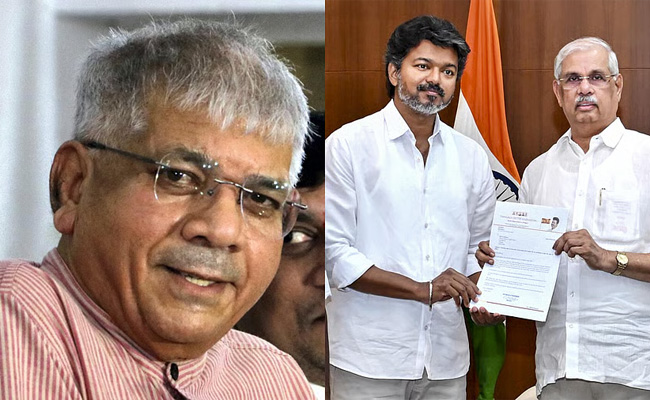
Mumbai: Senior politician and constitutional expert Prakash Ambedkar has opined that Tamil Nadu Governor Rajendra Arlekar should invite the Tamilaga Vettri Kazhagam President Vijay to form the government as his party emerged as the single largest party in the Assembly elections.
Ambedkar, who is a Mumbai-based advocate, activist and also the grandson of Dr. BR Ambedkar, is a former Parliamentarian.
Citing articles from the Constitution and similar incidents in the political history of the nation, Prakash Ambedkar has explained why Vijay cannot be stopped from forming the government in Tamil Nadu, reports Deccan Herald.
“Merely doubt over whether the TVK has the necessary number cannot suffice to withhold the invitation to the party to form the government. The Governor should invite Vijay, President of TVK, the single-largest party, to form the government and assume office as the next Chief Minister. After taking charge, as per the Article 164 (2) of the Constitution, Vijay will have to prove that his government has a majority in the House,” Ambedkar explained.
He also gave examples from India’s political history supporting his argument.
Ambedkar cited the example of the 1989 Lok Sabha elections and said that, although the Congress (I) emerged the single-largest party with 194 seats, Rajiv Gandhi declined the invitation by President R Venkataraman to form the government. “My friend Vishwanath Pratap Singh, leader of the National Front, was then invited and sworn in as Prime Minister on December 2, 1989,” he added.
He then recalled the 1996 elections to the Lower House of the Parliament, when the BJP emerged the single-largest party, but the Parliament was hung as the BJP lacked a majority. “Atal Bihari Vajpayee was invited by President Shankar Dayal Sharma to form the government and was sworn in as Prime Minister. Vajpayee resigned 13 days later on May 28, 1996, after failing to secure majority support in the Lok Sabha,” Ambedkar explained.