CAG must audit how policies benefited private firms: Cong on fuel excise duty hike under Modi govt
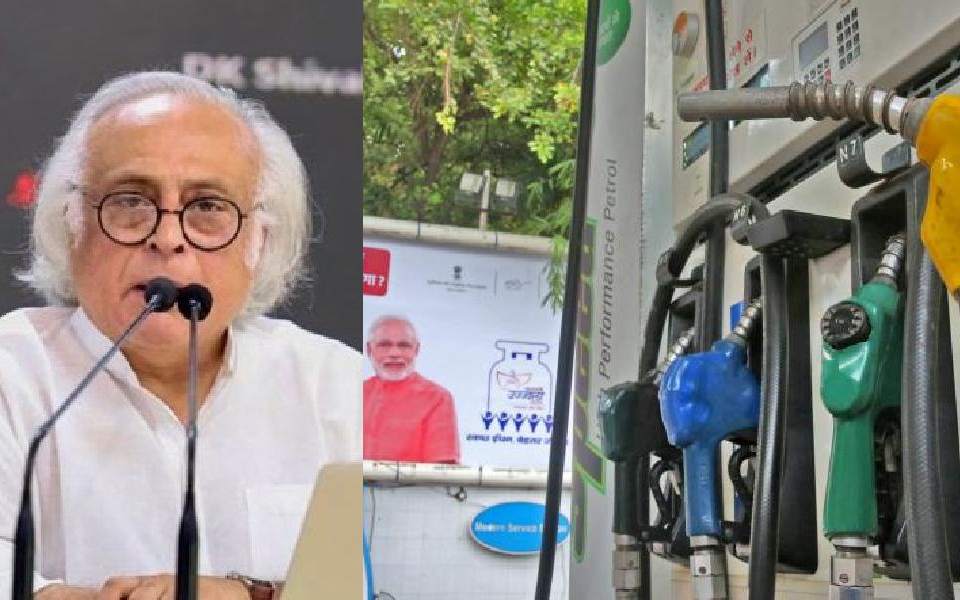
New Delhi, Apr 13 (PTI): Accusing the government of "looting" people by increasing excise duty on petrol and diesel, the Congress on Sunday called for fixing accountability and demanded that the CAG should audit how government policies benefited private companies.
The opposition party also demanded that the Central Vigilance Commission (CVC) and Central Bureau of Investigation (CBI) should investigate whether there was deliberate negligence or collusion in this.
Congress general secretary in-charge communications Jairam Ramesh in a post on X said, "The people of India are being looted — on one hand the Modi government is increasing the tax burden and picking people's pockets, while on the other hand private and government oil companies are making profits! This is open economic exploitation!''
"The truth is: In May 2014, the excise duty on petrol was Rs 9.20 and on diesel Rs 3.46. Which is now Rs 19.90 on petrol and Rs 15.80 on diesel in the Modi government — an increase of 357% and 54%!" he said in his post in Hindi.
The Congress leader claimed that the government earned Rs 39.54 lakh crore from the petroleum sector in the last eleven years, yet it did not give any relief to people.
"In May 2014, crude oil was USD 108/barrel, today it is only USD 65.31 — i.e. 40% cheaper, yet the prices of petrol and diesel are higher than the UPA era," Ramesh said.
"In 2014, petrol in Delhi was Rs 71.41 and diesel Rs 55.49 per liter. Today the same petrol is Rs 94.77 and diesel Rs 87.67 per liter — the public is being openly looted. Who is benefiting?" he asked.
The Congress leader said along with government companies, the private oil companies are also earning huge profits from refining and marketing, while the common man is burdened with expensive petrol and diesel.
"The issue is serious! CAG should audit how the government policies benefited these private companies. CVC and CBI should investigate whether there was deliberate negligence or collusion in this?" Ramesh said.
"Public money needs to be accounted for — accountability must be fixed," he asserted.
The Congress general secretary shared a media report, which stated that oil firms were benefiting big time but now lowering prices for people.
The Congress had last week taken a swipe at the government over the hike in excise duty on petrol and diesel, with Rahul Gandhi stating Prime Minister Narendra Modi finally gave a befitting reply to "tariffs".
Gandhi had also said that people suffering from inflation had been given another gift of "government loot".
The government hiked excise duty on petrol and diesel by Rs 2 per litre each. The excise duty on petrol was hiked to Rs 13 per litre and that on diesel to Rs 10 a litre.
भारत की जनता लूटी जा रही है — मोदी सरकार द्वारा एक तरफ़ टैक्स का बोझ बढ़ाकर जहां जनता की जेब काट रही है, वहीं दूसरी तरफ़ प्राइवेट व सरकारी तेल कंपनियां मुनाफ़ा कमा रही हैं!
— Jairam Ramesh (@Jairam_Ramesh) April 13, 2025
यह खुला आर्थिक शोषण है!
सच्चाई यह है :
1. मई 2014 में पेट्रोल पर एक्साइज ड्यूटी ₹9.20 और डीज़ल पर… pic.twitter.com/1JAYmNVUa7
Let the Truth be known. If you read VB and like VB, please be a VB Supporter and Help us deliver the Truth to one and all.
CM Siddaramaiah alleges ‘criminal conspiracy’ in Sringeri recount, vows legal action
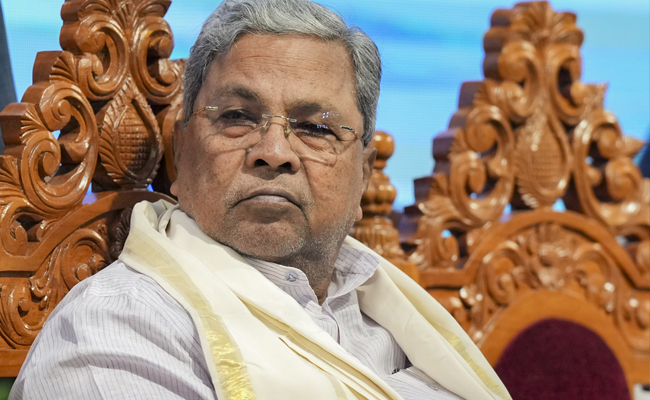
Bengaluru (PTI): Alleging a “criminal conspiracy” by BJP candidate D N Jeevaraj in the Sringeri Assembly poll recounting, Karnataka CM Siddaramaiah on Tuesday said the outcome was manipulated after valid postal ballot votes in favour of Congress leader T D Raje Gowda were tampered with during the recounting process.
Following a Karnataka High Court order on an election petition filed by Jeevaraj, challenging Raje Gowda’s election, the reverification and recounting were conducted on Saturday.
After the reverification and recount of postal ballots for the Sringeri Assembly constituency, votes polled in favour of Raje Gowda were reduced by 255, the returning officer said.
A report on the matter has been submitted to the Election Commission of India for further action, the officer added.
Congress leader Raje Gowda had won the 2023 Assembly polls from Sringeri by 201 votes, defeating his nearest rival Jeevaraj.
Addressing a press conference in Bengaluru, Siddaramaiah said the High Court had directed the recounting of postal ballots and that irregularities were noticed during the exercise conducted on May 2.
“This is a clear case of criminal conspiracy,” Siddaramaiah said, alleging that valid votes cast in favour of Raje Gowda were altered after being accepted by counting agents of all parties, including Congress, BJP, and JD(S).
He claimed that during the recounting of postal ballots, 255 votes were initially accepted as valid by all agents but were later tampered with by subordinate officials.
“There is a second mark on the votes polled in favour of Raje Gowda. They had accepted these as valid votes. Subsequently, another mark was made by officials. This is a clear case of criminal conspiracy,” he said.
When asked who was behind the alleged conspiracy, the CM replied, “It was hatched by Jeevaraj and others. It is planned.”
Siddaramaiah further alleged that the returning officer acted improperly by declaring the result despite the presence of an Election Commission observer during the recounting.
“Immediately after the counting, the returning officer announced the result. He should not have done so; this is against the law,” he said.
He pointed out that Raje Gowda had originally won by 201 votes, but after the recounting, the BJP candidate was declared the winner by 52 votes.
“The BJP has committed a criminal act of conspiracy. This is not vote chori but vote dacoity,” he alleged.
The CM said a police complaint had already been filed by Raje Gowda’s election agent, Sudhir Kumar, and emphasised the need for electoral integrity.
“We want transparency and free and fair elections. That is what our Constitution mandates,” he added.
Stating that the government would pursue legal remedies, Siddaramaiah said, “We are preparing an appeal challenging the returning officer’s announcement in a court of law.”
Responding to a separate query on elections in other states, the CM said there appeared to be an anti-incumbency factor in West Bengal, while results in Tamil Nadu were “surprising,” adding that Vijay’s party was emerging as the largest there.
Following the victory of party candidates in Bagalkote and Davanagere South, Siddaramaiah expressed confidence about future electoral prospects in Karnataka.
“Even in 2028, we will win the Assembly elections. We will come back,” the CM said.
Siddaramaiah added that he would order a forensic examination into the alleged tampering of postal ballots.