Cases with court-monitored probe showed better outcome: Supreme Court judge
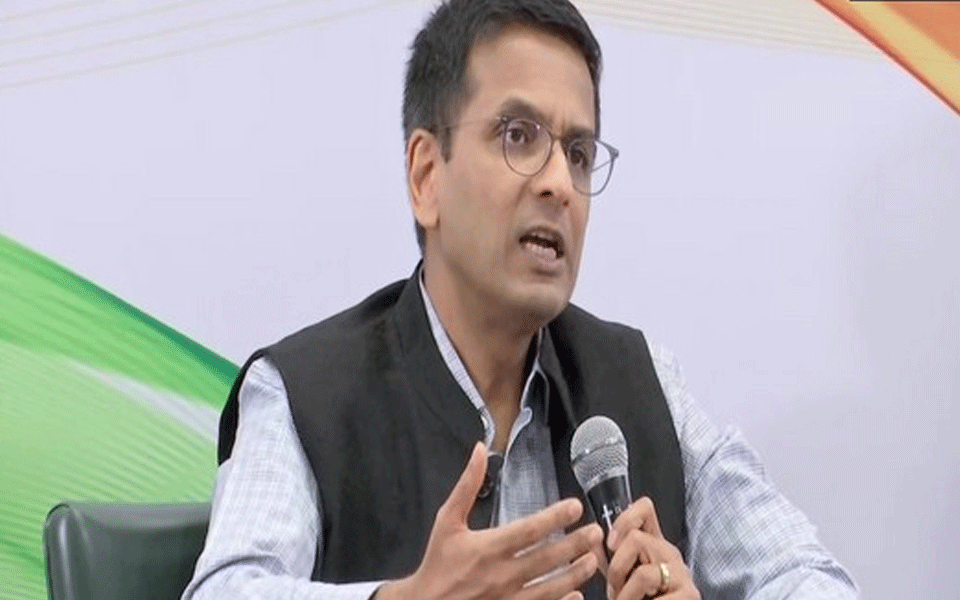
Mumbai: Cases in which probe was being monitored by courts have shown a better outcome, Justice Dhananjaya Chandrachud has said, while making an observation regarding the acquittal of all the accused in the Pehlu Khan lynching case.
"We see this repeatedly... This is one of the great torments of being a judge to have to decide on the basis of evidence as it stands," the Supreme Court judge said at an event here on Saturday.
"And then you find the investigation by the police has been woefully inadequate either deliberately or just as a matter of incompetence, that it is going to result in acquittal," he said when asked about the acquittals in the case.
All six accused in the Pehlu Khan lynching case were acquitted last Wednesday by a court in Rajasthan after getting the benefit of doubt due to "serious shortcomings" in the police probe.
"Cases where courts have been approached at an appropriate stage and have been able to monitor (the) investigation have perhaps shown better outcome," Justice Chandrachud said.
He cited the example of the Kathua rape-murder case, where the apex court had taken a number of steps to ensure the investigation was not "deflected".
The top court judge, however, added there were limitations to the number of cases that could be monitored by courts.
Delivering a lecture on 'Imagining Freedom through Art', Justice Chandrachud said freedom had become an avenue to spew venom on those who think, speak, eat, dress and believe differently.
"The danger lies when freedom is suppressed -- whether by the state, by the people or even by art itself," he said. "Ironically, a globally-networked society has rendered us intolerant of those who don't come conform."
"We are facing a world of intolerance where art is suppressed, defaced or co-opted," Justice Chandrachud said, adding that art grants voice and narratives to the oppressed communities, and resists the majoritarian hegemony.
"Art invites us to explore the crevices of our mind, instigating self reflection on how we as individuals can make our society a better and kinder place," he added.
Let the Truth be known. If you read VB and like VB, please be a VB Supporter and Help us deliver the Truth to one and all.
11k litres of milk poured into Narmada river after religious event; environmentalists see red
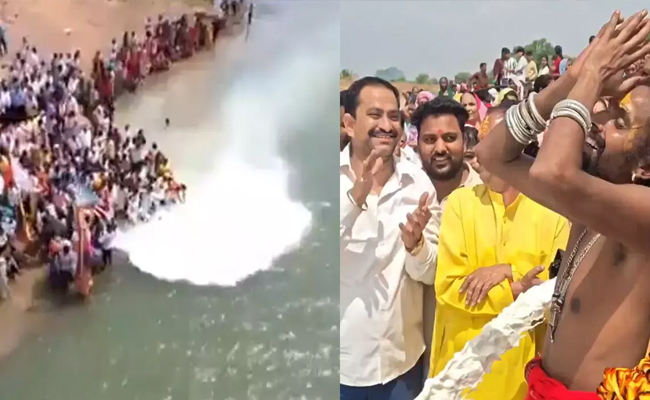
Sehore (PTI): Around 11,000 litres of milk were poured into Narmada river, often called the lifeline of Madhya Pradesh, in Sehore district on the culmination of a 21-day religious event as part of a sanctification ritual, prompting environmentalists to flag its negative impact on the ecosystem.
The event concluded at Satdev village in Bherunda area, located about 90 km from the district headquarters, with a 'mahayagna' on Wednesday.
The milk was offered to the river as part of rituals and prayers for the purity of the waters, the well-being of pilgrims and prosperity, organisers said.
The milk was brought in tankers to the riverbank and later poured into the flowing water amid chanting of mantras in the presence of a crowd of devotees.
However, environmentalists raised concerns over the practice, warning of its potential ecological impact.
"Such large quantities of organic matter can deplete dissolved oxygen in water, adversely affecting the river ecosystem. These impact local communities dependent on the river for drinking water and threaten aquatic life as well as domestic animals," noted environmentalist and wildlife activist Ajay Dube said.
Religious offerings should be symbolic and mindful, he asserted.
Renowned environmentalist Subhash Pandey said 11,000 litres of milk acts as a significant organic pollutant.
"It is highly oxygen-demanding and can lead to oxygen depletion, aquatic mortality, eutrophication (process of plants growing on river surface) and loss of potability. These effects are predictable from dairy-effluent chemistry and have been documented in similar incidents worldwide," Pandey pointed out.
Narmada originates at Amarkantak in the state and traverses 1,312 km westward to Maharashtra and Gujarat, emptying into the Arabian Sea via the Gulf of Cambay.
It is the largest west-flowing river in the peninsula, passing through a rift valley, and acts as a crucial water source for irrigation in MP, Gujarat and Maharashtra.