CBI faces flak over unprofessional wanted ad: ‘Ball’ instead of ‘bail’, unclear photos raise eyebrow
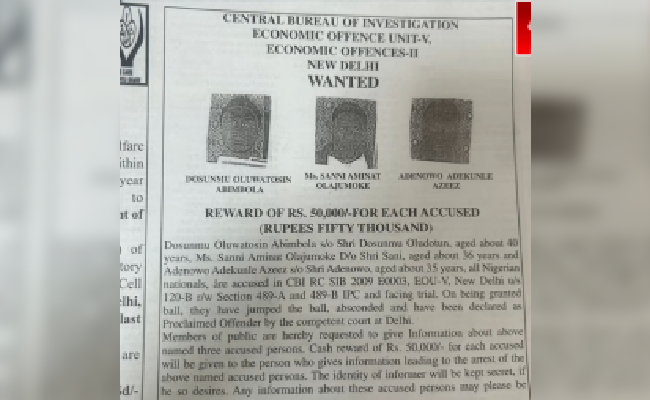
New Delhi: India’s premier investigative agency, the Central Bureau of Investigation (CBI), is under criticism after the release of a public advertisement seeking information about three wanted accused in a counterfeiting case. Far from serving its purpose, the ad has sparked ridicule and concern over the agency’s professionalism.
The CBI ad, intended to appeal to the public for information about three Nigerian nationals, Dosunmu Oluwatosin Abimbola, Sanni Aminat Olajumoke, and Adenowo Adekunle Azeez, has been criticised for glaring errors and poor execution.
Journalist Sanket Upadhyay, speaking on his YouTube channel Red Mike, slammed the ad, questioning who drafts such notices. Pointing to the hazy images of the accused, he remarked that “to get the reward, people should at least be able to see the image,” and sarcastically described the visuals as resembling a “seventh-time photocopy.”
The most glaring mistake? The word “bail” is repeatedly misspelled as “ball.” The ad reads: “On being granted ball, they have jumped the ball, absconded…”, a language slip that has not gone unnoticed, with social media users mocking the agency for its linguistic negligence.
In addition to the spelling error, the photographs of the accused included in the ad have been called out for being “beyond recognition.” Blurry, pixelated and unclear, the images fail to serve the very function of helping identify the accused, prompting users to ask, “Is this a CBI Ad or a joke?”
The ad mentions that each accused carries a reward of ₹50,000 for information leading to their arrest. The three individuals are accused in a 2009 case registered by the CBI’s Economic Offences Unit (RC SIB 2009 E0003, EOU-V, New Delhi) under sections 120-B, 489-A, and 489-B of the Indian Penal Code. According to the CBI, they were granted bail but subsequently absconded and have been declared proclaimed offenders by a Delhi court.
While the agency is urging the public to share any leads, critics say the CBI must first ensure its outreach materials are accurate, clear, and professional.
The CBI has not yet issued any clarification or correction regarding the ad.
Contact information listed in the ad:
Superintendent of Police, CBI, EOU-V, 4th Floor, Plot 5-B, Opp. Electronics Niketan, Lodhi Road, New Delhi – 110003
Telefax: 011-24362132
Email: speou5del@cbl.gov.in (misspelt in original ad)
CBI Control Room: 011-24360334, 24362755, 24361273
Let the Truth be known. If you read VB and like VB, please be a VB Supporter and Help us deliver the Truth to one and all.
Man arrested with Rs 2.54-crore heroin in Mumbai

Mumbai (PTI): Police have arrested a man and seized over 500 grams of heroin worth Rs 2.54 crore in the illicit market from him in Mumbai, officials said on Friday.
The police's Anti-Narcotics Cell (ANC) made the drug seizure in Santacruz in the western suburbs. The operation was conducted by the Kandivali unit of the ANC on Thursday as part of a special crackdown against drug trafficking in the area, they said.
Acting on specific inputs, an ANC team conducted a raid in Santacruz (East) and intercepted a man. During a search, the team recovered 508 grams of high-grade heroin from his possession, an official said.
The seized contraband, a highly addictive, opioid drug derived from morphine, is estimated to be worth Rs 2.54 crore in the international market, he informed.
Following the seizure, a case was registered against the man under relevant sections of the Narcotic Drugs and Psychotropic Substances (NDPS) Act, 1985, and he was formally placed under arrest in the early hours of Friday.
The police are currently investigating the source of the drug and trying to identify the intended recipients of the consignment, he said.