Centre signs MoU with six states for water project
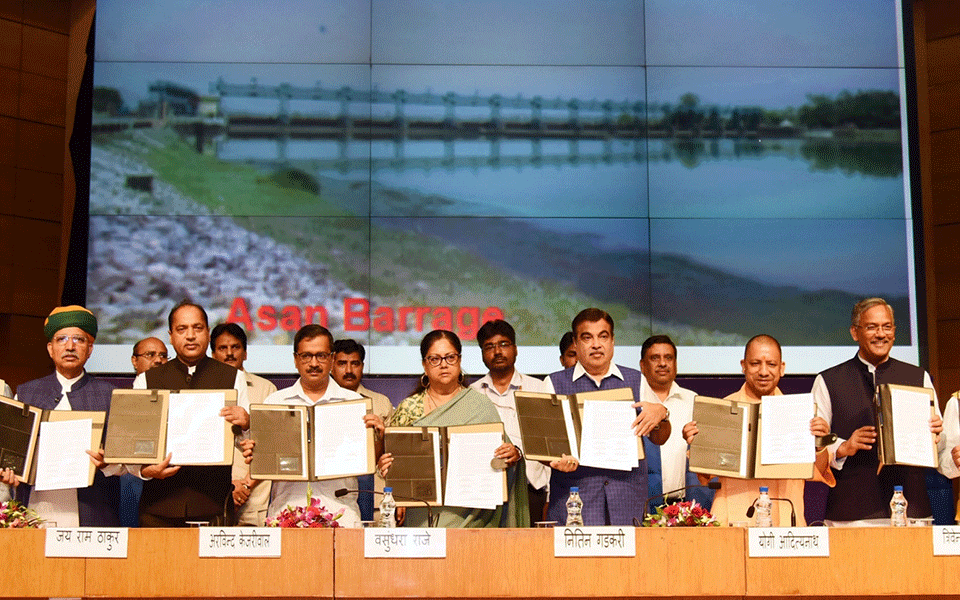
New Delhi, Aug 28 : Union Water Resources Minister Nitin Gadkari on Tuesday signed a memorandum of understanding (MoU) with six states for the construction of the Lakhwar multi-purpose project in the upper Yamuna basin to deal with water crisis.
Chief Ministers Yogi Adityanath of Uttar Pradesh, Vasundhara Raje of Rajasthan, Trivendra Singh Rawat of Uttarakhand, Jai Ram Thakur of Himachal Pradesh, Manohar Lal Khattar of Haryana and Arvind Kejriwal of Delhi signed the MoU for the construction of the 204-metre high water storage project near Uttarakhand's Lohari village.
"It will create storage facilities of 330.66 million cubic metres in the upper Yamuna basin to deal with water crisis between January and June," Gadkari said.
The agreement will help conserve and utilise monsoon water that flows into the Yamuna, said the Minister, adding that 90 per cent of the project will be funded by the Centre and the remaining amount by the six states.
The total project cost is Rs 3,966.51 crore.
Gadkari said that the stored water will help irrigate 33,780 hectares of land and make available an additional 78.83 MCM of water for domestic, drinking and industrial use in the six basin states.
The Lakhwar project will also boost electricity production in Uttarakhand. The project will generate 300 megawatt power and will be executed by the Uttarakhand Jal Vidyut Nigam Limited.
"When Delhi, Haryana, Uttar Pradesh and Rajasthan face drinking water crisis from January to May due to water shortage in the Yamuna, the project will help maintain an optimum level to resolve drinking water problem," said the Minister.
Gadkari said that the project will also help increase the Yamuna's storage capacity by 65 per cent and that there would be no drinking water problem in the coming 20-25 years.
He urged the six states to pay attention towards such water projects that are pending for 20-25 years due to absence of agreements among them.
Referring to the partition of India, the Minister said three rivers were given to India in 1947 and pointed out that "our water is flowing into Pakistan's rivers due to lack of management".
"I think maximum water can be taken to the Yamuna to help resolve the irrigation problem in Haryana, Rajasthan and Uttar Pradesh. I think water is a biggest problem in our country. There is no crisis of water, but the problem lies with water management."
The Lakhwar project was initially approved by the Planning Commission in 1976 and the construction started in 1987. After 30 per cent construction was done, the project work came to a halt in 1992 due to paucity of funds. In 2009, it was declared a national project.
Let the Truth be known. If you read VB and like VB, please be a VB Supporter and Help us deliver the Truth to one and all.
Maharashtra sets up state vaccination task force to strengthen immunisation programme

Mumbai (PTI): The Maharashtra government has set up a State Vaccination Task Force to strengthen the regular immunisation programme and review the progress of related campaigns, a health department official said on Monday.
The State Vaccination Task Force will comprise at least 29 members and will be headed by the administrative head of the health department, he informed.
The government has also constituted separate district-level and municipal vaccination task forces to improve implementation and address challenges at the grassroots level, he said.
Municipal task forces, chaired by respective civic commissioners, have been constituted in view of the vast urban population in Maharashtra and the role of civic bodies in implementing different health programmes.
The district-level task forces will function under the chairmanship of collectors.
"Complete immunisation of children at the appropriate age is an extremely simple, cost-effective and highly effective measure to reduce child mortality and the prevalence of diseases among kids. Immunisation is a powerful tool for reducing illness in children," maintained the official.
To ensure full vaccination of all children, the state government implements various campaigns from time to time as per the central government guidelines, he pointed out.
"Active participation and cooperation of other relevant government departments are essential (in making these campaigns successful)," according to the official.
The state-level body will review the regular immunisation programme, associated campaigns and vaccine-preventable diseases in detail. It will also conduct focused assessments of high-risk districts and municipal corporations, including vacancies at district, municipal and sub-district levels, availability of cold chain equipment, resource gaps and training requirements, he noted.
The state task force will review allocation and utilisation of funds for immunisation and ensure timely action by officers concerned based on reports from district and municipal task forces and state-level monitoring mechanisms, the official said.
It will also ensure active coordination and participation of other government departments in immunisation drives, while district and municipal task forces will carry out similar functions at their respective levels, the official added.