Chef Imtiaz Qureshi dies at 93, tributes pour in
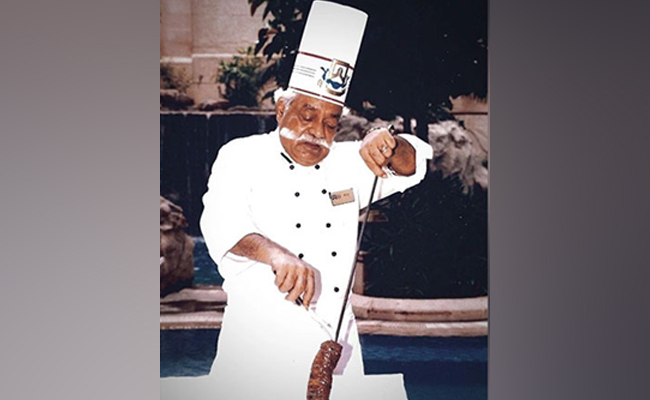
New Delhi (PTI): Legendary chef Imtiaz Qureshi, who was known for having revived the old-Lucknowi tradition of dum pukht style of cooking, died of age-related ailments at Mumbai's Lilavati Hospital in the early hours of Friday, his son Ishtiyaque Qureshi told PTI. He was 93.
"He had been admitted in the hospital for the last 14 days. There was no one specific health condition. He was diabetic, so there were problems related to that," Ishtiyaque said.
He added that his father spent time with family members last night and also talked to his grandchildren through video call.
"At around 4 am this morning, his condition deteriorated as his oxygen saturation level also dropped. The doctors tried but could not revive him," his son said.
The last rites were performed in the afternoon.
Qureshi is survived by five sons and two daughters.
Born on February 2, 1931 in Lucknow, Qureshi is credited to be the mastermind behind some of the iconic hotels across the country, including the world-renowned brands like Delhi's Dum Pukht and Bukhara at ITC Maurya.
Throughout a career spanning over five decades, Qureshi served several lavish banquets to the the likes of Jawaharlal Nehru and Indira Gandhi in the 1960s.
For his contributions to the culinary arts, the chef was awarded the prestigious Padma Shri in 2016, becoming the first in the chef community to receive it.
Tributes poured in on social media for the late chef.
"With great sadness and a heavy heart, I regret to inform you of the heartbreaking news of the passing of Padmashree Chef Mr. Imtiaz Qureshi, who departed from this world earlier this morning. His culinary legacy and contributions will forever be remembered and cherished. May his soul find eternal peace and may his memory continue to inspire us all," chef Kunal Kapur posted on X.
Ranveer Brar remembered his days as a trainee chef at the Taj Palace and going to ITC Maurya next door to have Galouti Kebab at Dum Pukht and called it a "life changing" experience.
"As a Lucknow boy with dreams of becoming a chef, the folklore of Imtiaz Qureshi is something I grew up with. It was around 1998-1999 when I was working as a trainee chef at the Taj Palace in Delhi. I remember once taking the Rs. 612/- I had earned to ITC Maurya next door and having only the Galouti Kebab at Dum Pukht. The fact that I was eating @LegendOfImtiaz Qureshi's food in an ITC hotel was life changing for me," Brar wrote on X.
He added, "Not only had he pulled the dum pukht technique out of Lucknow, he had given it a personality, an unmistakable refinement. RIP chef, your legacy lives on forever."
Food critic Vir Sanghvi also took to X and credited Qureshi for inventing the dum pukht biryani and transforming North Indian restaurant food.
"Rest In Peace Imtiaz Qureshi who, in his years at @ITCHotels, transformed North Indian restaurant food by popularising the haute cuisine of Awadh and who invented the Dum Pukth biryani that is still the model for all North Indian biryani served everywhere in the world," Sanghvi posted.
Singer Adnan Sami paid condolences to Qureshi and termed him "the modern day father of Awadhi cuisine".
"Sad to learn that Padma Shri Master Chef Imtiaz Qureshi has passed away. He was a culinary genius & a man full of zeal for life!! He was also the modern day father of Awadhi Cuisine & his Biryani was legendary amongst everything else he fed the world. My deepest heartfelt condolences to his family. ?????? ?????? ????????? ???????? ???????? May Allah SWT bless him in Jannat-ul-Firdaus...Ameen," Sami said.
Let the Truth be known. If you read VB and like VB, please be a VB Supporter and Help us deliver the Truth to one and all.
China confirms its support to Pakistan during four-day conflict with India

Beijing (PTI): China, for the first time, has confirmed that it provided on-site technical support to Pakistan during the four-day conflict with India last year, official media reports here said.
China's state broadcaster CCTV on Thursday aired an interview with Zhang Heng, an engineer from the Aviation Industry Corporation of China's (AVIC) Chengdu Aircraft Design and Research Institute, a key developer of China’s advanced fighter aircraft and unmanned aerial vehicle design.
Zhang had provided technical support to Pakistan during the four-day war last May, Hong Kong-based South China Morning Post reported, quoting CCTV.
Pakistan's air force operates a fleet of Chinese-made J-10CE jets, produced by an AVIC subsidiary.
"At the support base, we frequently heard the roar of fighter jets taking off and the constant wail of air-raid sirens. By late morning, in May, the temperature was already approaching 50 degrees Celsius (122 degrees Fahrenheit). It was a real ordeal for us, both mentally and physically,” Zhang said.
What drove his team was the "desire to do an even better job with on site support” and to ensure their equipment could “truly perform at its full combat potential”, Zhang told CCTV.
“That wasn’t just a recognition of the J10CE; it was also a testament to the deep bond we formed through working side by side, day in and day out,” he said.