Chidambaram apologises for loss of lives during Telangana statehood stir, BRS says too late
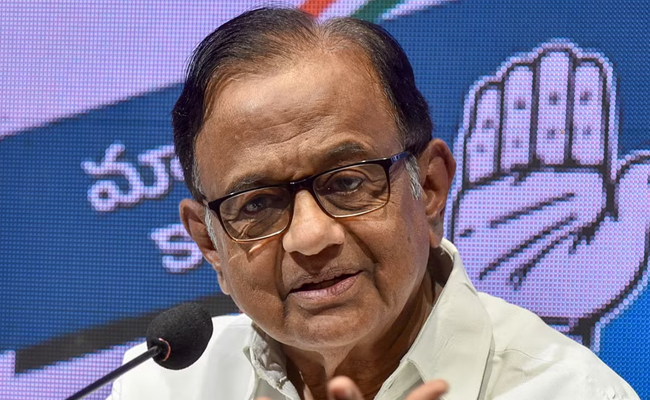
Hyderabad (PTI): Senior Congress leader P Chidambaram has apologised for the loss of lives during the Telangana statehood agitation, drawing sharp reactions from the ruling BRS.
Speaking to mediapersons here on Thursday, the former Union Minister also said creating a state or dividing a state was not child's play and it was done in response to people's movement.
Reacting to Chidambaram's remarks, BRS leader and Minister K T Rama Rao said it was already too late.
Describing suicide as an 'unfortunate incident', Chidambaram said, "If in the people's movement some persons lost their lives in the agitation... we are sorry for that. But you can't hold the (then) Central government responsible for that."
He was responding to the accusation of Chief Minister K Chandrasekhar Rao that previous UPA government had delayed the formation of Telangana resulting in loss of lives.
The Congress veteran further said Telangana was formed in response to the people's movement.
In a post on "X", BRS working president Rama Rao said, "Too late and Too little Chidambaram Ji.. Your party is solely responsible for taking the lives of hundreds of Telangana youngsters from 1952-2014. No matter how hard you try now, people of Telangana will always remember the brutalities Congress perpetrated on us."
Chidambaram, however, alleged that over 4,000 suicides were reported in Telangana under K Chandrasekhar Rao-led BRS government and sought to know who was responsible for it.
"A state is created after a movement like original Andhra Pradesh was created. A state is divided in response to people's movement. If some lives have been lost we are sorry for that. But what about the 4,000 odd suicides in Telangana under KCR's government. Who is responsible for those suicides?" he asked.
During his poll rallies, Rao had charged Congress with delaying the formation of Telangana.
Though the previous UPA government agreed to the formation of Telangana after he began an indefinite fast, it went back on its word.
Later, the UPA government fulfilled its promise only after massive protests, he had claimed.
Rao also blamed the Congress for the deaths during the statehood agitation and said the grand old party delayed its approval for a new state.
Chidambaram further said Rao emerged as a prominent leader of that movement and that is why he is the Chief Minister today.
"I hope KCR is not saying that the people have nothing to do with that and I got Telangana... I hope he is not saying that and if he is saying that then people will answer him in the elections," he said.
The former Union Minister recalled that it was after great amount of work and persuasion that the Congress agreed to carve out Telangana and an announcement to this effect was made on December 9, 2009 following which Chandrasekhar Rao called off his fast.
"He (KCR) profusely thanked us. But, another agitation broke out. And Justice Srikrishna Commission was appointed, which gave six recommendations. Ultimately, the Congress party and the government in the Centre agreed to divide united Andhra Pradesh into Telangana and AP," he added.
To a query on KCR's statement that the Congress merged Telangana with Andhra Pradesh earlier (in 1956), against the will of the people here, Chidambaram said, "I think Chandrasekhar Rao is not a particularly good student of history."
"How was Andhra Pradesh formed? A large part of Andhra Pradesh was part of Madras presidency. And there was Hyderabad state. There was a massive movement for creating a Telugu speaking state and that is how a single Andhra Pradesh was formed bringing together all Telugu speaking people and all Telugu speaking regions of this part of India," he said.
In his response, Telangana Finance Minister T Harish Rao in a post on "X", said, "Congress leader Chidambaram's comment is like a murderer expressing condolences. Youth sacrificed their lives during the agitation because of Chidambaram going back on his statement about formation of Telangana."
Let the Truth be known. If you read VB and like VB, please be a VB Supporter and Help us deliver the Truth to one and all.
Karnataka: College student dies by suicide in Dharwad, 3 policemen suspended
Dharwad (Karnataka) (PTI): A college student allegedly died by suicide here, following which three policemen were suspended over allegations of harassment linked to his death by the victim's family.
Aditya Myageri, a BSc student at a private college here, was among 18 students detained by the Vidyagiri police on April 25 during an anti-drug drive, police said on Wednesday.
He hailed from Belur village in Bagalkot district, but was staying with his friends at a rented accommodation in Girinagar area of Dharwad city, police said.
Among the 18 students tested, Aditya was among the 10 who had tested negative for ganja consumption and was subsequently released.
Some of his roommates, however, tested positive.
According to police, Aditya's family alleged that despite testing negative, he was harassed by police. They also claimed some policemen demanded Rs 2,000 to settle the matter and threatened legal action if he failed to pay.
He had called his mother asking for money, but she could not arrange it immediately, the family claimed.
On Monday night, Aditya allegedly died by suicide by hanging from a ceiling fan at his rented accommodation, with his family alleging police harassment and pressure over demand for money drove him to the extreme step, a senior police officer said.
Police Commissioner N Shashi Kumar told PTI that an unnatural death case has been registered at Vidyagiri police station. Three policemen have been suspended over the allegations, and further investigation is underway.