College graduates face toughest job market in more than decade as hiring slows

Washington (AP): While completing a master's degree in data analysis, Palwasha Zahid moved from Dallas to a town near Silicon Valley. The location made it easy to visit the campuses of tech stalwarts such as Google, Apple, and Nvidia.
Zahid, 25, completed her studies in December, but so far she hasn't found a job in the industry that surrounds her.
“It stings a little bit,” she said. “I never imagined it would be this difficult just to get a foot in the door.”
Young people graduating from college this spring and summer are facing one of the toughest job markets in more than a decade. The unemployment rate for degree holders ages 22 to 27 has reached its highest level in a dozen years, excluding the coronavirus pandemic. Joblessness among that group is now higher than the overall unemployment rate, and the gap is larger than it has been in more than three decades.
The rise in unemployment has worried many economists as well as officials at the Federal Reserve because it could be an early sign of trouble for the economy. It suggests businesses are holding off on hiring new workers because of rampant uncertainty stemming from the Trump administration's tariff increases, which could slow growth.
“Young people are bearing the brunt of a lot of economic uncertainty,” Brad Hersbein, senior economist at the Upjohn Institute, a labour-focused think tank, said. “The people that you often are most hesitant in hiring when economic conditions are uncertain are entry-level positions.”
The growth of artificial intelligence may be playing an additional role by eating away at positions for beginners in white-collar professions such as information technology, finance, and law.
Higher unemployment for younger graduates has also renewed concerns about the value of a college degree. More workers than ever have a four-year degree, which makes it less of a distinguishing factor in job applications. Murat Tasci, an economist at JPMorgan, calculates that 45 per cent of workers have a four-year degree, up from 26 per cent in 1992.
While the difficulty of finding work has demoralised young people like Zahid, most economists argue that holding a college degree still offers clear lifetime benefits. Graduates earn higher pay and experience much less unemployment over their lifetimes.
The overall US unemployment rate is a still-low 4.2 per cent, and the government's monthly jobs reports show the economy is generating modest job gains. But the additional jobs are concentrated in health care, government, and restaurants and hotels. Job gains in professions with more college grads, such as information technology, legal services, and accounting have languished in the past 12 months.
The unemployment rate has stayed low mostly because layoffs are still relatively rare. The actual hiring rate — new hires as a percentage of all jobs — has fallen to 2014 levels, when the unemployment rate was much higher, at 6.2 per cent. Economists call it a no-hire, no-fire economy.
For college graduates 22 to 27 years old, the unemployment rate was 5.8 per cent in March — the highest, excluding the pandemic, since 2012, and far above the nationwide rate.
Lexie Lindo, 23, saw how reluctant companies were to hire while applying for more than 100 jobs last summer and fall after graduating from Clark Atlanta University with a business degree and 3.8 GPA. She had several summer internships in fields such as logistics and real estate while getting her degree, but no offer came.
“Nobody was taking interviews or responding back to any applications that I filled out,” Lindo, who is from Auburn, Georgia, said. "My resume is full, there's no gaps or anything. Every summer I'm doing something. It's just, OK, so what else are you looking for?'”
She has returned to Clark for a master's program in supply chain studies and has an internship this summer at a Fortune 500 company in Austin, Texas. She's hopeful it will lead to a job next year.
Artificial intelligence could be a culprit, particularly in IT. Matthew Martin, senior US economist at Oxford Economics, has calculated that employment for college graduates 28 and above in computer science and mathematical occupations has increased a slight 0.8 per cent since 2022. For those ages 22 to 27, it has fallen 8 per cent, according to Martin.
Company announcements have further fuelled concerns. Tobi Lutke, CEO of online commerce software company Shopify, said in an April memo that before requesting new hires, “teams must demonstrate why they cannot get what they want done using AI.”
Last week, Amazon CEO Andy Jassy said AI would likely reduce the company's corporate work force over the next few years.
“We will need fewer people doing some of the jobs that are being done today, and more people doing other types of jobs,” Jassy said in a message to employees. “We expect that this will reduce our total corporate workforce as we get efficiency gains from using AI extensively across the company.”
Zahid worries that AI is hurting her chances. She remembers seeing big billboard ads for AI at the San Francisco airport that asked, “Why hire a human when you could use AI?”
Still, many economists argue that blaming AI is premature. Most companies are in the early stages of adopting the technology.
Professional networking platform LinkedIn categorized occupations based on their exposure to AI and did not see big hiring differences between professions where AI was more prevalent and where it wasn't, said Kory Kantenga, the firm's head of economics for the Americas.
“We don't see any broad-based evidence that AI is having a disproportionate impact in the labour market or even a disproportionate impact on younger workers versus older workers,” Kantenga said.
He added that the Federal Reserve's interest rate hikes have also slowed hiring in tech. Many IT firms expanded when the Fed pinned its short-term rate at nearly zero after the pandemic. In 2022, the Fed began cranking up rates to combat inflation, which made it harder to borrow and grow.
In fact, IT's hiring spree when rates were low — fuelled by millions of Americans ramping up their online shopping and video conferencing — left many firms with too many workers, economists say.
Cory Stahle, an economist at the job-listings website Indeed, says postings for software development jobs, for example, have fallen 40 per cent compared with four years ago. It's a sharp shift for students who began studying computer science when hiring was near its peak.
Zahid, who lives in Dublin, California, has experienced this whiplash firsthand. When she entered college in 2019, her father, who is a network engineer, encouraged her to study IT and said it would be easy for her to get a job in the field.
She initially studied psychology but decided she wanted something more hands-on and gravitated to data analysis. Her husband, 33, has a software development job, and friends of hers in IT received immediate job offers upon graduation a few years ago. Such rapid hiring seems to have disappeared now, she said.
She has her college diploma, but hasn't hung it up yet.
“I will put it up when I actually get a job, confirming that it was worth it all,” she said.
Let the Truth be known. If you read VB and like VB, please be a VB Supporter and Help us deliver the Truth to one and all.
MP boat tragedy: Death toll rises to 10 with recovery of one more body; 3 tourists still missing
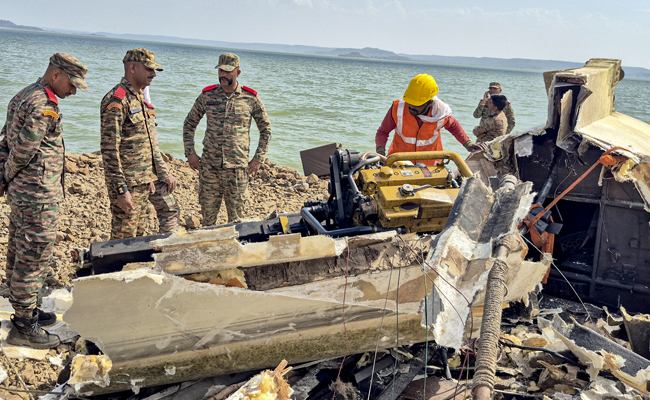
Jabalpur (PTI): The body of a child was retrieved on Saturday evening from Bargi Dam in Jabalpur district of Madhya Pradesh, raising the death toll in the cruise boat tragedy that took place two days ago to ten, while search continued for three missing tourists.
The boat, operated by the state tourism department, capsized during a storm on Thursday evening with some of the survivors alleging negligence and safety lapses such as life jackets not being distributed in time.
The body recovered on Saturday evening was possibly that of six-year-old Viraj Soni, said Sub-Divisional Officer of Police (SDOP) Anjul Ayank Mishra.
"The identity will be confirmed after family members identify the body," he told PTI.
Kamraj, an employee of the Ordnance Factory at Khamaria, his five-year-old son Tamil, and another child Mayuram (5) who had come from southern India were still missing.
Authorities have arranged equipment to search deep waters of the dam and are getting a generator to facilitate diving operations, Mishra added.
Divers and disaster response teams have expanded the search radius to five km, he said.
Of the 41 identified passengers on board the ill-fated vessel, 28 were rescued, police said.
More than 200 rescuers, including around 20 Army divers airlifted from Agra, joined the search operation that resumed at 5 on Saturday morning. The operation, involving the National Disaster Response Force, State Disaster Response Force and local divers, was briefly affected at around 9 am due to strong winds, officials said.
Post-mortem examinations of nine deceased persons have been completed, Mishra said.
"Our priority is to search for the missing persons. We will also register a First Information Report in the case soon," he said.
Police said CCTV footage near the boarding point showed 43 people heading towards the boat while the identities of 41 passengers have been confirmed so far.
The state government on Friday ordered a probe into the tragedy and dismissed three crew members. It also banned operation of similar vessels in the state.