Cong cites book to claim Gandhi described RSS as 'communal body with totalitarian outlook'
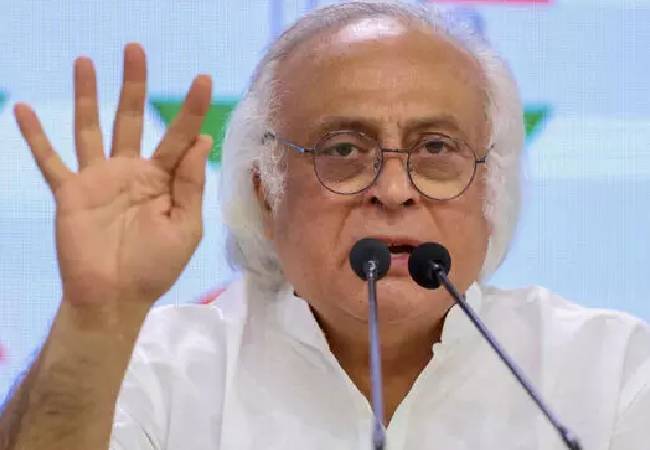
New Delhi (PTI); In a scathing attack on the RSS on its 100th anniversary, the Congress on Thursday cited excerpts from a book to claim that Mahatma Gandhi described the Sangh as a "communal body with a totalitarian outlook".
The opposition party also cited a media report from 1948 that quoted a speech of India's first home minister Sardar Vallabhbhai Patel at a Congress session in Jaipur in which he vehemently criticised the RSS.
In a post on X, Congress general secretary in-charge communications, Jairam Ramesh, said Pyarelal was one of Gandhi's closest aides, being part of his personal staff for almost three decades, and became his secretary after the death of Mahadev Desai in 1942.
"Pyarelal's books on Mahatma Gandhi have become standard reference works. In 1956, he published the first volume of his book 'Mahatma Gandhi: The Last Phase'... brought out by Navajivan Publishing House, Ahmedabad. It carried a long introduction by the President of India, Dr. Rajendra Prasad, as well as an endorsement by the Vice President, Dr. S. Radhakrishnan," Ramesh said.
The second volume appeared two years later, he said.
"On page 440 of the second volume, Pyarelal writes of a conversation between Mahatma Gandhi and one of his colleagues in which the Father of the Nation describes the RSS as a 'communal body with a totalitarian outlook'," the Congress leader said, adding that this conversation took place on September 12, 1947.
Five months later, then Union home minister Sardar Patel banned the RSS, he said.
Ramesh also shared a screenshot of a passage from the book which states that Gandhi characterised the RSS as a "communal body with a totalitarian outlook".
In another post, Ramesh said that on December 16, 1948, Patel spoke at the Congress session in Jaipur. He also shared a media report that was published the next day quoting Patel.
"Sardar Patel was referring to the steps which the Government had taken against the RSS. He said that the RSS organisation, which operated secretly, was supposed to safeguard Hindu culture.
"There was a challenge to the national flag which had come to be respected by kings and rulers, and the power that ruled over India for 200 years. It was under that flag that the Congress made great sacrifices and today under no circumstances would they give up the ideal for which they had lived and worked," the report quoted Patel as saying.
"The Deputy Prime Minister, Sardar Patel, expressed himself forcefully and emphasised that India must be a secular State. That was what the Congress had fought for, laboured and sacrificed all these years," it said.
"He warned that any organisation which sought to supplant the national flag by another would be sternly dealt with. Sardar Patel, who vehemently condemned the activities of the RSS, was loudly cheered at the conclusion of his speech," stated the report, a screenshot of which was shared by Ramesh.
After Prime Minister Narendra Modi hailed the RSS for its role in nation-building on Wednesday, the Congress reminded him that Patel said that the Sangh's activities created an atmosphere that led to the killing of Mahatma Gandhi.
In a post on X on Wednesday, Ramesh said, "The PM has spoken much of the RSS this morning. Is he even aware of what Sardar Patel wrote to Dr Syama Prasad Mookerjee on July 18, 1948?"
The Congress leader shared extracts from a letter Patel wrote to Syama Prasad Mookerjee.
In the letter, Patel said, "As regards the RSS and the Hindu Mahasabha, the case relating to Gandhi ji's murder is sub-judice and I should not like to say anything about the participation of the two organisations, but our reports do confirm that, as a result of the activities of these two bodies, particularly the former, an atmosphere was created in the country in which such a ghastly tragedy became possible...
"The activities of the RSS constituted a clear threat to the existence of the government and the State. Our reports show that those activities, despite the ban, have not died down. Indeed, as time has marched on, the RSS circles are becoming more defiant and are indulging in their subversive activities in an increasing measure..."
In another post, Ramesh said, "Sardar Patel addressed a massive public gathering in Jaipur on December 19, 1948, and spoke forcefully on the RSS."
Congress’ media and publicity department head Pawan Khera said, “If you wanted to issue a coin for the RSS, you would have issued one of Rs 60, the same amount as Savarkar's pension from the British government. If you wanted to issue a postage stamp, you would have issued one of the British postal mail through which apologies were sent.”
“Print as many stamps as you want, issue coins, and include the RSS in the curriculum - this country was Gandhi's, is Gandhi's, and will remain Gandhi's. As soon as you are out of power, history will throw you and your ideology out like a fly is removed from milk,” Khera said in a post in Hindi on X.
Participating in the centenary celebrations of the Rashtriya Swayamsevak Sangh (RSS) on Wednesday, Modi said the organisation never displayed any bitterness despite several attacks on it as it continued to work on the principle of nation first.
To mark the occasion, Modi also released a special postage stamp and a commemorative coin, which features the first-ever depiction of Bharat Mata on Indian currency.
Slamming the PM, Congress general secretary K C Venugopal said, "Inaugurating a commemorative coin and stamp to honour the RSS is a deep insult to India's freedom struggle and the Constitution."
Honouring an organisation that actively collaborated with India's colonial masters and continues to spread poison in society to this day must be seen as a dark day in history, he said in a post late on Wednesday night.
"How can an organisation that was banned by Sardar Patel be honoured today by the Indian Government? How can those who advocate for rewriting our Constitution and destroying the social justice agenda given to us by Dr. Ambedkar be celebrated as national icons?" Venugopal asked.
Let the Truth be known. If you read VB and like VB, please be a VB Supporter and Help us deliver the Truth to one and all.
Akola hottest in India at 46.9 deg C; Vidarbha under grip of heat wave
Nagpur (PTI): Akola in Maharashtra has recorded the highest temperature in the country at 46.9°C, while Nagpur and several other parts of Vidarbha reeled under a severe heat wave, MeT officials said on Monday.
Heat wave conditions are expected to persist across parts of the state's Vidarbha region till Tuesday, as maximum temperatures may reach 45 to 46 degrees Celsius and touch 47 degrees Celsius at isolated locations, they said.
On Sunday, Akola recorded 46.9 degrees Celsius, the highest temperature in the country, followed by Amravati at 46.8 degrees Celsius, according to the India Meteorological Department's Regional Meteorological Centre (RMC) in Nagpur.
Wardha sizzled at 46.4 degrees Celsius, Yavatmal logged 46 degrees Celsius, Nagpur scorched at 45.4 degrees Celsius, while Chandrapur recorded 45 degrees Celsius, as per the data.
Akola, Amravati, Wardha, Yavatmal, Chandrapur and Nagpur experienced heat wave conditions, while several other districts reported above-normal temperatures, RMC scientist Dr Praveen Kumar told PTI.
The prevailing above-normal and persistently high temperatures over Vidarbha can be attributed to an anticyclonic circulation over Maharashtra and adjoining areas. At the same time, hot and dry northwesterly winds have been continuously affecting the region, he said.
In addition, weak western disturbances and the absence of moisture incursion or any significant weather systems have contributed to the intensification of heat over the region, the official said.
As per the Met department, heat wave conditions are likely to continue at a few or isolated places over the region till Tuesday.
The IMD has issued an 'orange' alert for Akola, Amravati and Wardha and a 'yellow' alert for Nagpur, Chandrapur and Yavatmal for Tuesday, saying that the maximum temperatures are likely to reach 45 to 46 deg C and possibly up to 47 deg C at isolated locations.
A relief from the heat wave is expected thereafter and the mercury is likely to dip by 2 to 3 deg C, with the possibility of rainfall and gusty winds in the coming days, it added.
The IMD grades the severity of any weather system through colour-coded alerts – green (no warning), yellow (be aware), orange (be prepared) and red (take action).