Congress kicks off LS poll campaign from PM's home state
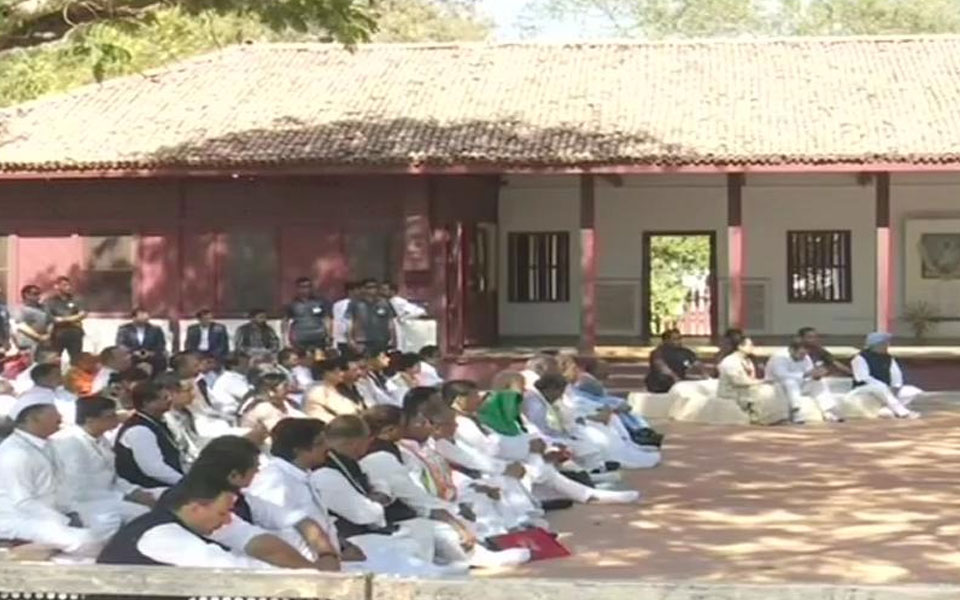
Ahmedabad: Top Congress leadership Tuesday paid their respect to Mahatma Gandhi at the Sabarmati Ashram here, ahead of launching the party's poll campaign for the Lok Sabha elections.
Party leaders led by its chief Rahul Gandhi, UPA chairperson Sonia Gandhi, Congress general secretary Priyanka Gandhi Vadra, former prime minister Manmohan Singh sought to give a symbolic message to the people of the country ahead of the general elections by remembering Mahatma and his ideals of non-violence and tolerance.
Other party leaders like A K Antony, Ghulam Nabi Azad, Ahmed Patel, Rajasthan Chief Minister Ashok Gehlot, Chhattisgarh Chief Minister Bhupesh Baghel, Puducherry Chief Minister V Narayanasamy, former chief ministers Siddaramaiah, Tarun Gogoi, Harish Rawat and Oommen Chandy attended a prayer meeting at the Sabarmati Ashram.
Rahul while addressing Congress booth workers in Delhi on Monday had said the upcoming general elections will be a battle between Mahatma Gandhi's India and Nathuram Godse's India with love on one side and hate on the other.
Tuesday also marks the anniversary of the famous 'Dandi March' started by Mahatma Gandhi from Sabarmati Ashram on March 12, 1930 with a group of Satyagrahis.
"Today marks the anniversary of the #DandiMarch, led by Mahatma Gandhi, which played a pivotal role in India's struggle for independence. The march was a non-violent protest against the rigorous and oppressive British policies on salt," the Congress said on its official Twitter handle.
The Congress, at its meeting of the working committee-- the highest decision making body, later in the day will give the final shape to its strategy for the general elections.
The Congress Working Committee (CWC) meeting is being held at Vallabhbhai Patel's national memorial here, with top party leaders, including former prime minister Manmohan Singh and newly-appointed Congress general secretary Priyanka Gandhi Vadra in attendance. This will be the first official meeting of Priyanka after assuming an active political role in the Congress party.
Later, the party will sound the poll bugle from Prime Minister Narendra Modi's home state, with a 'Jan Sankalp Rally' here, party leaders said.
The day-long meeting of the Congress Working Committee assumes significance as it comes barely two days after the declaration of the poll schedule.
Sources said the Congress is seeking to give a strong political message to the nation from the land of Mahatma Gandhi and Sardar Patel, with the party leadership holding the prayer meeting at Sabarmati Gandhi Ashram in Ahmedabad, followed by the CWC meet at Sardar Vallabhbhai Patel national memorial in the state.
The CWC meeting is being held in Gujarat after a gap of 58 years. It was last held in the state at Bhavnagar in 1961.
The party will also hold a public meeting in Adalaj in Gandhinagar district of Gujarat with the slogan of 'Jai Jawan, Jai Kisan'. Priyanka Gandhi is also likely to address this meeting in her first public rally after entering politics.
Patidar leader Hardik Patel, who shot to fame by spearheading quota stir in the state and is set to fight the Lok Sabha polls, will join the Congress at the meeting in the presence of party chief Rahul Gandhi.
Besides giving final shape to its Lok Sabha election strategy, the party will demand answers from Modi and the BJP on what it calls the "failures" and "unfulfilled promises" of the government.
The top Congress leadership led by Rahul, Sonia, Manmohan Singh and other senior leaders will deliberate on key issues for the national elections beginning April 11.
The party leaders will also discuss ways to corner Modi and his government on issues of governance, agrarian and economic crisis, unemployment and lack of job creation, national security and women's safety.
The party has maintained that the narrative for the general elections needs to be steered towards real issues and problems confronting people rather than the "propaganda" plank of the current regime, especially after the Pulwama attack and subsequent air strike on terror camps in Pakistan.
Sources said the party will issue a statement after the CWC, covering all these issues.
The Congress leaders feel that the party needs to demand answers from the prime minister on the status of the promises made by him five years ago and on his governance track record.
Let the Truth be known. If you read VB and like VB, please be a VB Supporter and Help us deliver the Truth to one and all.
Real Madrid fines Valverde and Tchouaméni half a million euros each for altercation
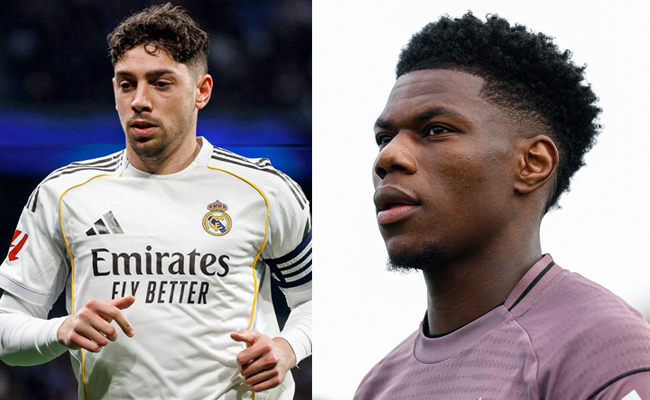
Barcelona (AP): Real Madrid slapped players Federico Valverde and Aurélien Tchouaméni with half-a-million-euro ($588,000) fines on Friday for their altercation during practice.
The massive fines came a day after the midfielders tussled when the team trained. Valverde said in a post on social media on Thursday that no punches were thrown. But Valverde knocked his head on a table and he suffered a small cut that required a brief hospital visit.
On social media, Valverde initially called it a “meaningless fight” with a teammate and said “everything has been blown out of proportion."
His employers, however, considered it a significant enough breach of team discipline to nail both Valverde and Tchouaméni with fines that bite even the bank account of a top soccer player. The half-a-million euro penalties reflect the reputational damage the club was enduring in a chaotic end to a disappointing season.
In a statement, the 15-time European champion said its disciplinary action was concluded after both players expressed to the club “their complete remorse for what happened and apologized to one another.”
Madrid added they also apologized to their teammates, the coaching staff and club supporters, as well as showing their willingness to accept whatever disciplinary action the club deemed “opportune.”
Tchouaméni was back training with Madrid on Friday, two days before they play at Barcelona in a clasico. Madrid has to win otherwise Barcelona will be crowned La Liga champion.
After being notified of the fine, he posted a public apology to the club and its fans on social media.
“What happened this week in training is unacceptable,” Tchouaméni wrote. "I say this while thinking about the example we are expected to set for young people, whether in football or at school.
“Above all, I am sorry for the image we projected of the club.”
Valverde was not at practice due to the head knock.
Both players are set to play in the World Cup next month, with Tchouaméni playing for France and Valverde for Uruguay.
Chaotic end to a poor season
===================
The run-in between the players, who for seasons have played side by side in Madrid's midfield, came after they argued this week in previous training sessions. But tempers boiled over on Thursday. Spanish media was rife with reports that the players previously disagreed over the club's decision to let coach Xabi Alonso go after just months on the job.
It was not the only altercation involving Madrid players during training this week. Álvaro Carreras confirmed he was in a “minor” incident with a teammate. Spanish media said he and fellow defender Antonio Rüdiger got into a scuffle.
Álvaro Arbeloa, the coach who was promoted from Madrid's reserve team when Alonso was fired in January, will face tough questions on what went wrong inside the changing room when he gives a press conference on Saturday ahead of the clasico at Camp Nou.
Madrid is facing a second consecutive campaign without a major trophy amid rumors in the Spanish media that club president Florentino Pérez is considering bringing back Jose Mourinho to straighten out his underperforming team.