Congress will win assembly elections in at least four states: Sachin Pilot
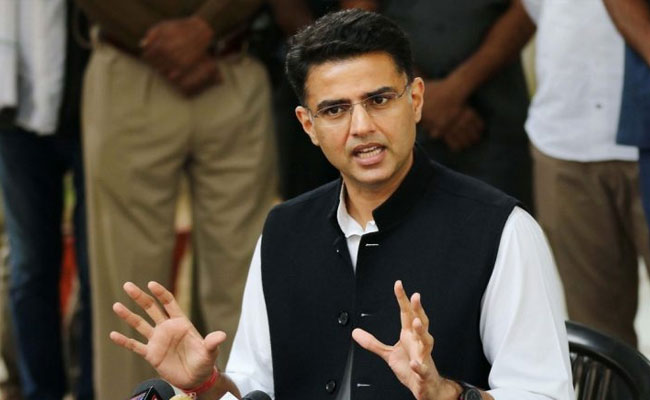
Indore (PTI): Senior Congress leader Sachin Pilot has said his party will form government in at least four states in the upcoming assembly polls and that would be a clear indication as to which way the wind is blowing for the 2024 general elections.
He also brushed aside talk of cracks in the INDIA bloc over disagreements on seat sharing for the assembly polls, saying that while it could have been handled "slightly more differently", but "such hiccups" will not come in the way of sharing Lok Sabha seats among alliance partners.
In an interview with PTI on board a helicopter, while on the campaign trail in Madhya Pradesh, Pilot said all members of the INDIA bloc are committed to working together to defeat the BJP in 2024 and who "will take what position will be decided after the polls".
Asked about the Congress' performance in the upcoming polls in Rajasthan, Madhya Pradesh, Chhattisgarh, Telangana and Mizoram, Pilot said the party is well placed to win at least four states and form governments.
"I am saying this with all the feedback that has been received, the response in our meetings and the lack of faith people have displayed in the BJP. So, in at least four states out of five, the Congress will form government and that will be a clear indication as to which way the wind is blowing," the Congress leader told PTI.
Asked how the INDIA bloc would counter the BJP's "Modi versus who" narrative for the 2024 polls, Pilot said, "I think we made it very clear, for us it is not about taking on a position of power. All members of the INDIA bloc are committed to working together to defeat the BJP because our nation needs a better alternative."
"So who will take what position will be decided after the polls. I don't think anybody is there to grab power or to prove a point. They are very mature, very senior leaders of various states who are a part of the alliance," he said.
"The Congress of course is a very old party, we have a lot of gravitas, a lot of workers across the country, so we will work together. I don't think we are so keen on projecting and naming individuals. Right now it is about people's issues, getting everyone together and the more cohesive, the more streamlined the INDIA bloc partnership is, the more dent we can cause to the BJP and the NDA," he asserted.
Asked if the Indian National Developmental Inclusive Alliance (INDIA) bloc would decide on the prime ministerial face after winning the general elections, he said, "So far that is what the decision is, not to project one or two faces, it is about the whole alliance. Everyone is equally important. Of course numbers make a difference in a democratic set up, but it is not important for us to have A B or C, it is important to have a united, people-oriented campaign."
"Don't forget that two-thirds of the voters voted against the BJP in 2019 and now when two-thirds of those alliance partners are working together, clearly it is worrying the BJP, that is why you see all this name-calling and the aversion of the BJP to even accept the name of our alliance," Pilot said.
"The alliance name has rattled the BJP and they also know it is not easy for it to win the next elections. Therefore, we are committed, alliance partners are strong, small differences may be there but very mature, very senior leaders are part of this alliance and they will see these through because India as a country is far more important than one party...The nation needs an alternative and INDIA alliance is that alternative," the former Union minister and member of the Congress Working Committee (CWC) said.
Dismissing talk of cracks in the INDIA bloc's ranks, Pilot said all members of the alliance are committed to a larger national objective which is to defeat the BJP.
"You are right, there were some issues in terms of seat adjustments in these states. But by and large these (election-bound) states are bipolar states where the Congress has much larger stakes. Perhaps, we could have handled things slightly more differently but I don't think these hiccups will come in the way of the larger grand alliance in terms of sharing Lok Sabha seats with alliance partners," he said.
The INDIA bloc is not about grabbing power or projecting somebody or assuming positions or occupying chairs of influence, it is about giving India a better alternative and that commonality of objective is what brings them together, he said.
"The INDIA bloc is very strong, Mr (Mallikarjun) Kharge, our party president, has reached out to many others and in the times to come, you will see a more cohesive strategising, campaigning and election-oriented work that the alliance partners will do," the Congress leader stressed.
But for the INDIA bloc to do well, the Congress also has to do well, Pilot said.
"In the election going states a lot depends on the Congress' performance. So, if the Congress does well, the INDIA bloc will automatically do well," Pilot said.
Asked about the war of words among INDIA bloc partners in the state polls, especially between the Congress and the Samajwadi Party, Pilot said there is no war and there were only a few problems that may have arisen in some states on some seats.
More than that "it is not a clash but a slight disagreement on some issues", he added.
But now the time has gone, the alliance partners will sit down together, resolve all differences and focus on the national seat sharing alliance, Pilot said.
On the BJP raising the issue of the killing of Kanhaiya Lal, a tailor who was hacked to death in Udaipur last year, the former Rajasthan deputy chief minister said any violence cannot and should not be tolerated.
"Any act which is as gruesome as the one in Udaipur needs to be condemned in the strongest words. But more importantly when the incident happened, the perpetrators were caught within four to five hours. What is far more important is to look at the background of the people who were caught in this crime and the perpetrators of that crime have close links with the BJP," he alleged.
"They (the BJP) must answer why people with links with the BJP are caught doing these heinous crimes. I think any crime that happens in society should not be tolerated. In fact law and order should be top priority for all governments. The Congress governments have acted very swiftly and decisively to ensure justice whenever such crimes take place," he said.
The Udaipur tailor was murdered on June 28 last year by two cleaver-wielding men who accused him of insulting Islam.
Asked about the Congress doing well in 2018 but being decimated in the Lok Sabha polls in 2019 and what was different this time, Pilot said the 2019 elections were conducted after very unique circumstances at our borders.
"Balakot happened and other things followed. Those circumstances were different. Now we have had almost 10 years of the BJP government. People are now asking for the report card in terms of delivery, governance, economic policy-making and look at the back-breaking inflation that has affected the entire country," he said.
In the 2024 elections there is also the fatigue factor and there is the law of diminishing returns, so it is not so easy for the BJP to reclaim another mandate, Pilot said.
Pilot said 2024 will be a "watershed election" where the INDIA bloc will be able to defeat the BJP-led NDA.
Let the Truth be known. If you read VB and like VB, please be a VB Supporter and Help us deliver the Truth to one and all.
Karnataka: College student dies by suicide in Dharwad, 3 policemen suspended
Dharwad (Karnataka) (PTI): A college student allegedly died by suicide here, following which three policemen were suspended over allegations of harassment linked to his death by the victim's family.
Aditya Myageri, a BSc student at a private college here, was among 18 students detained by the Vidyagiri police on April 25 during an anti-drug drive, police said on Wednesday.
He hailed from Belur village in Bagalkot district, but was staying with his friends at a rented accommodation in Girinagar area of Dharwad city, police said.
Among the 18 students tested, Aditya was among the 10 who had tested negative for ganja consumption and was subsequently released.
Some of his roommates, however, tested positive.
According to police, Aditya's family alleged that despite testing negative, he was harassed by police. They also claimed some policemen demanded Rs 2,000 to settle the matter and threatened legal action if he failed to pay.
He had called his mother asking for money, but she could not arrange it immediately, the family claimed.
On Monday night, Aditya allegedly died by suicide by hanging from a ceiling fan at his rented accommodation, with his family alleging police harassment and pressure over demand for money drove him to the extreme step, a senior police officer said.
Police Commissioner N Shashi Kumar told PTI that an unnatural death case has been registered at Vidyagiri police station. Three policemen have been suspended over the allegations, and further investigation is underway.