Conservative activist Charlie Kirk fatally shot in act of 'political assassination' at Utah college
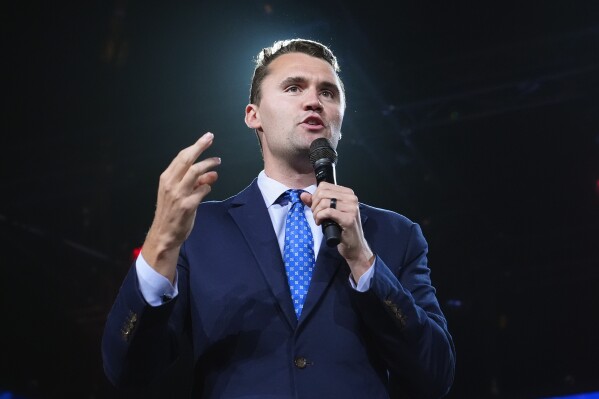
Orem (US) (AP): Charlie Kirk, a conservative activist and close ally of President Donald Trump who played an influential role in rallying young Republican voters, was shot and killed Wednesday at a Utah college event in what the governor called a political assassination carried out from a rooftop. A person of interest was in custody, officials said.
“This is a dark day for our state. It's a tragic day for our nation," said Utah Gov. Spencer Cox. "I want to be very clear this is a political assassination.”
Authorities did not immediately identify the person in custody, a motive or any criminal charges, but the circumstances of the shooting drew renewed attention to an escalating threat of political violence in the United States that in the last several years has cut across the ideological spectrum.
The assassination drew bipartisan condemnation but a national reckoning over ways to prevent political grievances from manifesting as deadly violence seemed elusive.
Videos posted to social media from Utah Valley University show Kirk speaking into a handheld microphone while sitting under a white tent emblazoned with the slogans “The American Comeback” and “Prove Me Wrong.”
A single shot rings out and Kirk can be seen reaching up with his right hand as a large volume of blood gushes from the left side of his neck.
Stunned spectators are heard gasping and screaming before people start to run away. The Associated Press was able to confirm the videos were taken at Sorensen Center courtyard on the Utah Valley University campus.
Kirk was speaking at a debate hosted by his nonprofit political organisation. Immediately before the shooting, Kirk was taking questions from an audience member about mass shootings and gun violence.
“Do you know how many transgender Americans have been mass shooters over the last 10 years?” the person asked. Kirk responded, “Too many.”
The questioner followed up: “Do you know how many mass shooters there have been in America over the last 10 years?”
“Counting or not counting gang violence?” Kirk asked.
Then a single shot rang out. The shooter, who Cox pledged would be held accountable in a state with the death penalty, wore dark clothing and fired from a roof on campus some distance away.
The death was announced on social media by Trump, who praised the 31-year-old Kirk, the co-founder and CEO of the youth organisation Turning Point USA, as “Great, and even Legendary.”
“No one understood or had the Heart of the Youth in the United States of America better than Charlie,” Trump posted on his Truth Social account.
Utah Valley University said the campus was immediately evacuated and remained closed. Classes were cancelled until further notice. Those still on campus were asked to stay in place until police officers could safely escort them off campus. Armed officers walked around the neighbourhood bordering the campus, knocking on doors and asking for information on the shooter.
Officers were seen looking at a photo on their phones and showing it to people to see if they recognised a person of interest.
The event, billed as the first stop on Kirk's “The American Comeback Tour,” had generated a polarising campus reaction.
An online petition calling for university administrators to bar Kirk from appearing received nearly 1,000 signatures. The university issued a statement last week citing First Amendment rights and affirming its “commitment to free speech, intellectual inquiry, and constructive dialogue.”
Last week, Kirk posted on X images of news clips showing his visit was sparking controversy. He wrote, “What's going on in Utah?”
The shooting drew swift condemnation across the political aisle as Democratic officials joined Trump, who ordered flags lowered to half-staff and issued a presidential proclamation, and Republican allies of Kirk in decrying the violence.
“The attack on Charlie Kirk is disgusting, vile, and reprehensible,” Democratic California Gov. Gavin Newsom, who last March hosted Kirk on his podcast, posted on X.
“The murder of Charlie Kirk breaks my heart. My deepest sympathies are with his wife, two young children, and friends,” said Gabrielle Giffords, the former Democratic congresswoman who was wounded in a 2011 shooting in her Arizona district.
The shooting appeared poised to become part of a spike of political violence that has touched a range of ideologies and representatives of both major parties.
The attacks include the assassination of a Minnesota state lawmaker and her husband at their house in June, the firebombing of a Colorado parade to demand Hamas release hostages, and a fire set at the house of Pennsylvania's governor, who is Jewish, in April. The most notorious of these events is the shooting of Trump during a campaign rally last year.
Former Utah congressman Jason Chaffetz, a Republican who was at Wednesday's event, said in an interview on Fox News Channel that he heard one shot and saw Kirk go back.
“It seemed like it was a close shot,” Chaffetz said, who seemed shaken as he spoke.
He said there was a light police presence at the event and Kirk had some security but not enough.
“Utah is one of the safest places on the planet,” he said. “And so we just don't have these types of things.”
Turning Point was founded in suburban Chicago in 2012 by Kirk, then 18, and William Montgomery, a tea party activist, to proselytize on college campuses for low taxes and limited government. It was not an immediate success.
But Kirk's zeal for confronting liberals in academia eventually won over an influential set of conservative financiers.
Despite early misgivings, Turning Point enthusiastically backed Trump after he clinched the GOP nomination in 2016. Kirk served as a personal aide to Donald Trump Jr., the president's eldest son, during the general election campaign.
Soon, Kirk was a regular presence on cable TV, where he leaned into the culture wars and heaped praise on the then-president. Trump and his son were equally effusive and often spoke at Turning Point conferences.
Let the Truth be known. If you read VB and like VB, please be a VB Supporter and Help us deliver the Truth to one and all.
Single higher education regulator bill tabled in LS; Oppn flags ‘centralisation,' JPC likely
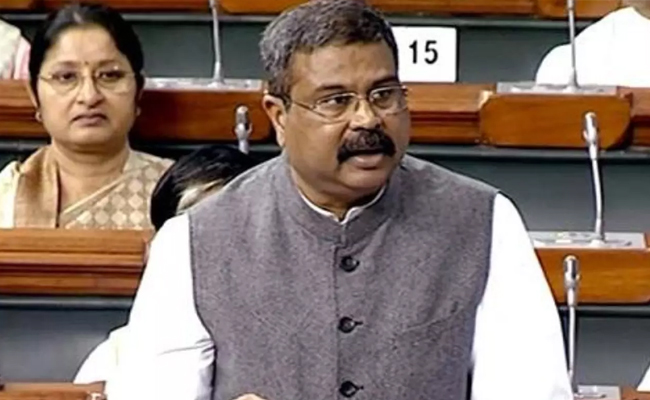
New Delhi: A bill to set up a 13-member body to regulate institutions of higher education was introduced in the Lok Sabha on Monday.
Union Education Minister Dharmendra Pradhan introduced the Viksit Bharat Shiksha Adhishthan Bill, which seeks to establish an overarching higher education commission along with three councils for regulation, accreditation, and ensuring academic standards for universities and higher education institutions in India.
Meanwhile, the move drew strong opposition, with members warning that it could weaken institutional autonomy and result in excessive centralisation of higher education in India.
The Viksit Bharat Shiksha Adhishthan Bill, 2025, earlier known as the Higher Education Council of India (HECI) Bill, has been introduced in line with the National Education Policy (NEP) 2020.
The proposed legislation seeks to merge three existing regulatory bodies, the University Grants Commission (UGC), the All India Council for Technical Education (AICTE), and the National Council for Teacher Education (NCTE), into a single unified body called the Viksit Bharat Shiksha Adhishthan.
At present, the UGC regulates non-technical higher education institutions, the AICTE oversees technical education, and the NCTE governs teacher education in India.
Under the proposed framework, the new commission will function through three separate councils responsible for regulation, accreditation, and the maintenance of academic standards across universities and higher education institutions in the country.
According to the Bill, the present challenges faced by higher educational institutions due to the multiplicity of regulators having non-harmonised regulatory approval protocols will be done away with.
The higher education commission, which will be headed by a chairperson appointed by the President of India, will cover all central universities and colleges under it, institutes of national importance functioning under the administrative purview of the Ministry of Education, including IITs, NITs, IISc, IISERs, IIMs, and IIITs.
At present, IITs and IIMs are not regulated by the University Grants Commission (UGC).
Government to refer bill to JPC; Oppn slams it
The government has expressed its willingness to refer it to a joint committee after several members of the Lok Sabha expressed strong opposition to the Bill, stating that they were not given time to study its provisions.
Responding to the opposition, Parliamentary Affairs Minister Kiren Rijiju said the government intends to refer the Bill to a Joint Parliamentary Committee (JPC) for detailed examination.
Congress Lok Sabha MP Manish Tewari warned that the Bill could result in “excessive centralisation” of higher education. He argued that the proposed law violates the constitutional division of legislative powers between the Union and the states.
According to him, the Bill goes beyond setting academic standards and intrudes into areas such as administration, affiliation, and the establishment and closure of university campuses. These matters, he said, fall under Entry 25 of the Concurrent List and Entry 32 of the State List, which cover the incorporation and regulation of state universities.
Tewari further stated that the Bill suffers from “excessive delegation of legislative power” to the proposed commission. He pointed out that crucial aspects such as accreditation frameworks, degree-granting powers, penalties, institutional autonomy, and even the supersession of institutions are left to be decided through rules, regulations, and executive directions. He argued that this amounts to a violation of established constitutional principles governing delegated legislation.
Under the Bill, the regulatory council will have the power to impose heavy penalties on higher education institutions for violating provisions of the Act or related rules. Penalties range from ₹10 lakh to ₹75 lakh for repeated violations, while establishing an institution without approval from the commission or the state government could attract a fine of up to ₹2 crore.
Concerns were also raised by members from southern states over the Hindi nomenclature of the Bill. N.K. Premachandran, an MP from the Revolutionary Socialist Party representing Kollam in Kerala, said even the name of the Bill was difficult to pronounce.
He pointed out that under Article 348 of the Constitution, the text of any Bill introduced in Parliament must be in English unless Parliament decides otherwise.
DMK MP T.M. Selvaganapathy also criticised the government for naming laws and schemes only in Hindi. He said the Constitution clearly mandates that the nomenclature of a Bill should be in English so that citizens across the country can understand its intent.
Congress MP S. Jothimani from Tamil Nadu’s Karur constituency described the Bill as another attempt to impose Hindi and termed it “an attack on federalism.”
_vb_22.jpeg)