Consumer forum orders Flipkart to pay man Rs 10k for mental harassment after it cancels iPhone order
Mumbai, Mar 17: A consumer disputes redressal commission here found Flipkart guilty of adopting unfair trade practices and ordered it to pay a customer Rs 10,000 for the mental harassment he suffered after it cancelled his iPhone order.
The cancellation was intentional to make extra profit, which amounts to a deficiency in service and unfair and restrictive trade practice adopted by the online platform, said the District Consumer Disputes Redressal Commission, Central Mumbai, in the order passed last month.
The detailed order was available on Sunday.
The commission noted that though the customer had received a refund, he needed to be compensated for the mental harassment and agony he suffered because of the unilateral cancellation of his order.
As per the complainant, a Dadar resident, he ordered an iPhone from Flipkart on July, 10 2022 and paid Rs 39,628 using his credit card.
The phone was supposed to be delivered on July 12, but six days later he received an SMS from the e-commerce company that his order was cancelled.
When contacted, the company told him that their Ekart delivery boy had made several attempts to deliver the product but the complainant was unavailable and hence, the order was cancelled.
The cancellation has not only caused loss, and mental harassment but also subjected him to online fraud, the complainant said.
Flipkart's delivery partner, Ekart Logistics, was also a party to the complaint but the commission held that it is a delivery partner and there is no consumer and service provider relationship between the complainant and the logistics firm.
Flipkart, in its written response, said the complainant had mistakenly taken it as the seller of the product.
The company said it merely operates as an online platform as an intermediary, and all the products on the platform are sold and supplied by independent third-party sellers.
The seller in this case was International Value Retail Private Limited, and Flipkart had no role to play in the entire transaction entered between the complainant and the seller, it said.
The company claimed that it informed the seller of the complainant's grievance, the latter said the delivery person had made several attempts to deliver the product to the address but the complainant was unavailable and hence, the order was cancelled by the seller.
The money has been refunded and the dispute exists only between the complainant and the seller, and there is no cause of action against Flipkart, it said.
However, the commission, noted that the order was "unilaterally cancelled" by the e-commerce company that too when the complainant was constantly in touch with it and was assured that his concern was being looked into.
It further said Flipkart had not produced any proof about multiple attempts of service by it or by the seller as claimed.
The commission noted that Flipkart has admitted that the order was cancelled and the complainant was asked to place a fresh order.
This adds weight to the complainant's case that the cost of the said product had increased by around Rs 7,000 and hence the order was cancelled and he was asked to place a fresh order, it said.
The commission pointed out that Flipkart had done this intentionally to make extra profit, which amounts to a deficiency in service and unfair and restrictive trade practices adopted by it.
"Though the complainant has received the refund, he needs to be compensated for the mental harassment and agony suffered by him due to the unilateral cancellation of his order by Flipkart," it said.
The commission ordered Flipkart to pay Rs 10,000 towards compensation for the mental harassment and agony suffered by the complainant and Rs 3,000 towards the cost.
Let the Truth be known. If you read VB and like VB, please be a VB Supporter and Help us deliver the Truth to one and all.
KKR defeat LSG via Super Over
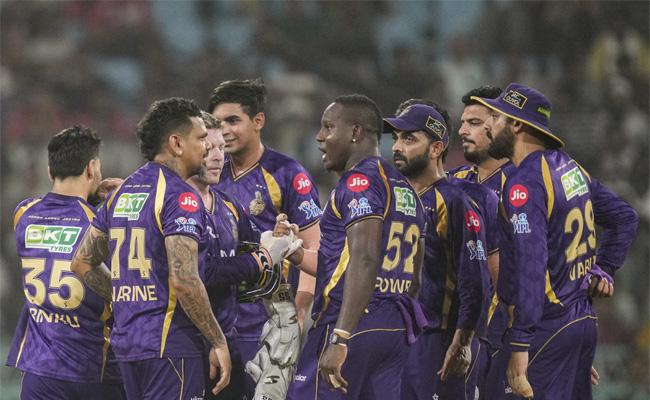
Lucknow (PTI): Kolkata Knight Riders edged Lucknow Super Giants via Super Overs in a battle between two bottom-placed teams in the IPL, here on Sunday.
Chasing a modest 156, LSG suffered a batting collapse and managed to tie the contest and take it to Super Over with No. 9 Mohammed Shami striking a last-ball six against a wayward Kartik Tyagi, who leaked 16 runs in the final over.
But Sunil Narine bowled a stunning Super Over conceding just one run and taking two wickets to give KKR an easy target.
Rinku Singh then finished the chase with a boundary off first ball from Prince Yadav.
Earlier the KKR were in deep trouble with 93/7 in 15 overs but Rinku smashed a sensational 83 not out from 51 balls including four sixes in a row in the final over to lift them to 155/7.
Cameron Green (34) was the only other batter to reach double-digit scores as KKR suffered a familiar batting meltdown with Mohsin taking his maiden fifer.
In reply, LSG continued their dismal show with the bat to succumb to their fifth loss in a row.
Brief Scores:
Kolkata Knight Riders 155/7; 20 overs (Rinku Singh 83 not out, Cameron Green 34; Mohsin Khan 5/23). Lucknow Super Giants 155/8; 20 overs (Rishabh Pant 42). KKR won via Super Over.