Countdown begins for PSLV-C45 mission with many a firsts for ISRO
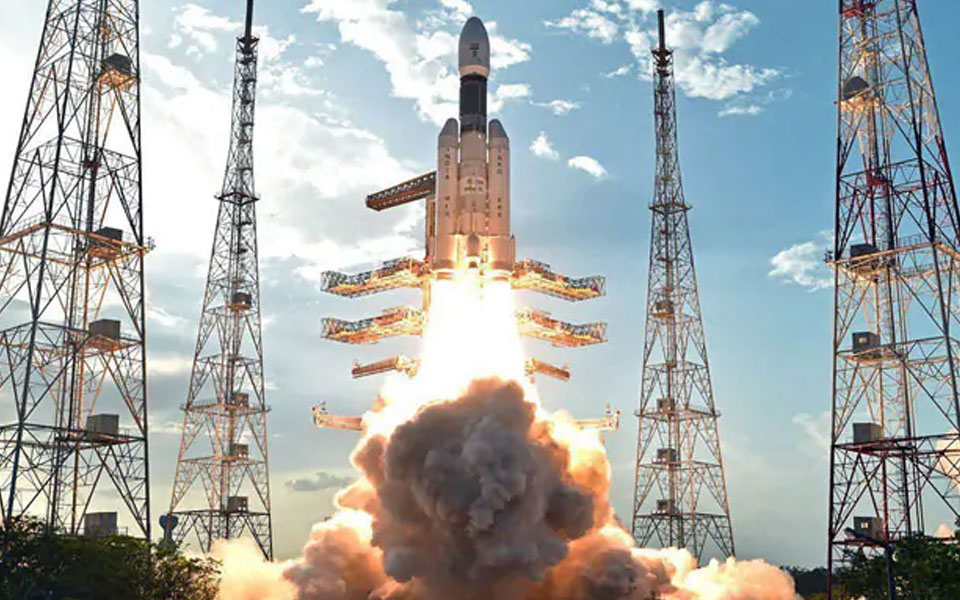
Chennai: A 27-hour countdown began Sunday for the launch of India's EMISAT satellite along with 28 nano satellites of global customers from Sriharikota Monday, a mission which would witness the ISRO placing payloads in three orbits and conducting space experiments for the first time.
The EMISAT satellite is aimed at electromagnetic measurement.
The countdown began at 6.27 am for the launch on board Indian Space Research Organisation's third generation workhorse Polar Satellite Launch Vehicle (PSLV), in its 47th flight, ISRO said.
The four-stage PSLV-C45 will blast off from the second launch pad at the spaceport of Sriharikota, about 125 kms from here, at 9.27 AM Monday, agency officials said.
The mission will mark several firsts to the credit of the space agency as it would manoeuvre satellites in various orbits and orbital experiments including on maritime satellite applications.
According to ISRO, a new variant of the rocket PSLV-QL equipped with four Strap-On motors in the first stage is used for the launch.
PSLV, also used in India's two key missions -- "Chandrayan" in 2008 and Mars Orbiter in 2013, is a reliable and versatile launch vehicle for ISRO with 39 consecutive successful flights till June, 2017 and five-in-a row from January 2018.
The rocket has encountered only two failures so far -- its maiden developmental flight ended unsuccessful way back in 1993. In September, 2017 the flight went off without any hitch but the IRNSS-1H Satellite could not be released into orbit after the PSLV-C39's heat shield failed to open on reaching the orbit.
In Monday's mission, ISRO scientists would place the satellites and payloads in three different orbits, a first for the agency.
After injecting the 436 kg primary satellite EMISAT, intended for electromagnetic spectrum measurement, at around 17 minutes from lift off in a 749 km orbit, they would restart the fourth stage again.
During this initiative, all the other 28 customer satellites, totally weighing about 220 kgs, would be released by lowering the fourth state to around 504 kms orbit.
Again, the fourth stage would be reignited and further lowered to 485 kms orbit to serve as an orbital platform for carrying out space borne experimentations for the first time in ISRO's history.
According to ISRO, this is the first time it has been envisaged to provide a micro-gravity environment for research organisations and academic institutes to perform experiments.
The PS4-fourth stage hosts three payloads in this mission. They are automatic identification system from ISRO for Maritime satellite applications capturing messages transmitted from ships.
Automatic Packet Repeating System from AMSAT (Radio Amateur Satellite Corporation), India to assist amateur radio operators in tracking and monitoring position data.
Advanced Retarding Potential Analyzer for lonospheric Studies (ARIS) from Indian Institute of Space Science and Technology (IIST) for the structural and composition studies of ionosphere.
The other 28 international satellites -- 25 3U type, two 6U type and one 2U type nano satellites -- are from Lithuania (two), Spain (1), Switzerland (1) and the United States (24).
All these satellites are being launched under commercial arrangements, ISRO said.
The previous launches by ISRO this year include the imaging satellite Microsat-R for military purpose along with 1.2 kg Kalamsat in January onboard PSLV-C44.
In February, ISRO launched India's communication satellite GSAT-31 from the European launch service provider Ariane from French Guiana.
Let the Truth be known. If you read VB and like VB, please be a VB Supporter and Help us deliver the Truth to one and all.
EAM Jaishankar meets Jamaican PM, gifts over 10 BHISHM Cubes
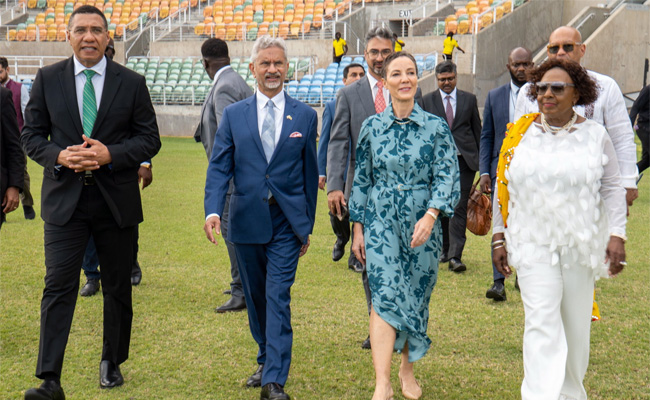
Kingston (PTI): External Affairs Minister S Jaishankar on Monday met Jamaican Prime Minister Andrew Holness and discussed ways to further deepen "political, economic and people-to-people cooperation."
Jaishankar also conveyed greetings from Prime Minister Narendra Modi to Holness.
"Pleased to call on Prime Minister @AndrewHolnessJM in Kingston. Conveyed the greetings of PM @narendramodi," Jaishankar posted on X.
"Discussed deepening our political, economic and people-to-people cooperation. Value his commitment towards further strengthening India-Jamaica relations," the post further read.
Also, the external affairs minister handed over 10 BHISHM (Bharat Health Initiative for Sahyog Hita & Maitri) Cubes as a gift to Jamaica.
"Formally handed over 10 BHISHM Cubes as a gift from India to Jamaica, in the presence of PM @AndrewHolnessJM, Health Minister @christufton and FM @kaminajsmith," Jaishankar posted on X.
"The BHISHM Cube mobile hospital system, designed for rapid deployment, will help Jamaica during disasters and emergencies. The gift of these cubes is a statement of friendship, a commitment to disaster preparedness, and an outcome of innovation," the post said.
Jaishankar arrived in Kingston on Saturday evening, marking the first leg of his nine-day tour of Jamaica, Suriname, and Trinidad and Tobago, aimed at further strengthening India's strategic and cultural ties with the Caribbean nations.
Earlier in the day, he interacted with the Indian diaspora and discussed India's ongoing transformation in infrastructure, human development and technology-driven governance and entrepreneurship with them.
He also highlighted the cricket bond between both countries as India gifted a scoreboard to Jamaica.
A scoreboard was dedicated at Sabina Park in Kingston. It is the home of the Jamaica cricket team and is the only Test cricket ground in the Caribbean island nation.
The minister expressed hope that the new scoreboard would witness many memorable innings, including those symbolising the enduring friendship between the two countries.
Cricket has long been a strong cultural bridge between India and Jamaica, which is part of the West Indies cricket team.
Jamaican players, including Chris Gayle, Courtney Walsh and Michael Holding, have played a major role in shaping the legacy of West Indies cricket in the international arena, contributing to its dominance in earlier decades and its continued global appeal.