Counting of votes for Lok Sabha polls Thursday, matching VVPAT slips likely to delay results
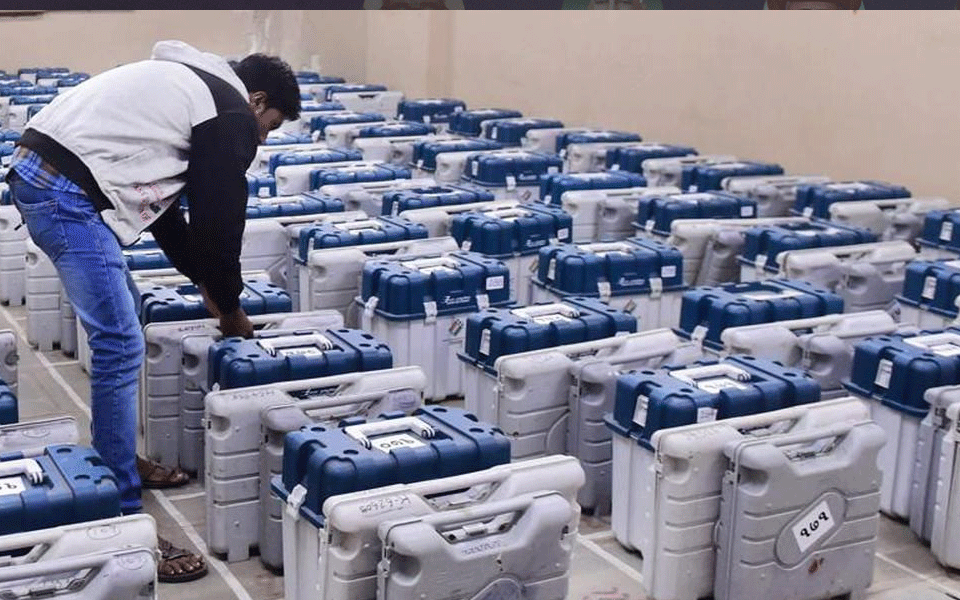
New Delhi: Counting of votes for the Lok Sabha elections, in which over 8,000 candidates were in the fray for 542 seats, will begin at 8.00 am Thursday and results are expected only by late evening due to tallying of voter verified paper audit trail slips with EVM count for the first time.
67.11 per cent of the 90.99 crore electors had cast their vote in the seven phase elections.This is the highest ever-voter turnout in Indian parliamentarian elections.
This is for the first time in a Lok Sabha election that results of voting machines will be matched with slips generated by paper trail machines.
The exercise will take place in five polling stations per assembly segment which effectively means that out of nearly 10.3 lakh polling stations, the EVM-VVPAT matching will take place in 20600 such stations.
The Election Commission is yet to provide the number of counting centres being set up for Thursday, saying the data is not centrally available.
As per procedure, postal ballots would be the first to be counted.
Service voters stood at 18 lakh. These include personnel of the armed forces, central police force personnel and state police personnel who are posted outside their constituencies.
Diplomats and support staff posted in Indian embassies abroad are also counted as service voters. Out of 18 lakh registered voters, 16.49 lakh have sent their postal ballots to their respective returning officers as on May 17.
The exercise of counting postal ballots manually will itself take a couple of hours at least, an EC official said.
The paper trail machines slips will be counted in the end. As per the procedure, first the slips will be counted and the EVM displays would be switched on later to match the results.
In case of a mismatch, the results based in paper slip count will be considered as final. The entire exercise of EVM-Paper trail machine matching will take an additional four to five hours.
Out of the 543 Lok Sabha seats, elections were held in 542 constituencies as the EC had cancelled polls to the Vellore constituency on the grounds of excessive use of money power.
The poll panel is yet to announce a fresh date for elections in Vellore.
Prime Minister Narendra Modi, several union ministers, Congress President Rahul Gandhi, UPA chairperson Sonia Gandhi and SP chief Akhilesh Yadav are among key leaders who contested the polls.
Let the Truth be known. If you read VB and like VB, please be a VB Supporter and Help us deliver the Truth to one and all.
TN Governor should invite Vijay to form govt, then prove majority: Former MP Prakash Ambedkar
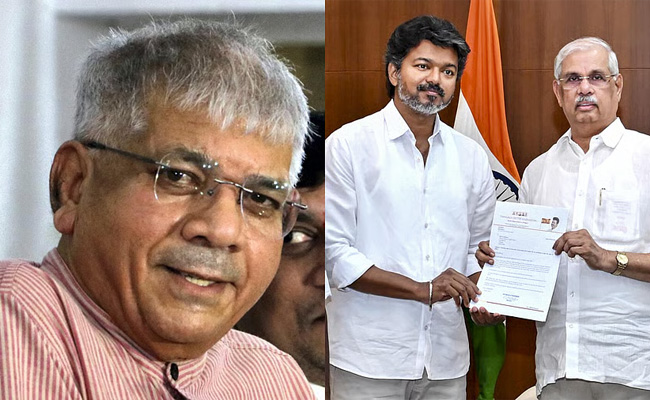
Mumbai: Senior politician and constitutional expert Prakash Ambedkar has opined that Tamil Nadu Governor Rajendra Arlekar should invite the Tamilaga Vettri Kazhagam President Vijay to form the government as his party emerged as the single largest party in the Assembly elections.
Ambedkar, who is a Mumbai-based advocate, activist and also the grandson of Dr. BR Ambedkar, is a former Parliamentarian.
Citing articles from the Constitution and similar incidents in the political history of the nation, Prakash Ambedkar has explained why Vijay cannot be stopped from forming the government in Tamil Nadu, reports Deccan Herald.
“Merely doubt over whether the TVK has the necessary number cannot suffice to withhold the invitation to the party to form the government. The Governor should invite Vijay, President of TVK, the single-largest party, to form the government and assume office as the next Chief Minister. After taking charge, as per the Article 164 (2) of the Constitution, Vijay will have to prove that his government has a majority in the House,” Ambedkar explained.
He also gave examples from India’s political history supporting his argument.
Ambedkar cited the example of the 1989 Lok Sabha elections and said that, although the Congress (I) emerged the single-largest party with 194 seats, Rajiv Gandhi declined the invitation by President R Venkataraman to form the government. “My friend Vishwanath Pratap Singh, leader of the National Front, was then invited and sworn in as Prime Minister on December 2, 1989,” he added.
He then recalled the 1996 elections to the Lower House of the Parliament, when the BJP emerged the single-largest party, but the Parliament was hung as the BJP lacked a majority. “Atal Bihari Vajpayee was invited by President Shankar Dayal Sharma to form the government and was sworn in as Prime Minister. Vajpayee resigned 13 days later on May 28, 1996, after failing to secure majority support in the Lok Sabha,” Ambedkar explained.