Court seeks CBI response on Chidambaram's plea
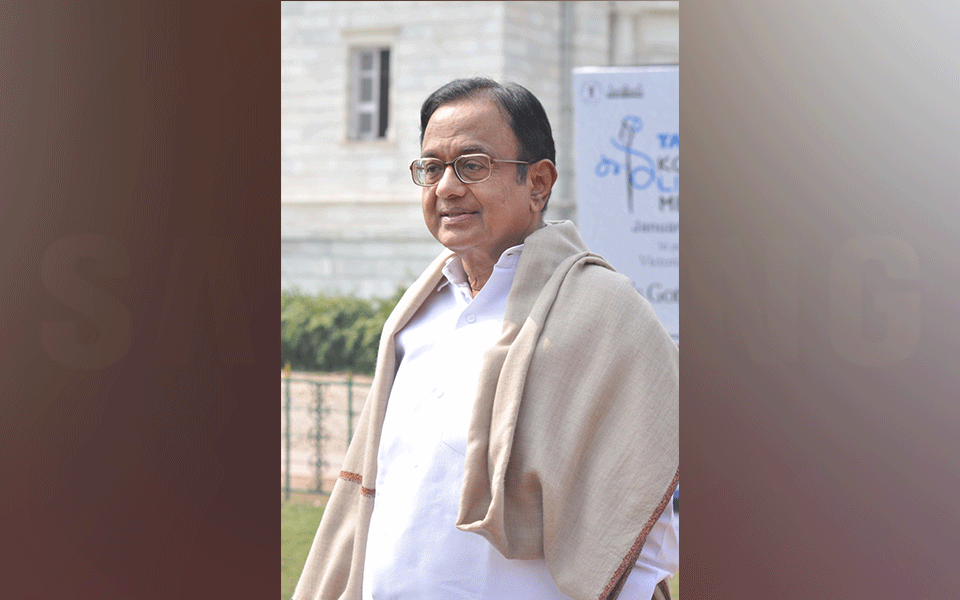
New Delhi, Aug 28 : A court here on Tuesday directed the CBI to respond to former Union Finance Minister P. Chidambaram's plea wherein he alleged that the agency is not interested in a fair trial in the Aircel-Maxis case as part of the charge sheet was leaked to the media.
Special Judge O.P. Saini asked the Central Bureau of Investigation (CBI) to file its response and listed the matter for October 8.
"The CBI has clandestinely provided a copy of the charge sheet to a newspaper which is publishing it in instalments to sensationalise the issue and prejudice the rights of the accused," Chidambaram said in his plea.
Chidambaram pleaded that the CBI wanted a media trial, which was causing grave prejudice to the rights of the accused. "The CBI is making a mockery of the judicial process, resulting in complete travesty of justice," the petitioner said.
Chidambaram, a senior Congress leader, his son Karti and others have been charge sheeted in the Aircel-Maxis case by the CBI which claims that he as the then Finance Minister had the power to approve foreign investments only up to Rs 600 crore but cleared the Rs 3,200-crore investment without referring the matter to the Cabinet Committee of Economic Affairs.
Chidambaram pointed out that the court had not taken cognisance of the charge sheet, and hence copies of the same have not been supplied to any of the accused.
He did not seek any particular direction but urged the court to pass any order as it deems fit in the interest of justice.
On Monday Chidambaram had maintained that he had approved the deal on the basis of a proposal from the Foreign Investment Promotion Board (FIPB).
"The CBI leaks its charge sheet to one newspaper because it wants a trial by the media. Fortunately, under our legal system, the trial can take place only in a court of law," Chidambaram had said on Twitter.
"It is the FIPB that decides if a proposal falls within the competence of the Finance Minister. The FIPB put up the proposal to me and I approved it along with 20 other proposals," he had added.
Let the Truth be known. If you read VB and like VB, please be a VB Supporter and Help us deliver the Truth to one and all.
Maharashtra sets up state vaccination task force to strengthen immunisation programme

Mumbai (PTI): The Maharashtra government has set up a State Vaccination Task Force to strengthen the regular immunisation programme and review the progress of related campaigns, a health department official said on Monday.
The State Vaccination Task Force will comprise at least 29 members and will be headed by the administrative head of the health department, he informed.
The government has also constituted separate district-level and municipal vaccination task forces to improve implementation and address challenges at the grassroots level, he said.
Municipal task forces, chaired by respective civic commissioners, have been constituted in view of the vast urban population in Maharashtra and the role of civic bodies in implementing different health programmes.
The district-level task forces will function under the chairmanship of collectors.
"Complete immunisation of children at the appropriate age is an extremely simple, cost-effective and highly effective measure to reduce child mortality and the prevalence of diseases among kids. Immunisation is a powerful tool for reducing illness in children," maintained the official.
To ensure full vaccination of all children, the state government implements various campaigns from time to time as per the central government guidelines, he pointed out.
"Active participation and cooperation of other relevant government departments are essential (in making these campaigns successful)," according to the official.
The state-level body will review the regular immunisation programme, associated campaigns and vaccine-preventable diseases in detail. It will also conduct focused assessments of high-risk districts and municipal corporations, including vacancies at district, municipal and sub-district levels, availability of cold chain equipment, resource gaps and training requirements, he noted.
The state task force will review allocation and utilisation of funds for immunisation and ensure timely action by officers concerned based on reports from district and municipal task forces and state-level monitoring mechanisms, the official said.
It will also ensure active coordination and participation of other government departments in immunisation drives, while district and municipal task forces will carry out similar functions at their respective levels, the official added.