COVID-19: Court denies bail to murder case accused saying they are safe in jail than outside
Mumbai: Observing that the accused lodged in jails are in a "secure situation" compared to the daily working people in society who are exposed to the "outside social atmosphere", a court here had rejected the interim bail plea of Chintan Upadhaya, arrested in connection with the murder of his artist wife and her lawyer in 2015, and another accused who had sought the relief citing the COVID-19 pandemic.
A detailed order of the court was made available on Tuesday.
Chintan Upadhaya and Pradeep Rajbhar had sought temporary bail citing a surge in COVID-19 cases, coronavirus variants and the pandemic.
Hema Upadhyay, a Mumbai-based artist, and her lawyer Haresh Bhambhani were killed on December 11, 2015 and their bodies disposed of in suburban Kandivali.
Denying them relief, additional sessions judge D D Khoche said jail authorities are taking care of inmates "at their level best and therefore the pandemic could not effectively spread in the prison".
"Rather, as compared with the daily-working people in the society who are usually exposed to the outside social atmosphere, applicants/accused can be observed as comparatively in a secure situation in the jail," the judge noted.
He further observed that the second wave of the pandemic is now under control.
"Though this court may understand the feelings of the accused, even pains that they are kept in jail under this fearful situation of COVID-19, in view of the proceeding of the trial and for want of the recommendation to release the accused in a murder case on interim bail. (But) the court cannot consider their situation, because it is the case beyond its limitation," the court added.
The court on Tuesday directed the prosecution to produce witnesses to testify before the court from the next hearing which is scheduled on July 27.
However, the trial couldn't progress due to the pandemic.
Chintan Upadhyay was arrested on December 22, 2015, for the murders and is currently in judicial custody.
The other arrested accused are Shiv Kumar Rajbhar, Pradip Kumar Rajbhar, Vijay Kumar Rajbhar and Azad Rajbhar. Another accused Vidhyadhar continues to be absconding.
Let the Truth be known. If you read VB and like VB, please be a VB Supporter and Help us deliver the Truth to one and all.
TN Governor should invite Vijay to form govt, then prove majority: Former MP Prakash Ambedkar
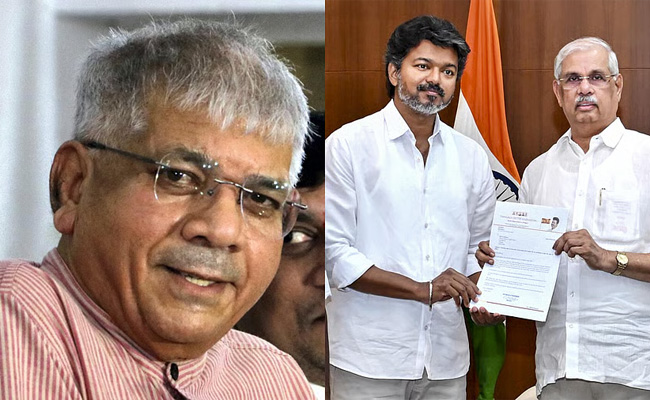
Mumbai: Senior politician and constitutional expert Prakash Ambedkar has opined that Tamil Nadu Governor Rajendra Arlekar should invite the Tamilaga Vettri Kazhagam President Vijay to form the government as his party emerged as the single largest party in the Assembly elections.
Ambedkar, who is a Mumbai-based advocate, activist and also the grandson of Dr. BR Ambedkar, is a former Parliamentarian.
Citing articles from the Constitution and similar incidents in the political history of the nation, Prakash Ambedkar has explained why Vijay cannot be stopped from forming the government in Tamil Nadu, reports Deccan Herald.
“Merely doubt over whether the TVK has the necessary number cannot suffice to withhold the invitation to the party to form the government. The Governor should invite Vijay, President of TVK, the single-largest party, to form the government and assume office as the next Chief Minister. After taking charge, as per the Article 164 (2) of the Constitution, Vijay will have to prove that his government has a majority in the House,” Ambedkar explained.
He also gave examples from India’s political history supporting his argument.
Ambedkar cited the example of the 1989 Lok Sabha elections and said that, although the Congress (I) emerged the single-largest party with 194 seats, Rajiv Gandhi declined the invitation by President R Venkataraman to form the government. “My friend Vishwanath Pratap Singh, leader of the National Front, was then invited and sworn in as Prime Minister on December 2, 1989,” he added.
He then recalled the 1996 elections to the Lower House of the Parliament, when the BJP emerged the single-largest party, but the Parliament was hung as the BJP lacked a majority. “Atal Bihari Vajpayee was invited by President Shankar Dayal Sharma to form the government and was sworn in as Prime Minister. Vajpayee resigned 13 days later on May 28, 1996, after failing to secure majority support in the Lok Sabha,” Ambedkar explained.