Crimes against women 'skyrocketed uncontrollably' under BJP-JD(U) rule in Bihar: Congress
New Delhi (PTI): The Congress on Tuesday alleged that crimes against women have "skyrocketed uncontrollably" under the BJP-JD(U) rule in Bihar and posed questions to Prime Minister Narendra Modi on the alleged "neglect" of women's safety, health, and dignity in the last 20 years.
Congress president Mallikarjun Kharge slammed the BJP-JD(U) over the security situation for women and asserted that the Mahagathbandhan is fully committed to their empowerment and economic upliftment.
Kharge said the Congress' promises are not just to garner votes during elections or right before them, but rather, they are the same promises that the party will fulfil.
Congress general secretary in charge of communications, Jairam Ramesh, alleged that for the 20 years under the BJP-JD(U) government in Bihar, there has been a "consistent neglect" of women's safety, health, and dignity.
The prime minister didn't remember to check on Bihar's women for an entire decade, and now, at election time, a sham digital outreach is being staged for votes, Ramesh said.
In a post in Hindi on X, Kharge said, "The BJP-JDU government in Bihar has been in power for 20 years. If even today, Modi ji has to say that in Bihar 'daughters-in-law and daughters are not safe', then this is his self-admission that in 20 years, they have not made Bihar safe!".
He alleged that the situation of women and children in the state is extremely alarming.
Citing data from the National Family Health Survey (NFHS), Kharge claimed that 70 per cent of children in the state were afflicted with anaemia and 40 per cent were victims of malnutrition. Only 11 per cent of infants receive adequate nutrition, he said.
The Mahagathbandhan is fully committed to the empowerment and economic upliftment of half the population, he said, referring to women.
Listing the promises made to women by the Mahagathbandhan, Kharge said they will be given an assistance of Rs 2,500 per month if the opposition alliance comes to power.
A monthly pension of Rs 1,500-Rs 3,000 would be given to the elderly, widows, and disabled, while Jeevika Didis will be given official status, he said.
"Our promises are not just to garner votes during elections or right before them, but rather, they are the same promises that we will fulfil-and we have already fulfilled them in Congress-ruled states," he said.
Ramesh further slammed the government for the alleged rise in crimes against women.
"That's why today we're asking three direct questions: Crimes against women have skyrocketed uncontrollably under the BJP-JD(U) rule: A 336 per cent increase in crimes against women -- compared to before, now 20,222 crimes every year, with a total of 2,80,000 women victimised so far," he said in a post in Hindi on X.
Ramesh said 1,17,947 cases were pending in courts, with a 98.2 per cent pendency rate -- which he claimed was the highest in the country.
He said there has been a 1097 per cent surge in cases of women abductions -- from 929 in a year earlier to 10,190 every year now.
Despite record-breaking crimes against women, why has the BJP-JD(U) government failed to provide them security, Ramesh asked.
Women and adolescent girls in Bihar are suffering from severe anaemia, he said, adding that the data shows the situation is extremely alarming. Despite such a massive health crisis for women, why has the BJP-JD(U) government turned a blind eye, Ramesh asked.
Panicking over an impending electoral defeat, the government is now depositing Rs 10,000 into women's accounts, he claimed.
"But lakhs of daughters in Bihar are badly trapped in the debt web of microfinance companies: 1 crore 9 lakh women are already ensnared in this debt trap. Average outstanding dues have reached up to 30,000 rupees/month. As a result, there's a reign of terror by recovery agents, social humiliation, migration, and even suicides," Ramesh said.
"Sunita Devi from West Champaran is a living example of this: She took a loan of 40,000 rupees. After insurance/deductions, she received 33,000 rupees in hand and repaid 68,200 rupees over 2 years at 2,800/month. Even so, as soon as one instalment was missed, she received a threat from recovery agents that they would abduct her daughter," the Congress leader said.
And this is no exception -- there are lakhs of such cases in Bihar, Ramesh added.
"So the question is: Whose patronage is the microfinance mafia receiving? No compromise on women's safety, dignity, and rights. For liberation from atrocities against women -- freedom from NDA's rule is essential," Ramesh said.
The Bihar polls will be held in two phases on November 6 and 11, and results will be announced on November 14.
The opposition INDIA bloc, which has the RJD, the Congress and the Left parties as the main constituents, has declared RJD leader Tejashwi Yadav its chief ministerial candidate.
Let the Truth be known. If you read VB and like VB, please be a VB Supporter and Help us deliver the Truth to one and all.
Madhu Kishwar booked over misleading content on social media
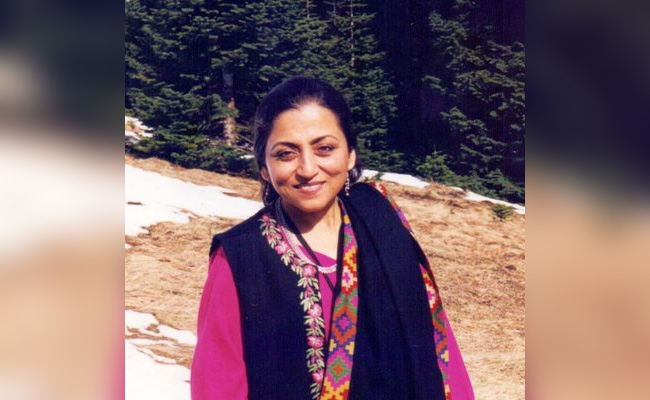
Chandigarh (PTI): Madhu Kishwar has been booked following a complaint by a Chandigarh resident over the alleged circulation of forged and misleading content on social media.
An FIR has been lodged against Kishwar and some other social media users under relevant sections, including 196 (criminalises acts that promote enmity, hatred, or ill-will between groups based on religion, race, language), 336 (1) (forgery) and 356 (criminal defamation) of Bharatiya Nyaya Sanhita and the IT Act at Police Station Sector-26 here.
According to an official statement issued by the Chandigarh police on Monday, a city-based complainant on April 19 alleged that some forged and misleading social media posts and video clips with obscene text and content were being circulated by various social media users, misidentifying the person in the video.
Further investigation into the matter is underway.
As per the complainant, it is a deliberate act of creating a false electronic record using obscene words and phrases, having knowledge and sufficient reason to believe that the posts are misleading and false, with the intent to cause damage or injury.
The video, which circulated with the intent to cause harm to the reputation of a constitutional authority and to disturb public peace and tranquility, should be investigated, and appropriate action should be taken, according to the complainant.
As per the complainant, the person seen in the video is a travel vlogger whose wife regularly posts updates about their activities on social media. The original video was shared from her social media account.
"As per the statement of the woman, she disclosed that the person in the video shared from her account is her husband. Statements of her husband and another lady in the video have also been recorded during preliminary investigation," said police in the statement.
Meanwhile, Kishwar, in a social media post, said a team of Chandigarh police had visited her late Monday night to serve her notice regarding the FIR registered against her.
"Since the law forbids the police to visit or arrest women after dark and before sunrise, I spoke on phone to the leader of the delegation. She told me that their team has come to serve notice regarding an FIR registered against me in Chandigarh. I insisted that they go by the law and come in the morning," she wrote on X.