Cyclone Montha: Rain, landslides damage roads, bridge and houses in Odisha
_vb_06.jpeg)
Bhubaneswar (PTI): Several parts of Odisha on Wednesday experienced light to moderate rain as the severe cyclonic storm Montha weakened into a deep depression and caused landslides, damaging roads, bridges and houses in southern districts, officials said.
Revenue and Disaster Management Minister Suresh Pujari thanked Lord Jagannath as the severe cyclonic storm slightly changed its anticipated landfall place in Andhra Pradesh coast at a distance of about 300 kilometer from Odisha’s Malkangiri district.
“The change in the cyclone’s trajectory spared Odisha from severe devastation. Cyclone Montha changed its course and touched land near Amalapuram instead of Kakinada in Andhra Pradesh, reducing the potential impact on Odisha. Kakinada is about 200 kilometres from Malkangiri,” Pujari told reporters after taking stock of the situation.
The minister said that the state government had made preparations keeping in view the IMD forecast and was prepared to face the eventuality.
Replying to a question on the change of expected landfall place, Dr Manorama Mohanty, the director of the Bhubaneswar Meteorological Centre, said, “The cyclone’s landfall has occurred within the areas of the cone of uncertainty. There has been no deviation. However, many scientific factors are there for a slight change in the trajectory of the system.”
The 'cone of uncertainty' is the projected path and intensity of a storm.
Meanwhile, in a revised forecast, the IMD issued a ‘yellow alert’ for five southern Odisha districts - Malkangiri, Koraput, Rayagada, Kalahandi and Nabarangpur – that is likely to experience heavy rain. Earlier, the Met Office had said the region would face extremely heavy rainfall and issued a ‘red alert’ (meaning: take action).
The IMD revised the forecast considering the movement of the system which has so far weakened into a deep depression.
“We have issued a 'yellow' warning (be aware) of heavy rainfall, very likely to occur at isolated places in Ganjam, Sundargarh, Keonjhar, Mayurbhanj, Balasore, Bhadrak, Koraput, Malkangiri, Rayagada, Gajpati, Kalahandi, and Nawarangpur districts,” said Mohanty, said.
While briefing the media, Pujari recalled the 1999 super cyclone that hit Odisha on this day, October 29, and left around 10,000 people dead.
“We are encountering a similar cyclone situation on October 29, 2025, but there has been no report of any human casualty so far,” the minister said, adding that the cyclone preparedness measures were made remembering the 1999 super cyclone incident.
Pujari, however, said that there have been reports of house collapse, tree falling, landslide and damage of roads and others. He informed reporters that Cyclone Montha has impacted people in 33 blocks and 11 urban local bodies in Odisha.
A total of 2,198 pregnant women were shifted to safer locations as part of the state’s evacuation efforts, he said.
He said the government opened as many as 362 free kitchens where cooked food was provided to 18,762 people, staying at the cyclone centres.
The minister said that there is also no fear from rains as the amount of rainfall was less than 200 mm. Gosani block in Gajapati district recorded the highest rainfall of around 150 mm followed by Patrapur in Ganjam at 117.4 mm, while 56 other blocks experienced rainfall ranging between 50 mm and 100 mm.
While stating that wind speed was also manageable, the minister said that a few places in Ganjam, Gajapati, Balasore and some other districts experienced power outage, which was restored within hours due to pre-planning and preparations. Roads blocked by uprooted trees were also immediately cleared. A total of 33 ODRAF, 5 NDRF and 13 Fire Services teams were deployed for rescue and restoration work, he said.
The minister, however, said that Odisha will remain on high alert till October 31 as the rain warning continues.
“Damage assessment of crop, houses, roads, and other public infrastructure will begin from tomorrow,” he said, adding that there are reports of damage to paddy, cotton and vegetable crops.
The affected people will be provided assistance as per the norm directly to their bank accounts. Polythene sheets have been distributed to households whose walls were damaged in the calamity, the minister said.
He said normalcy will be restored across the state by October 31.
Tata Power Southern Odisha Distribution Limited, in a statement, said the company has successfully restored electricity supply to more than 9.50 lakh consumers out of the 9.88 lakh affected, within just 18 hours of the cyclone’s peak impact.
Let the Truth be known. If you read VB and like VB, please be a VB Supporter and Help us deliver the Truth to one and all.
Madhu Kishwar booked over alleged misleading content on social media
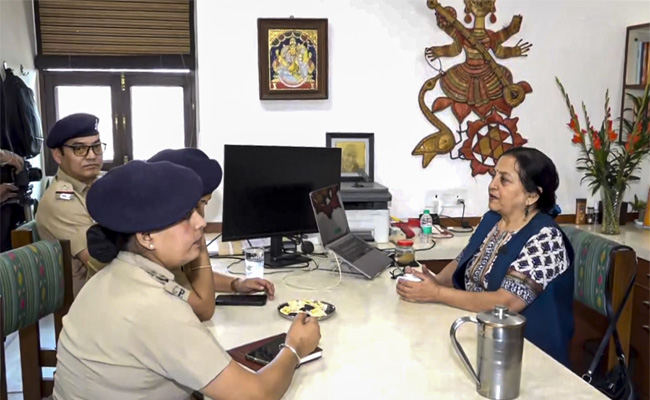
Chandigarh (PTI): Academician Madhu Kishwar has been booked on charges of criminal defamation, promoting enmity and other offences by Chandigarh police following a complaint by a resident alleging circulation of forged and misleading content on social media.
A Chandigarh police team on Tuesday served notice to Kishwar in Delhi, asking her to join the investigation in the case.
Sarita Roy, the Station House Officer of Sector-19 police station in Chandigarh, where the FIR was filed, told reporters in the national capital that the notice was issued under Section 35(3) of the BNSS and that Kishwar has been asked to appear and present her side.
Kishwar and some other social media users have been booked under various sections of Bharatiya Nyaya Sanhita, including 196 (criminalises acts that promote enmity, hatred, or ill-will between groups based on religion, race, language), 336 (1) (forgery) and 356 (criminal defamation), and the IT Act, according to the FIR.
ALSO READ: 21 hours raid fetch nothing for ED, claims Karnataka Cong MLA’s son
They have also been charged under Section 353 (penalises making, publishing, or circulating false information that cause public mischief...) and those related to cheating and forgery under the BNS.
According to a statement by the Chandigarh police, a city-based complainant on April 19 alleged that some forged and misleading social media posts and video clips with obscene text and content were being circulated by various social media users, misidentifying the person in the video.
The complainant alleged that it is a deliberate act of creating a false electronic record using obscene words and phrases, having knowledge and sufficient reason to believe that the posts are misleading and false, with the intent to cause damage or injury.
The video, which circulated with the intent to cause harm to the reputation of a constitutional authority and to disturb public peace and tranquillity, should be investigated, and appropriate action should be taken, the complainant said.
The complainant said the person seen in the video is a travel vlogger whose wife regularly posts updates about their activities on social media. The original video was shared from her social media account.
"As per the statement of the woman, she disclosed that the person in the video shared from her account is her husband. Statements of her husband and another lady in the video have also been recorded during preliminary investigation," said the police statement, adding that further probe is underway.
Meanwhile, Kishwar, in a social media post, said that a Chandigarh police team had visited her late Monday night to serve her notice regarding the FIR registered against her.
"Since the law forbids the police to visit or arrest women after dark and before sunrise, I spoke on phone to the leader of the delegation. She told me that their team has come to serve notice regarding an FIR registered against me in Chandigarh. I insisted that they go by the law and come in the morning," she wrote on X.