Declare Ayodhya site a national heritage: PIL
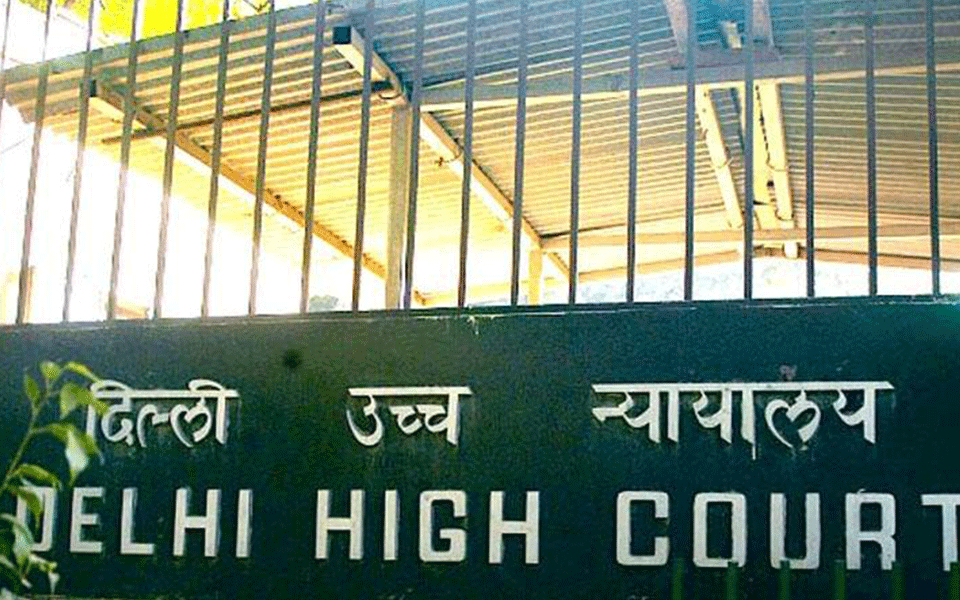
New Delhi, June 1: The Delhi High Court on Friday asked the advocate, who has sought a direction to declare the disputed Ram Janmabhoomi-Babri Masjid site at Ayodhya a national heritage, to file a representation before the Central government.
A bench of Acting Chief Justice Gita Mittal and Justice C. Hari Shankar asked petitioner advocate Anu Mehta to make a representation before the Union Ministry of Culture in this regard and said that the government may consider the representation and take a decision within three months.
The Public Interest Litigation (PIL) was filed by Mehta, who has sought the court's direction for protection and preservation of the ancient and endangered archaeological monument located at Ayodhya.
In the plea, she has sought a direction to declare the Ayodhya site as well as the entire monument at the site as per Ancient Monuments and Archaeological Sites and Remains Act a national heritage.
The petitioner has also sought the court's direction to preserve the protected Ayodhya site, take necessary action to preserve both monuments -- the ancient temple as well as the mosque independently, and if required, separate the superstructure from the original structure of the entire monument at the site to maintain the sanctity of both the monuments.
"Beneath the superstructure lies an ancient monument which dates back to centuries and holds a vital key to the history of the continent's ancient civilisation. Thus, the ancient monument constitutes national heritage as per the provisions of Ancient Monuments and Archaeological Sites and Remains Act," the plea read.
The PIL said that the monument holds vital information and proofs regarding the past civilisation and points at the social, cultural and religious advancement in the region in that era.
The plea also mentions that there also exists a mosque at the site which too may be acquired and protected by the Archaeological Survey of India and holds a historical importance as it signifies and denotes the sad invasion of India by Babur which too is a vital and historically unfortunate event in India's history.
Let the Truth be known. If you read VB and like VB, please be a VB Supporter and Help us deliver the Truth to one and all.
Efforts of party cadres will be rewarded on May 4: DMK chief Stalin
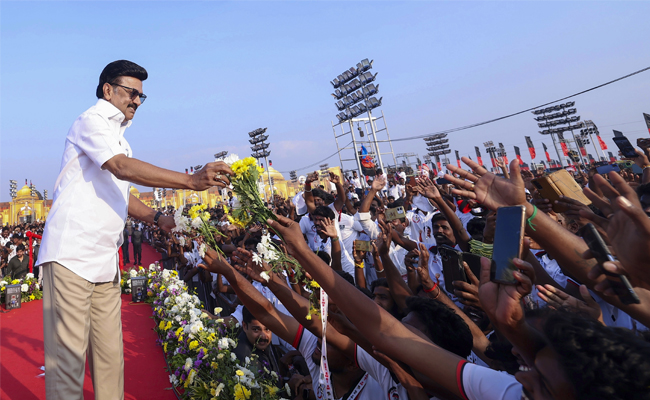
Chennai (PTI): Tamil Nadu Chief Minister M K Stalin on Friday said that the efforts made by his party cadres during the Assembly elections would be rewarded on May 4.
The counting of votes for the Assembly elections held on April 23 will be taken up on May 4.
"We are set to reap the rewards of the hard work put in by our party cadres on the coming fourth (May 4 counting day). There is absolutely no change in this and not even the slightest deviation," Stalin said at a May Day event here.
"There is no need for anyone to assume that I am speaking merely on the basis of exit polls," he added.
Stalin, who is also DMK chief, said that "good news" would come for those eagerly waiting for the election results.
Stating that the DMK governance is based on philosophy and principles, Stalin said, "This will continue."
He recalled the pivotal role of the then Chief Minister C N Annadurai, who first declared May Day as a government holiday, and subsequently, late CM M Karunanidhi, who was instrumental in extending it as a paid holiday across the nation.
"Responding to the request of Kalaingnar (Karunanidhi), the then Prime Minister V P Singh accepted the plea and declared it (May 1) a paid government holiday not merely for Tamil Nadu, but for the entire nation," Stalin said.