Defeating BJP first aim, decision on PM after 2019 polls: Congress sources
New Delhi, Aug 3 : There is a feeling among the opposition parties that the primary task is to defeat the BJP in the 2019 Lok Sabha elections and that the issue of prime ministership will be decided after the results based on the performance of each party, top Congress sources said here, asserting that a "strategic understanding" had been reached with the SP and BSP and the Congress on fighting the polls together in Uttar Pradesh.
The stance on leadership is different from that articulated in media reports last month where the party was seen to be willing to accept any opposition candidate as Prime Minister provided he had no links to RSS over any claims of Rahul Gandhi, who is the Congress candidate for the top post.
Party sources said "a strategic understanding" had been reached between the Congress, the Samajwadi Party and Bahujan Samaj Party to fight the Lok Sabha elections together in Uttar Pradesh and talks were being held between them.
The sources said that the Congress was unlikely to project a Chief Ministerial face in Rajasthan, Madhya Pradesh and Chhattisgarh, where Assembly elections will be held at the end of this year.
They said that the issue of leadership was "divisive" and nothing should be done which can adversely affect the goal of opposition parties to defeat the BJP.
"There is a feeling among all opposition parties that primary job is to defeat institution capturing by RSS. What happens after elections will depend on how different parties perform, what elections have to show. We do not want to get into anything divisive," the party sources said.
They also said that the primary role of the Congress today was to bring opposition parties together. "There should be no confusion in that. We will defeat them by forging a platform," the sources said.
"There is a clear cut line. The first stage is to defeat the BJP together without confusion, without disruption. Stage two is the result. It (leadership) will be decided on that basis," they added.
The sources said if alliances were forged properly across the country, the BJP cannot win.
They said Prime Minister Narendra Modi will need at least 230 seats to be able to continue on the post after 2019 polls and if a proper alliance was stitched between opposition parties in Uttar Pradesh, Bihar and Maharashtra, he would surely be defeated.
"Modi will need 230-240 seats to become Prime Minister after 2019 elections. Without this he can't be Prime Minister. There is a unique characteristic that if their allies get a choice, they will prefer someone else from the BJP.
"All opposition parties have accepted the need of coordination," the sources said.
They also said that the views of state leadership will be important in forging alliances and in places like Telangana and Delhi, where the units are fighting the ruling parties, their views were likely to prevail.
"The party will listen to state units. Broadly state units are clear, where alliance is beneficial, they will do it. Starting point is the state unit. Generally views of the state units will not be ruled out. Such states where state unit is directly fighting -- Telangana, Delhi -- the leadership will not ignore state units," the sources said.
The sources said the RSS - the ideological mentor of BJP - was trying to capture institutions and must be defeated.
"RSS is a cadre-based and a lot more. It is a threat to our institutional structures."
They said the Congress will fight a "decent number of Lok Sabha seats" and the party was unlikely to publicly state its winning target.
The sources said will perform significantly better in states such as Rajasthan, Madhya Pradesh, Chhattisgarh, Punjab, Haryana and Uttarkhand.
Let the Truth be known. If you read VB and like VB, please be a VB Supporter and Help us deliver the Truth to one and all.
Ruckus outside counting centre in Mamata's constituency, TMC claims entry of car with BJP flag
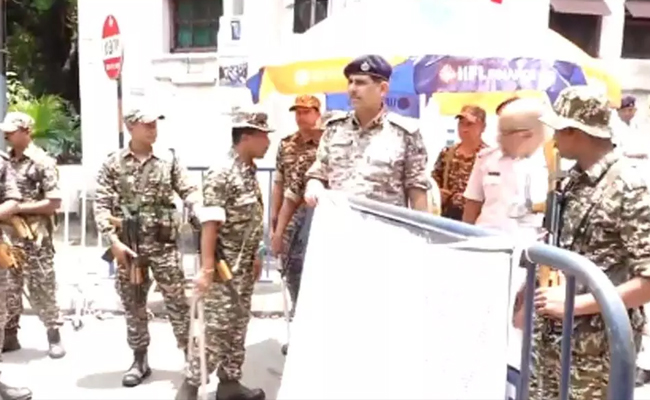
Kolkata (PTI): The counting centre at West Bengal Chief Minister Mamata Banerjee's Bhabanipur assembly constituency witnessed a ruckus a day ahead of the counting of votes, with TMC workers alleging two cars bearing the BJP's flag were allowed entry to the compound where EVMs are kept.
The incident comes close on the heels of a four-hour-long sit-in by Banerjee in front of the same counting centre at the Sakhawat Memorial Girls School on Thursday night, alleging unauthorised entry of persons into the strongroom.
With the polling now over, the wrangling for power in West Bengal has turned into a battle of nerves between the incumbent TMC and the BJP. Workers and leaders of both parties have been keeping a steely gaze on the security of strongrooms across the state where the electoral fate of the candidates is sealed.
Despite expressing her confidence in a "landslide victory", Banerjee has repeatedly aired her apprehensions of "counting malpractice and EVM tampering ahead of the day of results".
On Sunday morning, TMC workers camping 100 metres from the counting centre alleged that two cars with BJP flags entered the premises and went near the strongroom.
"The CAPF personnel at the spot are not allowing any vehicle or person to enter the premises of the counting centre without valid identity proof. Then how come this car, which we have not seen in the past few days, was allowed entry? Once we protested, the central forces asked us to move 100 metres away," a TMC activist said.
The TMC claimed that while the police personnel posted there promised the vehicle would be removed from the spot, it remained there for some time.
A senior Election Commission official said the car was passing by the Harish Mukherjee Road, and after checking by security forces and police, it was allowed to leave as nothing objectionable was found in it.
On Thursday night, two counting centres, including one at Sakhawat Memorial Girls School in the city, witnessed high drama after TMC leaders alleged a lack of transparency and possible malpractice at the strongrooms housing sealed EVMs of the assembly polls, which concluded on April 29.
TMC leaders and candidates, Sashi Panja and Kunal Ghosh, held a sit-in outside the Khudiram Anushilan Kendra counting centre on Thursday evening, alleging unauthorised activities inside the strongroom amid the absence of TMC agents
In Howrah, TMC protested renovation work by the public works department at a place adjacent to the strongroom, and the EC stopped the work temporarily.
On Saturday, the ruling party filed a complaint with the poll panel, alleging unauthorised sorting of postal ballot covers at the EVM strongroom in Khudiram Anushilan Kendra.
Similar scenes were witnessed on Saturday outside the strongrooms at Asansol College in Paschim Bardhaman and the Barasat Government College in North 24 Parganas districts, where TMC workers held protests, alleging that CCTV cameras were switched off for several minutes.
The EC turned down all allegations, saying the surveillance cameras were working in an uninterrupted manner.
BJP spokesperson Sajal Ghosh told reporters that the people of Bengal were finding it "hilarious" that the TMC, "which used to win elections through unfair means and strongarm tactics" were now coming up with all sorts of "frivolous charges".
"Are they scared of losing?" he posed.