Delhi air quality dips as firework ban goes up in smoke
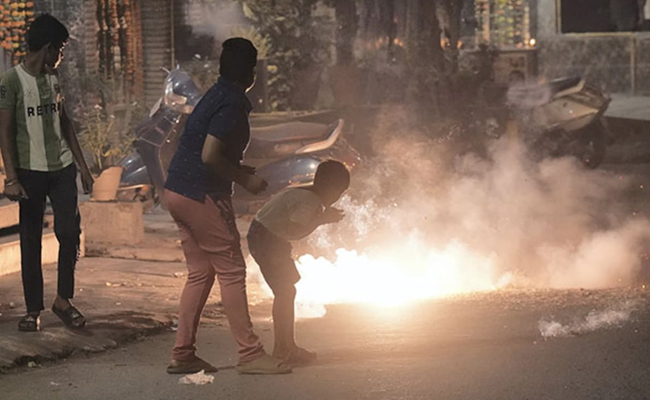
New Delhi (PTI): Delhi recorded a jump in pollution levels and a smoky haze returned on Monday morning after residents flouted the ban on firecrackers on Diwali night
The city recorded its best air quality on Diwali day in eight years on Sunday, with its 24-hour average Air Quality Index (AQI) standing at 218 at 4 pm.
However, firecracker bursting till late Sunday night led to a spike in pollution levels amid low temperatures.
At 7 am, the AQI stood at 275 (poor category). Pollution levels even entered the very poor category in some areas, including Shadipur (315), Ayanagar (311), Lodhi Road (308), Pusa (355) and Jahangirpuri (333).
The concentration of PM2.5, fine particulate matter that can penetrate deep into the respiratory system and trigger respiratory problems, exceeded the safe limit of 60 microgramme per cubic metre by six to seven times in these areas.
Firecracker bursting pushed the PM2.5 concentration at many places, including Okhla and Jahangirpuri, in the capital over 1,000 micrograms per cubic metre in the early morning hours.
Delhi recorded an AQI of 312 on Diwali last year, 382 in 2021, 414 in 2020, 337 in 2019, 281 in 2018, 319 in 2017 and 431 in 2016, according to Central Pollution Control Board data.
The city's AQI a day after Diwali stood at 360 in 2015; 445 in 2016; 403 in 2017; 390 in 2018; 368 in 2019; 435 in 2020, 462 in 2021 and 303 in 2022.
An AQI between zero and 50 is considered good, 51 and 100 satisfactory, 101 and 200 moderate, 201 and 300 poor, 301 and 400 very poor, 401 and 450 severe and above 450 severe plus.
Delhiites experienced clear skies and abundant sunshine on Saturday and Sunday as air quality improved sharply just ahead of Diwali this year. The improvement was attributed to intermittent rainfall on Friday and wind speeds favourable for the dispersion of pollutants.
The city experienced very poor to severe air quality for two weeks starting October 28 with a suffocating haze lingering over the national capital during the period.
In accordance with the practice of the past three years, Delhi has announced a comprehensive ban on the manufacture, storage, sale and the use of firecrackers within the city.
Last year, a decrease in stubble burning incidents, delayed spells of rain, favourable meteorological conditions and an early Diwali prevented the national capital from turning into a gas chamber following the festival of lights.
The Decision Support System, a numerical model-based framework capable of identifying the sources of particulate matter pollution in Delhi, estimated that stubble burning in the neighbouring states, particularly Punjab and Haryana, accounted for 35 per cent of the PM2.5 pollution in the city on Sunday. It is likely to be 22 per cent on Monday and 14 per cent on Tuesday.
The data also found that transport - another major cause of pollution in the city - contributed 12 to 14 per cent to Delhi's foul air over the past few days.
Let the Truth be known. If you read VB and like VB, please be a VB Supporter and Help us deliver the Truth to one and all.
Bengaluru Police bust major drug network; 16 arrested, narcotics worth Rs 36.67 crore seized

Bengaluru: In a major crackdown on drug trafficking and illegal narcotics trade, Bengaluru City Police have arrested 16 accused persons and seized narcotic substances worth Rs 36.67 crore.
According to Bengaluru City Police Commissioner Seemanth Kumar Singh, those arrested include four foreign nationals, eight persons from other states and four locals. Police said the network had interstate as well as international links.
Police recovered 9 kg 64 grams of MDMA, 5 kg 195 grams of hydro ganja, 19,755 LSD strips, 156 grams of heroin, 618 grams of charas, 332 grams of cocaine, 315 grams of drug-mixed gummies and 11 kg 470 grams of ganja from the accused.
The Commissioner said the action was carried out as part of a major anti-drug operation in the city. The network was busted with the support of the CCB Narcotics Control Squad and police stations of Bagaluru, Adugodi, Chikkajala, HSR Layout, Yeshwanthpur, Jalahalli and Jnanabharathi.
Cases were registered in CCB, East Division and West Division police stations based on specific intelligence received on different dates, following which raids were conducted.
Preliminary investigation revealed that the accused were procuring drugs at lower prices from foreign, interstate and local sources and selling them in Bengaluru at higher rates.
Police said college students and working professionals were among the main targets of the accused.