Delhi court finds juvenile guilty of rape, murder of 60-year-old woman

New Delhi (PTI): A Delhi court has found a juvenile guilty of raping and murdering a 60-year-old woman in 2017, expressing shock that he inflicted iron rod blows on every body part of the deceased and "mercilessly inserted" it in her private parts.
A final order regarding the sentence will be passed on a later date.
Additional Sessions Judge Amit Sahrawat was hearing the case against the juvenile against whom a case was registered for the penal offences of rape and murder.
The Juvenile Justice Board (JJB) in 2018 concluded that the child in conflict with law (CCL), aged between 16 and 18 years, was required to be tried as an adult, following which the case was transferred to the present Protection of Children from Sexual Offences (POCSO) court.
According to the prosecution, the juvenile inflicted injuries on the woman with the iron rod and then attempted to rape her in the afternoon of November 11, 2017.
It said that a security guard, upon witnessing the crime, raised an alarm, following which the juvenile was apprehended.
In an order dated October 28, the court said, "It is a proved fact that the metallic rod recovered from the spot was inserted by CCL into the private parts of the deceased and due to that the deceased sustained fatal injuries inside her private parts."
It underlined that according to law, if any object (not being the penis of the accused) was inserted to any extent into the vagina, urethra or anus of a woman, then it amounted to rape.
"Thus, even if there is no clarification from the versions of prosecution witness 3 (security guard) regarding the insertion of the private part of CCL into the private part of the deceased, then also the act of inserting this metallic rod into the private parts of the deceased amounts to rape," the court said.
It noted the post-mortem report, according to which several external injuries were inflicted from the "bulky" metallic rod on "each and every body part" of the deceased, including her face, back of neck, back of head, face, chest, arm, elbow, wrist, head, forearm, finger, vagina, anus and knee.
The court said that if so many injuries were caused to the 60-year-old woman, then there was no doubt about the juvenile's intention to cause death.
It said, "Further, it is also considerable that the CCL did not just give blows of this rod on the body of the deceased, rather he mercilessly inserted this rod into the private parts of the deceased and caused fatal injuries inside her private parts."
The court said that the accused "inserted this metallic rod inside the private parts of the deceased so mercilessly that even the flesh/ body part separating vagina and anus also got torn."
Further, the doctor had also opined that the injuries were sufficient to cause death, the court said.
"In a nutshell, CCL is found to be in conflict with law for the offence of rape and murder punishable under Sections 376 (rape) and 302 (murder) of the IPC," the court said.
Let the Truth be known. If you read VB and like VB, please be a VB Supporter and Help us deliver the Truth to one and all.
Madhu Kishwar booked over alleged misleading content on social media
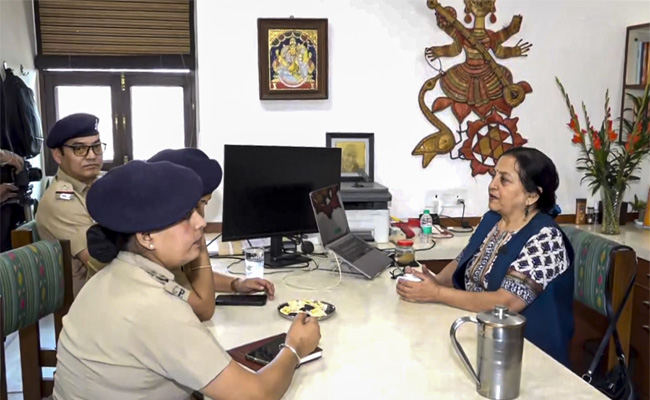
Chandigarh (PTI): Academician Madhu Kishwar has been booked on charges of criminal defamation, promoting enmity and other offences by Chandigarh police following a complaint by a resident alleging circulation of forged and misleading content on social media.
A Chandigarh police team on Tuesday served notice to Kishwar in Delhi, asking her to join the investigation in the case.
Sarita Roy, the Station House Officer of Sector-19 police station in Chandigarh, where the FIR was filed, told reporters in the national capital that the notice was issued under Section 35(3) of the BNSS and that Kishwar has been asked to appear and present her side.
Kishwar and some other social media users have been booked under various sections of Bharatiya Nyaya Sanhita, including 196 (criminalises acts that promote enmity, hatred, or ill-will between groups based on religion, race, language), 336 (1) (forgery) and 356 (criminal defamation), and the IT Act, according to the FIR.
ALSO READ: 21 hours raid fetch nothing for ED, claims Karnataka Cong MLA’s son
They have also been charged under Section 353 (penalises making, publishing, or circulating false information that cause public mischief...) and those related to cheating and forgery under the BNS.
According to a statement by the Chandigarh police, a city-based complainant on April 19 alleged that some forged and misleading social media posts and video clips with obscene text and content were being circulated by various social media users, misidentifying the person in the video.
The complainant alleged that it is a deliberate act of creating a false electronic record using obscene words and phrases, having knowledge and sufficient reason to believe that the posts are misleading and false, with the intent to cause damage or injury.
The video, which circulated with the intent to cause harm to the reputation of a constitutional authority and to disturb public peace and tranquillity, should be investigated, and appropriate action should be taken, the complainant said.
The complainant said the person seen in the video is a travel vlogger whose wife regularly posts updates about their activities on social media. The original video was shared from her social media account.
"As per the statement of the woman, she disclosed that the person in the video shared from her account is her husband. Statements of her husband and another lady in the video have also been recorded during preliminary investigation," said the police statement, adding that further probe is underway.
Meanwhile, Kishwar, in a social media post, said that a Chandigarh police team had visited her late Monday night to serve her notice regarding the FIR registered against her.
"Since the law forbids the police to visit or arrest women after dark and before sunrise, I spoke on phone to the leader of the delegation. She told me that their team has come to serve notice regarding an FIR registered against me in Chandigarh. I insisted that they go by the law and come in the morning," she wrote on X.