Delhi violence: Toll rises to 42, some signs of return to normalcy

New Delhi: The death toll in Delhi's communal violence rose to 42 on Friday as the situation showed some signs of returning to normalcy and clouds of smoke cleared to reveal the extent of the damage from the worst riots in the city in over three decades.
As people gingerly stepped out for work and opened shops and other establishments in northeast Delhi, anxiety escalated outside the Guru Teg Bahadur(GTB) hospital where people waited outside the mortuary to receive the bodies of their loved ones.
Police and paramilitary personnel also maintained a strict vigil in view of the Friday prayers at mosques.
The maulvis of the mosques in riot-hit areas appealed for peace and harmony and put out announcements asking people not to fall prey to rumours and cooperate with police.
The GTB hospital has recorded 38 deaths, the Lok Nayak Jai Prakash hospital three, while the Jag Pravesh Chandra hospital reported one death, officials said. Delhi Police spokesperson Mandeep Singh Randhawa, however, maintained that the death toll stood at 38.
Randhawa told reporters that a total of 148 FIRs were registered and 630 people were either arrested or detained so far.
"No untoward incident was reported today(Friday)," he said, adding prohibitory orders were relaxed for 10 hours in several areas.
He said forensic science laboratory teams have been called in and the crime scenes are being revisited.
More than 250 people have been injured in the communal clashes over the amended citizenship law, police said, amid reports that one in every three victims suffered bullet injuries.
The areas mainly affected include Jaffrabad, Maujpur, Chand Bagh, Khajuri Khas and Bhajanpura.
While civic workers swept the streets and bylanes of northeast Delhi littered with bricks, broken glass and other detritus of three days of communal clashes, some shopkeepers sorted through the charred remains of their vandalised and burnt shops.
Shops and other establishments opened in some places and more private vehicles were seen on roads. Autos and e-rickshaws also began plying in some areas as people stepped out of their homes to get back to work or catch up on essential errands.
Officials also said they were making extra efforts to quell rumours, and were holding regular flag marches and interactions in the neighbourhoods of affected areas as confidence-building measures.
"My job will be to ensure people feel safe and also that police is there for them," said senior IPS officer S N Shrivastava, who will take over as Delhi police commissioner from Sunday.
He said 331 peace meetings have been held in the affected areas over the last two days.
Shrivastava was repatriated from the Central Reserve Police Force(CRPF) and appointed as the special commissioner (law and order) of Delhi Police earlier this week when the violence started.
Nearly 7,000 paramilitary personnel have been deployed in the affected areas since Monday. Hundreds of Delhi Police personnel are also on the ground to maintain peace.
As survivors struggled to come to grips with the violence, victims recounted tales of horror.
"We jumped from the first floor with dupattas wrapped around our bodies to save ourselves," said a 45-year-old woman at Al-Hind Hospital, recalling how she and her two daughters were forced to flee their home after a mob allegedly barged in and molested them.
The nightmare on Wednesday night ended only after the three entered a Muslim-dominated lane.
"I was at home when a mob barged in. I and my two daughters were molested and our clothes torn by the mob," the woman, who runs an NGO in Karawal Nagar, claimed with tears in her eyes.
The Delhi Police also initiated an "outreach programme" as part of which its officials met imams and maulvis of mosques
The exercise was carried by senior officials outside mosques in Kardampuri and Kabir Nagar. These areas witnessed pitched battles between two communities for three days from Monday.
During the meeting, senior police officers were briefed about the recent riots.
The policemen posted in these areas briefed senior officials that people of these two areas, which witnessed large scale violence from Tuesday, have been generally peaceful and claimed it was the "outsiders" from adjoining areas such as Seelampur and Jaffrabad who indulged in violence.
Senior police officials were asked to take stock of the situation, especially keeping in mind that it was a Friday and some miscreants may take advantage of large gatherings to engineer an unrest again, they said.
The senior officials assured that police will take every action against the miscreants and ensure safety of locals.
After a visit to Jaffrabad, one of the worst affected areas, National Commission for Women (NCW) chairperson Rekha Sharma said the situation is peaceful but there is "tension in the air".
Chief Minister Arvind Kejriwal said the Delhi government has set up nine shelters for the riot-affected people and is distributing food among them.
Addressing a news conference, he said the government has started distributing Rs 25,000 in cash, as part of compensation, to those whose houses have been burnt during the violence.
For assistance of the violence-hit people, Kejriwal said the government has appointed 18 magistrates and four night magistrates.
Lieutenant Governor Anil Baijal visited the riot-affected areas to take stock of the situation and interacted with locals.
Baijal visited Maujpur, Jaffrabad and Gokulpuri, an official said. He was accompanied by senior police officers. This is his first visit to the riot-hit areas.
Let the Truth be known. If you read VB and like VB, please be a VB Supporter and Help us deliver the Truth to one and all.
BJP to resolve decades-old Gorkha issue within 6 months of forming govt in Bengal: Shah
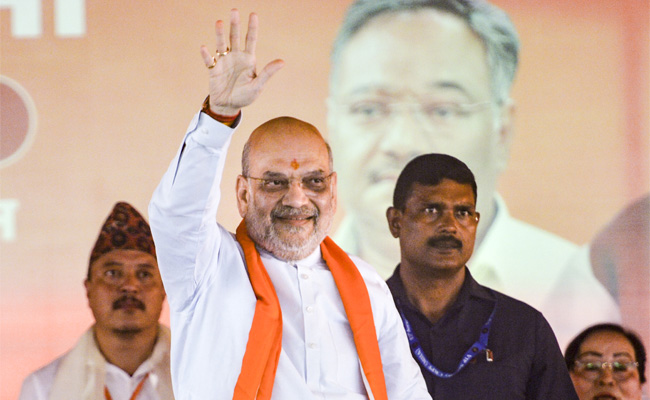
Kurseong (WB) (PTI): Seeking to strike an emotional chord with the politically crucial hill electorate, Union Home Minister Amit Shah on Tuesday promised that the BJP would resolve the decades-old Gorkha issue within six months if the BJP comes to power in West Bengal.
He said no party other than the BJP could find a solution acceptable to the Gorkhas.
Addressing a rally at Kurseong in Darjeeling district, Shah said the BJP understands the concerns and aspirations of the Gorkhas and would work towards a settlement on their terms.
"Within six months of the BJP forming the government in West Bengal, every Gorkha will have a smile on his face. We will find such a solution to the Gorkha issue that Gorkhas can live in peace," he said.
The Gorkha issue refers to the century-old demand for a separate state in the Gorkha-majority hill districts of north Bengal, although Shah did not utter the words 'Gorkhaland' or 'statehood' in his speech.
Instead, echoing the BJP's long-standing promise of a "permanent political solution" to the hill question, Shah said the issue would be resolved in accordance with the aspirations of the Gorkhas.
ALSO READ: APCR fact-finding team reports gaps between records, public narrative in Nashik TCS case
"I am leaving today after promising you that as soon as the BJP government is formed, the decades-old Gorkha issue will be resolved according to the Gorkhas' terms," he said.
The BJP, which has won the Darjeeling Lok Sabha seat in every election since 2009, has consistently promised a permanent political solution to the hill issue without committing itself to a separate state.
The home minister accused the Mamata Banerjee government of refusing to engage with efforts to resolve the issue and said that after becoming home minister, he had convened three meetings on the matter.
"After becoming home minister, I convened three major meetings to resolve the Gorkha issue, but not even once did a representative from Mamata's side attend," Shah said.
"Mamata Didi, we are not dependent on you for a solution to the Gorkha issue. We have appointed an interlocutor who is preparing a report by engaging with Gorkha organisations here and officials of the West Bengal government," he added.
Claiming that the BJP alone understands the concerns of the hill residents, Shah said, "We understand you and your problems. No one except the BJP can resolve the Gorkha issue."
The home minister alleged that the Congress and the TMC had betrayed the people of the hills for decades.
"The Congress and the TMC have done injustice not only to Darjeeling but also to our patriotic Gorkha brothers," he said.
Seeking to broaden the BJP's pitch beyond the Gorkha issue, Shah sought to portray the election as a battle to free north Bengal and the hills from what he called years of neglect and injustice under the TMC rule.
"This election is to free the entire West Bengal from TMC's crimes. In a way, it is an election to gain freedom from the injustice happening for decades in north Bengal and Darjeeling," he said.
Referring to the Sandeshkhali controversy, Shah said, "The whole of West Bengal has decided that it is time for Didi to step down. This election is about protecting our sisters across the state. The Sandeshkhali incident has brought shame to the state."
The BJP leader told the gathering that while Darjeeling had repeatedly backed the BJP, the party needed support from the rest of West Bengal this time.
"For three elections, Darjeeling has been voting for the BJP anyway, but the rest of West Bengal did not provide as much support. But this time, the whole of West Bengal has made up its mind that it's time to oust Didi," he said.
Shah also raised the issue of Gorkhas' names being allegedly deleted from the electoral rolls during the Special Intensive Revision (SIR) exercise.
"The names of some Gorkhas were deleted during SIR. Once the BJP government is formed in West Bengal, all such names will be included in the electoral rolls again," he said.
He further alleged that hundreds of false cases had been slapped on Gorkha activists and promised that these would be withdrawn if the BJP formed the government.
"They have filed hundreds of false cases against our Gorkha brothers and sisters. The results will come out on May 4, and a BJP government will be formed on May 5. Before July 31, the BJP government in West Bengal will withdraw all cases against Gorkha brothers and sisters," Shah said.
The home minister also attacked the Mamata Banerjee government over budgetary allocations for the tribals.
"For tribal development, for Adivasis, for the hills, and for north Bengal, the Mamata government's total budget is Rs 2,000 crore. But for Muslims and madrasas, the Mamata government's budget is Rs 5,800 crore. This injustice will not last much longer," he said.
The demand for Gorkhaland and greater political autonomy for the Darjeeling hills has remained one of the most enduring and emotive political issues in north Bengal, often shaping electoral outcomes in the region.
Successive agitations -- from the Subhash Ghising-led GNLF movement in the 1980s to the later stir spearheaded by Bimal Gurung and the GJM, have repeatedly convulsed the hills.
Yet, despite the BJP's rise in Darjeeling and its continued dominance in the Lok Sabha seat since 2009, the party has so far stopped short of endorsing a separate state as it would have an adverse impact on south Bengal, preferring instead to speak of a "permanent political solution".