Delhi water crisis: Atishi begins fast for more water from Haryana
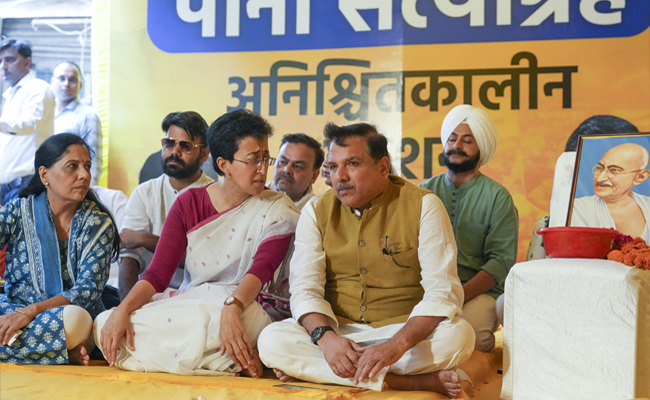
New Delhi (PTI): Delhi Water Minister Atishi on Friday began her indefinite hunger strike in south Delhi's Bhogal to press on her demand for more water from Haryana.
Chief Minister Arvind Kejriwal's wife Sunita Kejriwal, along with AAP MP Sanjay Singh and Delhi Minister Saurabh Bharadwaj, were present as Atishi began her fast.
Sunita Kejriwal read out a message from the chief minister, who is currently lodged in Tihar jail, in which he expressed hope that Atishi's 'tapasya' would be successful.
The chief minister said he was immensely pained by seeing on TV the plight of the people facing water shortage amid the ongoing intense heatwave, he said.
"It's our culture to provide water to the thirsty. Delhi gets water from neighbouring states. We hoped support of neighbouring states in such intense heat. But, Haryana reduced Delhi's water share.
"Although there are governments of different parties in the two states but is this time for politics over water," he said, referring to the BJP that is in power in Haryana.
Earlier, Atishi, accompanied by Sunita Kejriwal, Singh, Bharadwaj and other leaders paid tributes to Mahatma Gandhi at Rajghat before heading to Bhogal.
There is such intense heat in Delhi and the water requirements of the people have increased. In such times, the people need more water, but there is a shortage. All the water in Delhi comes from its neighbouring states, Atishi said as she began her indefinite fast.
She said her appeal to the Haryana government and a letter to Prime Minister Narendra Modi for help did not yield any result and Delhi was not getting adequate water.
"I am left with no choice now but to start an indefinite hunger strike as I am unable to watch the plight of the men, women and children of Delhi. This indefinite Jal Satyagrah will continue till Delhi people get water from Haryana," she said.
Delhi gets 1005 MGD water which is supplied to people in the city. For the last two weeks, Haryana is giving 513 MGD instead of 613 MGD water to Delhi. More than 28 lakh people face shortage when Haryana stops 100 MGD of water, she said.
Haryana has further reduced the release of Delhi's share from 100 MGD to 120 MGD in the last two days, she claimed.
In the morning, the minister said she would begin her indefinite hunger strike in Bhogal as, despite all efforts, the Haryana government was not releasing the full share of Delhi's water.
"I will start 'Pani Satyagraha' from today... I will start an indefinite fast at Bhogal, Jangpura from 12 o'clock until the people of Delhi get their rightful share of water from Haryana," she said on X earlier in the day," she said on X.
The minister has claimed that Haryana for the last two weeks was releasing 100 million gallons per day less water to Delhi against its share of 613 MGD, as a result, 28 lakh people in Delhi were affected.
Delhi is facing an unprecedented heatwave as a result the water demand has increased.
Let the Truth be known. If you read VB and like VB, please be a VB Supporter and Help us deliver the Truth to one and all.
Man arrested with Rs 2.54-crore heroin in Mumbai

Mumbai (PTI): Police have arrested a man and seized over 500 grams of heroin worth Rs 2.54 crore in the illicit market from him in Mumbai, officials said on Friday.
The police's Anti-Narcotics Cell (ANC) made the drug seizure in Santacruz in the western suburbs. The operation was conducted by the Kandivali unit of the ANC on Thursday as part of a special crackdown against drug trafficking in the area, they said.
Acting on specific inputs, an ANC team conducted a raid in Santacruz (East) and intercepted a man. During a search, the team recovered 508 grams of high-grade heroin from his possession, an official said.
The seized contraband, a highly addictive, opioid drug derived from morphine, is estimated to be worth Rs 2.54 crore in the international market, he informed.
Following the seizure, a case was registered against the man under relevant sections of the Narcotic Drugs and Psychotropic Substances (NDPS) Act, 1985, and he was formally placed under arrest in the early hours of Friday.
The police are currently investigating the source of the drug and trying to identify the intended recipients of the consignment, he said.